
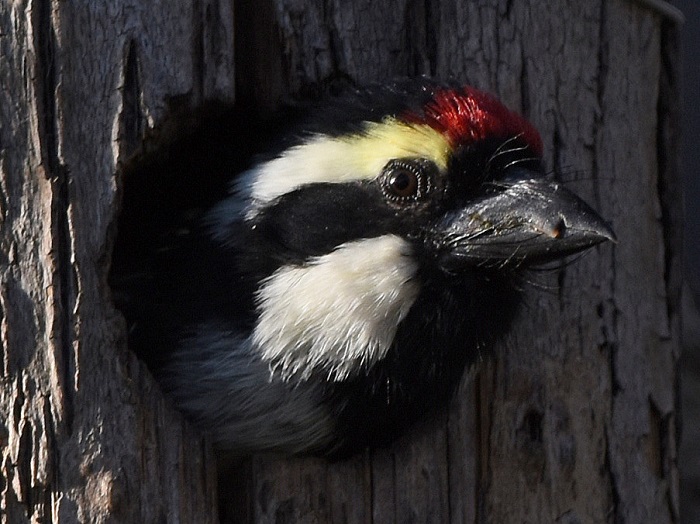
Cover image of Acacia Pied Barbet by Gerald Wingate – Cape Town, Western Cape
The Acacia Pied Barbet belongs to the family LYBIIDAE. Members of the family, which also includes Tinkerbirds, are commonly known as African Barbets. They are small to medium-sized nearpasserine birds known for their heavy, toothed or serrate bills, zygodactyl feet, prominent rictal bristles, and patches of bright colours. They eat mostly fruit and nest in self-excavated holes in trees or banks. They are found throughout sub-Saharan Africa. Lybiidae is composed of 43 species from 10 genera. 10 species occur in southern Africa.
Identification
The Acacia Pied Barbet is a stout species with a bold black-and-white striped head.
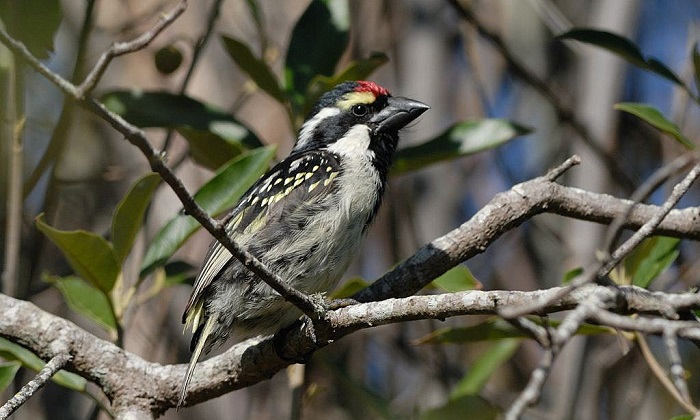
Cape Town, Western Cape
Photo by Gerald Wingate
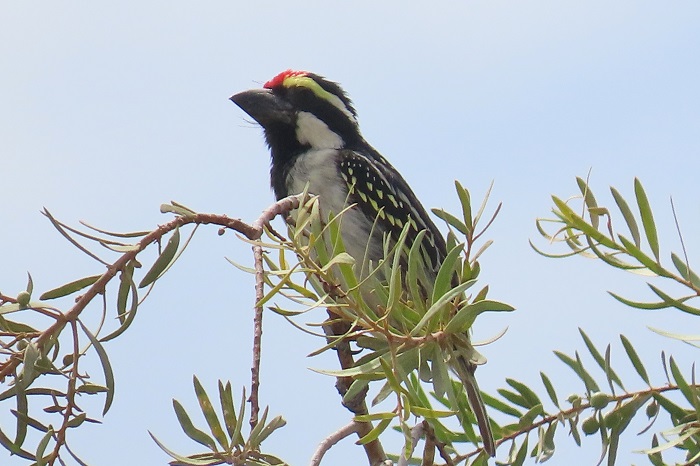
The sexes are alike. Adults have an overall black and white (pied) appearance. The forehead is bright red and the crown and nape are black. black. A broad white and yellow supercilium extends well behind the eye and onto the nape. Below this, a thick black eye stripe runs from the base of the bill to the nape. The rest of the upper parts are black with dull yellow-tipped feathers. The rump is yellow and appears as a narrow yellow stripe in flight. The tail dusky-brown with buff-yellow outer tail feathers.
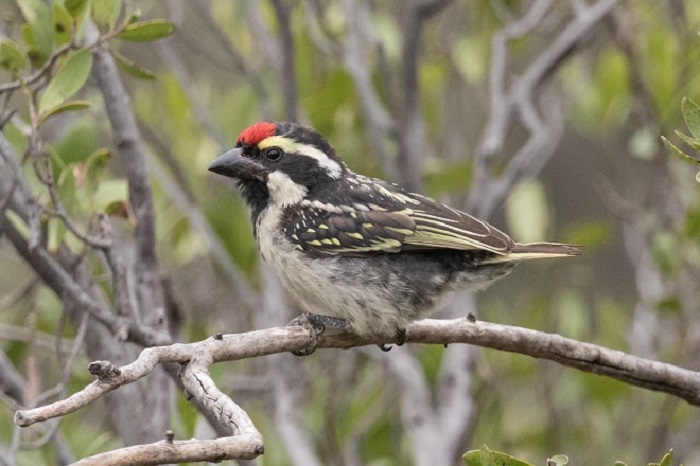
Smithfield, Free State
Photo by Lance Robinson
On the underparts, a broad black throat bib extends from the chin to the breast (diagnostic). The remainder of the underparts are white with a dull yellow wash. Some birds have indistinct blackish blotches on the belly and grey-washed flanks.The deep, heavy bill is black and notched on the upper mandible. Rictal bristles are prominent at the base of the bill. The eyes are dark brown and the legs and feet are blackish. Immature birds resemble the adults but the forehead is black (not red).
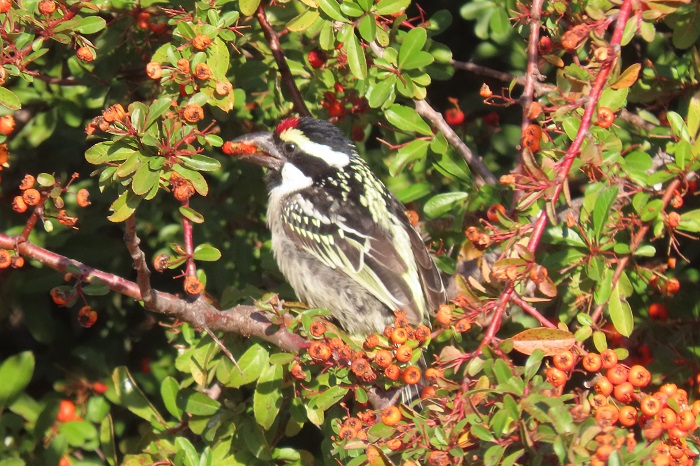
Near Hanover, Northern Cape
Photo by Jon Blanco
The Acacia Pied Barbet is sometimes confused with the much smaller Red-fronted Tinkerbird (Pogoniulus pusillus), and the orange-red foreheaded morph of the Yellow-fronted Tinkerbird (Pogoniulus chrysoconus). However, the tinkerbirds have a streaked crown and nape, white moustachial stripes and they lack the black throat bib.
Status and Distribution
The Acacia Pied Barbet is a common near-endemic to southern Africa, its ranges marginally into southern Angola and south-western Zambia. It is is the most widespread barbet in the region and is found virtually throughout South Africa.
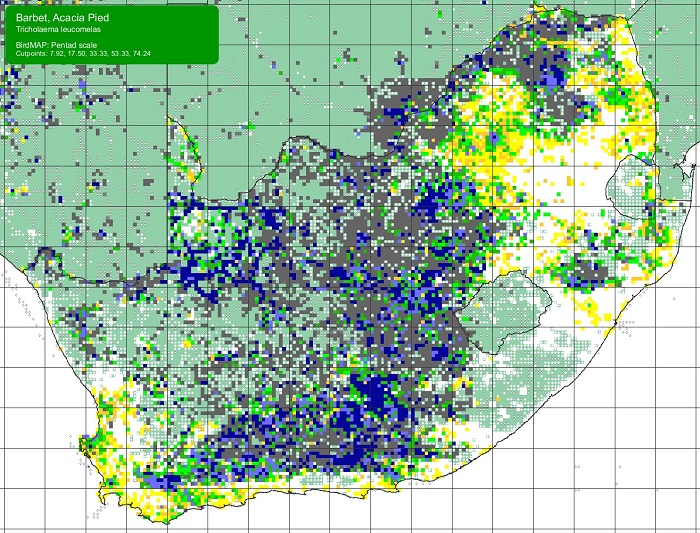
The Acacia Pied Barbet is not threatened. It has undergone a dramatic and well-documented range expansion, mainly due to the spread of alien trees and the proliferation of artificial water points. This spread into previously unsuitable habitats occurred during the 20th century. The availability of suitable trees for nesting apparently limited its distribution in the past. Other possibly important factors include the abundant supply of food from fruiting alien trees, iand icreases in the density of suitable indigenous nest trees due to bush encroachment.
Habitat
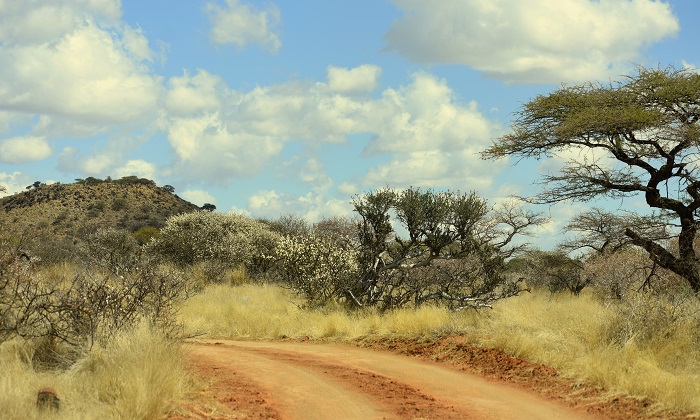
Mokala National Park, Northern Cape
Photo by Karis Daniel
The Acacia Pied Barbet is a characteristic savanna species. It is tolerant of varied ecological conditions but favours semi-arid savanna, particularly Vachellia/Senegalia (formerly Acacia) or mixed woodlands. In more open habitats, the Acacia Pied Barbet is found along wooded drainage lines. It also frequents gardens, parks, and orchards. The Acacia Pied Barbet’s occurrence in apparently unsuitable open or treeless habitats is attributed to both invasive alien and encroaching indigenous trees that provide nesting sites.
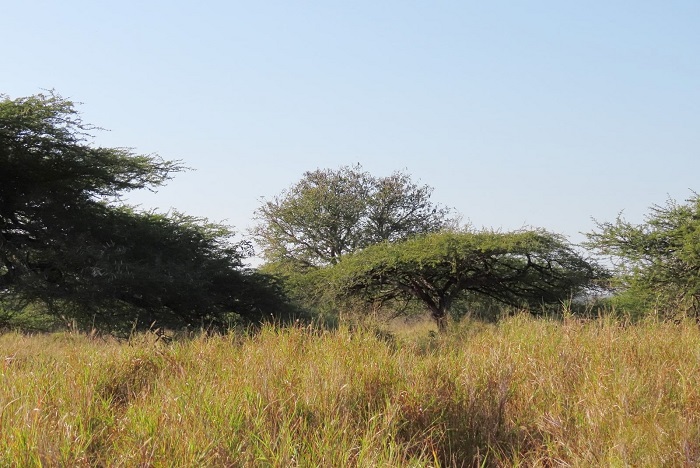
Mkhuze Game Reserve, KwaZulu-Natal
Photo by Colin Summersgill
Behaviour
The Acacia Pied Barbet is a sedentary resident with some local movements depending on food and water availability, especially in drier areas. It is mostly encountered singly or in pairs and readily frequents gardens in agricultural and suburban areas. The Acacia Pied Barbet roosts in its own nest holes or in a variety of other species’ nests, including those of Greater Striped Swallow, South African Cliff-Swallow, Sociable and Cape Weavers, Southern Masked Weaver, and Brown-throated Martin. The flight is fast and somewhat dipping.
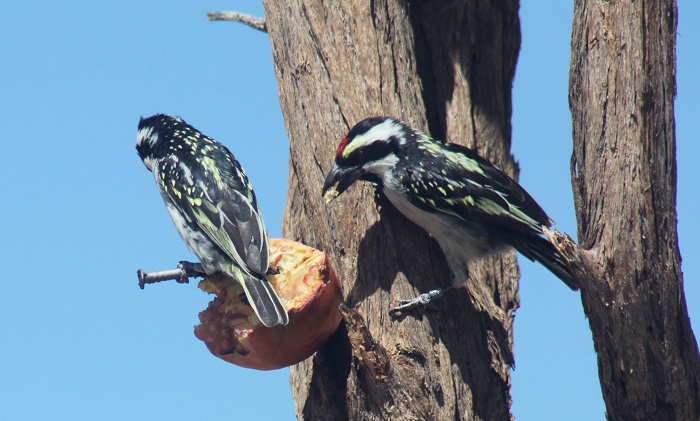
Karas, Namibia
Photo by Roy Earle
The larger Black-collared Barbet (Lybius torquatus) may exclude the Acacia Pied Barbet from some areas in the wetter regions of the region where greater competition for nest holes may occur. The Abundance of the Acacia Pied Barbet appears lower where it overlaps with the Black-collared Barbet.
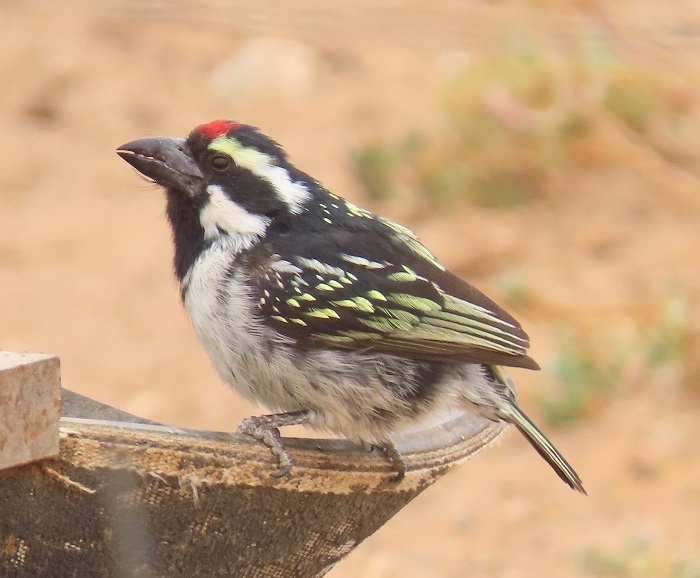
Near Willowmore, Eastern Cape
Photo by Cobus Elstadt
The Acacia Pied Barbet feeds mainly on fruit, and is especially fond of mistletoes (Loranthaceae, Viscaceae) and figs (Ficus spp). It disperses sticky mistletoe seeds by regurgitation onto branches. They also consume the fruits of shepherds-trees (Boscia spp), karees (Searsia spp), guarris (Euclea spp), Honeythorns (Lyceum spp.), and Wild Date Palm Phoenix reclinata, etc. In gardens and orchards, they eat apples, grapes, peaches, etc. Acacia Pied Barbets also eat insects and drink nectar from aloes. They have also been observed eating certain flowers, petals, and seed pods.
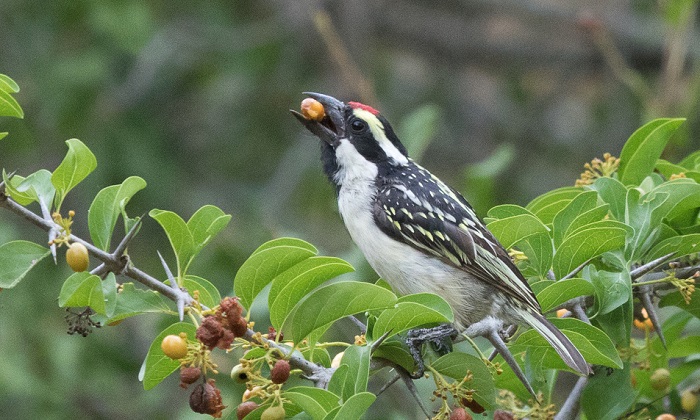
Hoedspruit, Limpopo
Photo by Derek Solomon
The Acacia Pied Barbet is a monogamous, solitary nester. Nesting territories are formed which they actively defend. Breeding is recorded in spring and summer from August to April. In the winter rainfall region, breeding peaks between September and October. In the summer rainfall parts of its range, breeding peaks from October to December.
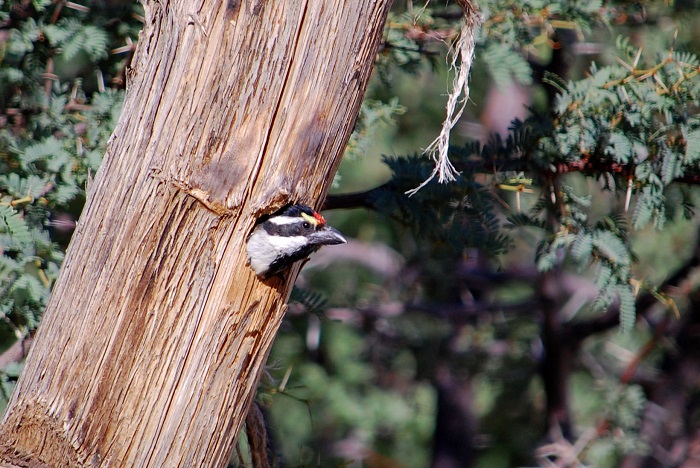
Kuruman River, Northern Cape
Photo by Kyle Finn
The nest is a self-excavated hole in a soft or dead branch of a tree, typically 1 to 3m above the ground. The entrance is roughly circular, up to 38mm in diameter. The nest may be reused again in the same season, but rarely in the following season. 2 to 4 plain white eggs are laid per clutch, although 3 is the norm. They are laid in wood chips at the bottom of the nest chamber. The incubation period lasts up to 18 days and is performed by both sexes. The nestling period takes up to 35 days, during which the nestlings are fed by both parents. The Acacia Pied Barbet is double-brooded.
Despite vigorous defence of the nest, the Acacia Pied Barbet is a brood host of the Lesser Honeyguide (Indicator minor), and less frequently, the Greater Honeyguide (Indicator indicator). The range expansion of the Lesser Honeyguide into the Western Cape province closely followed that of the Acacia Pied Barbet.
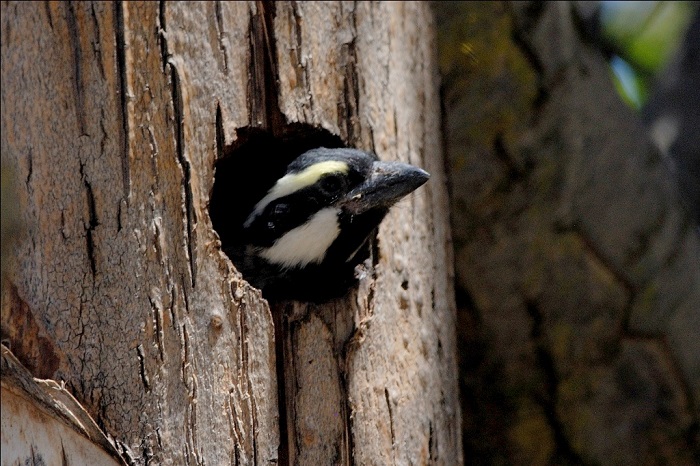
Cape Town, Western Cape
Photo by Gerald Wingate
Further Resources
Species text adapted from the first Southern African Bird Atlas Project (SABAP1), 1997.
The use of photographs by Cobus Elstadt, Colin Summersgill, Derek Solomon, Gerald Wingate, Jon Blanco, Karis Daniel, Kyle Finn, Lance Robinson, Roy Earle, and Ryan Tippett is acknowledged.
Other common names: Pied Barbet (Alt. English); Bonthoutkapper (Afrikaans); Barbican pie (French); Rotstirn-Bartvogel (German); Kaapse Baardvogel (Dutch); Barbaças-das-acácias (Portuguese)
Recommended citation format: Tippett RM. 2026. Acacia Pied Barbet Tricholaema leucomelas. Biodiversity and Development Institute. Available online at https://thebdi.org/2026/03/04/acacia-pied-barbet-tricholaema-leucomelas/
Erongo, Namibia
Photo by Cobus Elstadt
