
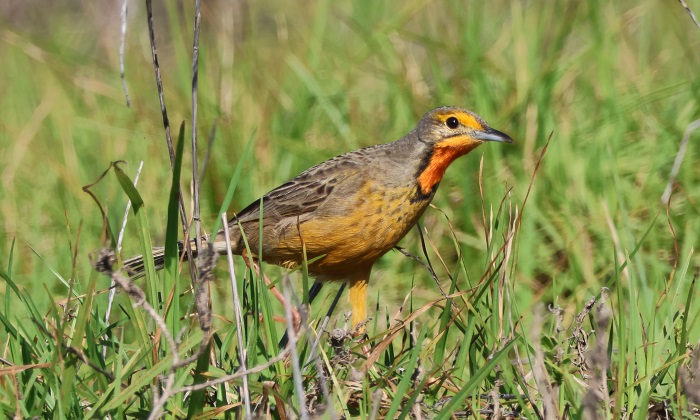
Cover image of Cape Longclaw by Sharon Stanton – Rietvlei Nature Reserve, Western Cape
Longclaws are members of the family MOTACILLIDAE. This group also includes Wagtails and Pipits. They are small passerine birds with medium to long tails and a long hind claw that is especially pronounced in the Longclaws. The family comprises 70 species from 6 genera. 23 species are known from southern Africa.
Identification
The Cape Longclaw is an attractive and easily recognisable species. The sexes differ slightly in their plumage colouration.
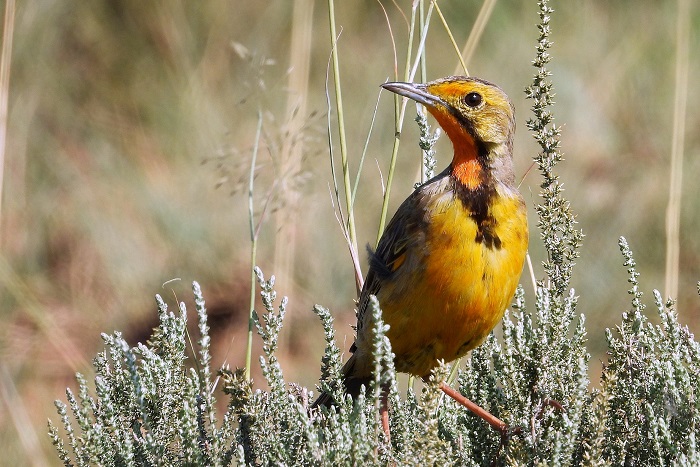
Near Middelburg, Mpumalanga
Photo by Joanne Putter
In adult males, the forehead to the nape, down to the back and rump are buff-brown with bold, dark brown spots and streaks. The tail is dark olive-brown with white outer tips. The ear coverts are pale brown with some whitish streaking, and the sides of the neck are greyish brown. The supercilium is bright orange. A blackish moustachial stripe leads into a broad black necklace across the upper breast. The throat is bright orange. The remainder of the underparts are deep yellow with buffy flanks. The bill is blackish, the eyes are brown, and the legs and feet are pale brown. As in all longclaws, the claw on the hind toe (Hallux claw) is elongated to push down vegetation, allowing them to easily clamber over grass tussocks.
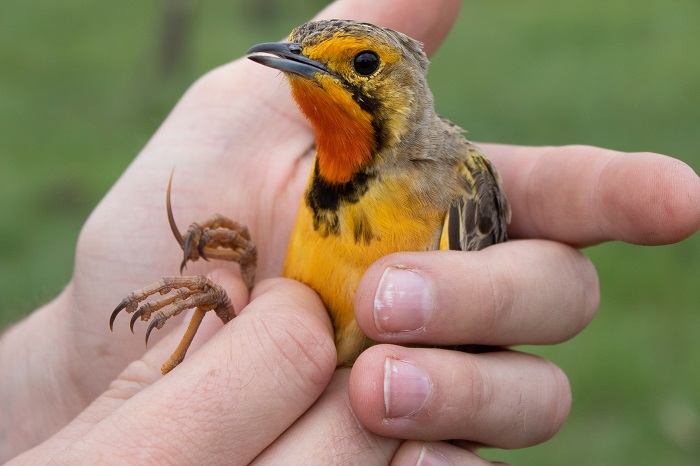
Dullstroom district, Mpumalanga
Photo by Lance Robinson
Adult females resemble adult males but are duller overall with a thinner, less defined black necklace.
Immature birds are brown above with whitish scalloping. The underparts are buff-coloured, becoming dull orange-yellow with age. The breast band is indistinct.
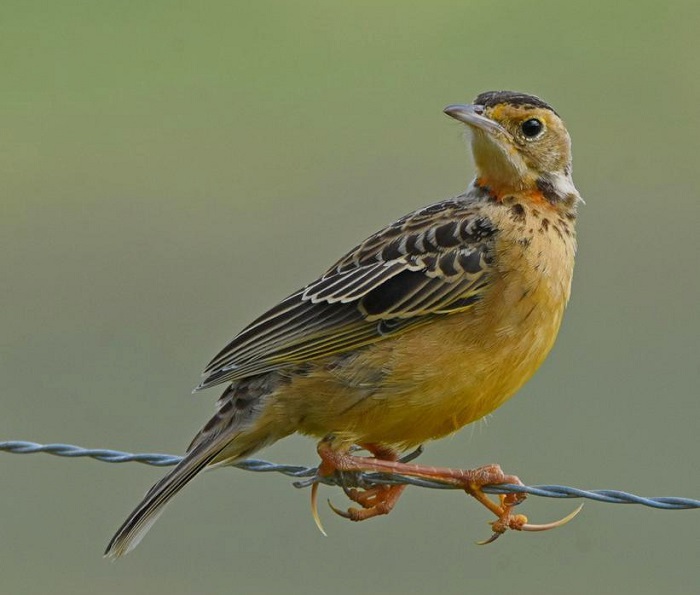
Near Memel, Free State
Photo by Rick Nuttall
Across most of its range, the Cape Longclaw should not be confused with any other species. However, in north-eastern KwaZulu-Natal and on the Zimbabwe plateau, it could be mistaken for the Rosy-throated Longclaw if not seen clearly.
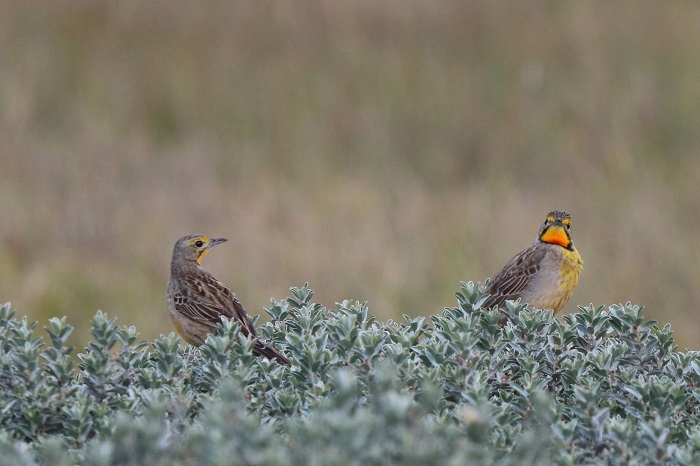
Rondebosch, Cape Town, Western Cape
Photo by Les Underhill
Status and Distribution
The Cape Longclaw is a locally common to common resident, and is endemic to southern Africa. It occurs from the southern parts of the Western Cape, extending eastwards narrowly along the coast before fanning out broadly inland into the Eastern Cape and northwards through KwaZulu-Natal, Lesotho, and the Free State to eSwatini (Swaziland) up to the Limpopo province. An isolated race occurs on the central plateau of Zimbabwe above 1200m, and east to the Eastern Highlands and marginally into adjoining parts of Mozambique.
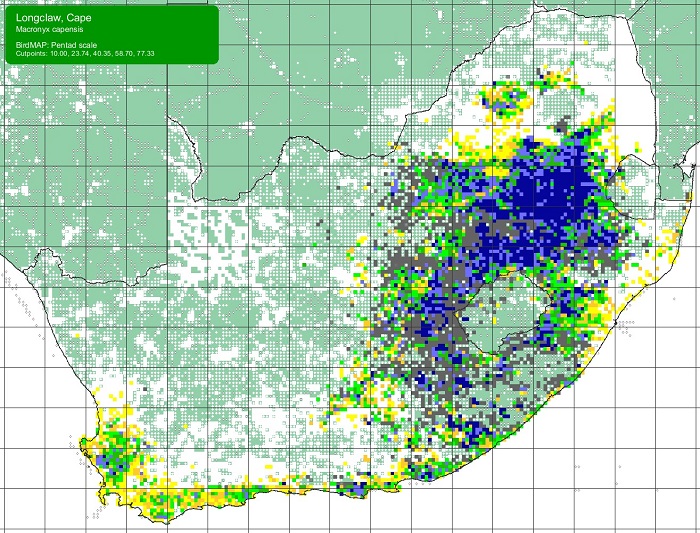
Details for map interpretation can be found here.
The historical range of the Cape Longclaw has probably changed little over the years; however, overgrazing has reduced habitat availability. Across much of its range, the Cape longclaw is a common breeding resident and is not threatened.
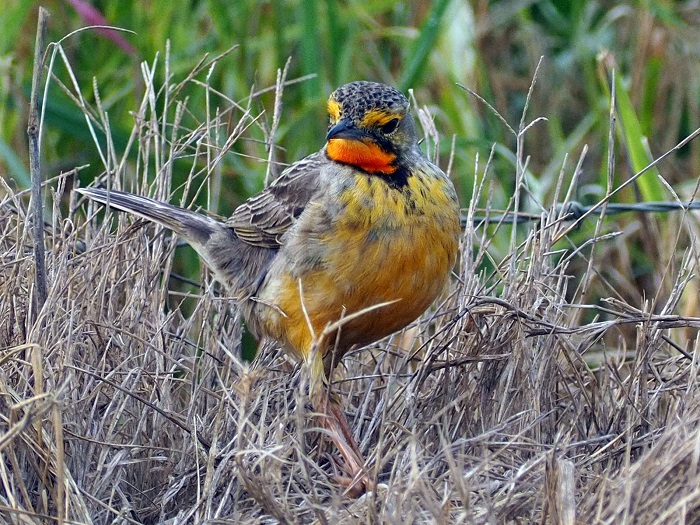
Near Riebeek Kasteel, Western Cape
Photo by Rene Navarro
Habitat
The Cape Longclaw inhabits a variety of grassland types, mostly at fairly high elevations, and with minimal tree cover. It prefers moist grasslands with short, dense grass 300-400 mm tall and avoids long, rank grass. It is less common in drier grassland areas. The Cape Longclaw is frequently found near wetlands, especially floodplains and the margins of marshes and dams. It also frequents pastures and burnt grassland, but avoids ploughed fields. The Cape Longclaw is not found in woodlands, though it may occur in grasslands adjacent to wooded areas. In the winter rainfall region, it may also be found in short fynbos, but is more often found in association with wetlands or pastures in that region.
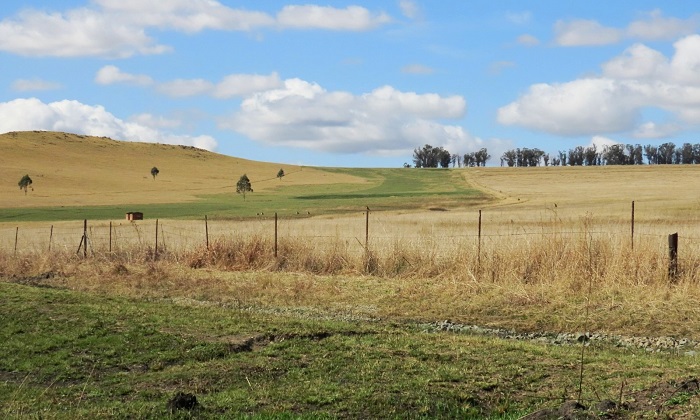
Midmar Nature Reserve, KwaZulu-Natal
Photo by Colin Summersgill
Behaviour
The Cape Longclaw is usually seen singly or in pairs. They may form loose groups of 3 to 5 during the winter non-breeding season, often alongside pipits on burnt ground. It is resident with no evidence to suggest local movements.
It frequently perches on termite mounds, boulders, or fence posts to sun or sing in the early morning. The Cape Longclaw crouches low when alarmed and flies off suddenly with its back to the intruder. Flies with short bursts of stiff wing-beats alternating with glides, typically with the tail fanned.
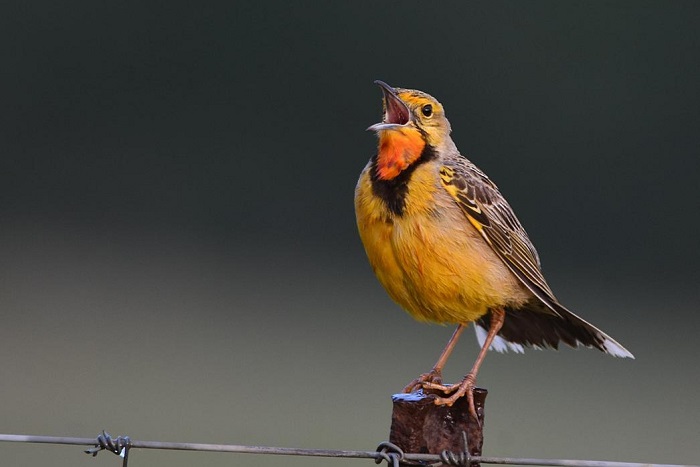
Memel district, Free State
Photo by Rick Nuttall
The Cape Longclaw forages by walking through or over short grass. They peck at or chase insects on the ground or aerially hawk flushed insects. They are also known to scratch open termite tunnels with their feet.
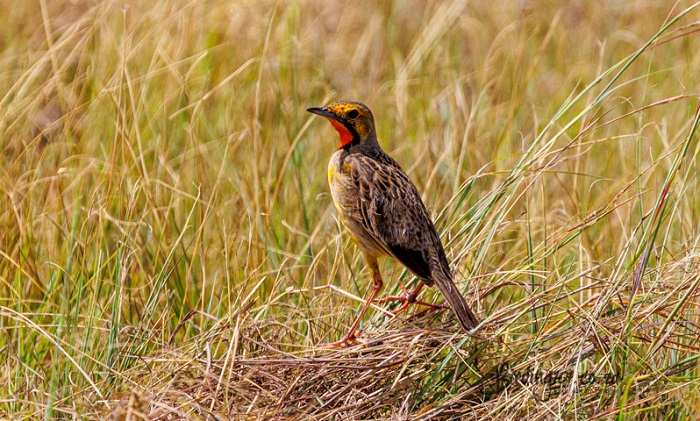
Johannesburg, Gauteng
Photo by Roelof van der Breggen
The Cape Longclaw mostly consumes insects and their larvae, including grasshoppers, beetles, caterpillars, and termite alates. They occasionally also eat seeds.
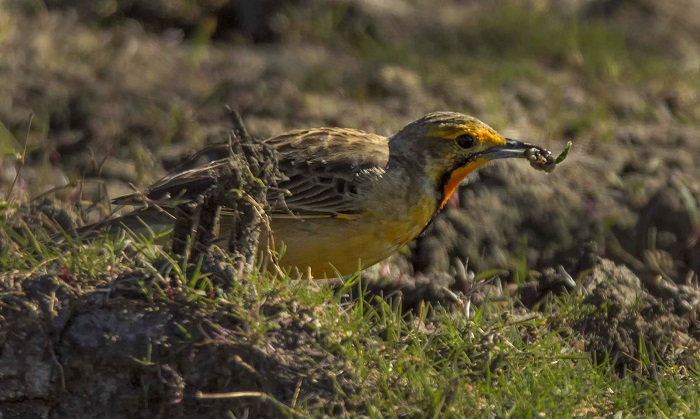
Near Klerksdorp, North West
Photo by Tony Archer
The Cape Longclaw breeds from October to March in the summer rainfall region, and from July to November in the winter rainfall region. It is a monogamous, solitary nester, and pairs are territorial. Fighting between pairs may occur, and takes place both on the ground and in the air with wings drooped, and tails fanned in threat posture. In flight display rises to around 10 m, combining fluttering flight with song, before dropping into thick grass. Also sings from a prominent vantage point.
The nest is a neat cup lined with fine rootlets, and is usually well hidden between grass tufts. The nest is built entirely by the female. However, she may be accompanied by the male while collecting nesting material. From 1 to 4 eggs are laid per clutch. The eggs are white to creamy white and heavily spotted with brown and grey. The incubation period lasts for 13 or 14 days, and all incubation is likely done by the female. Newly hatched young are undescribed. The nestling period lasts for 14 days, during which the young are fed by both parents.
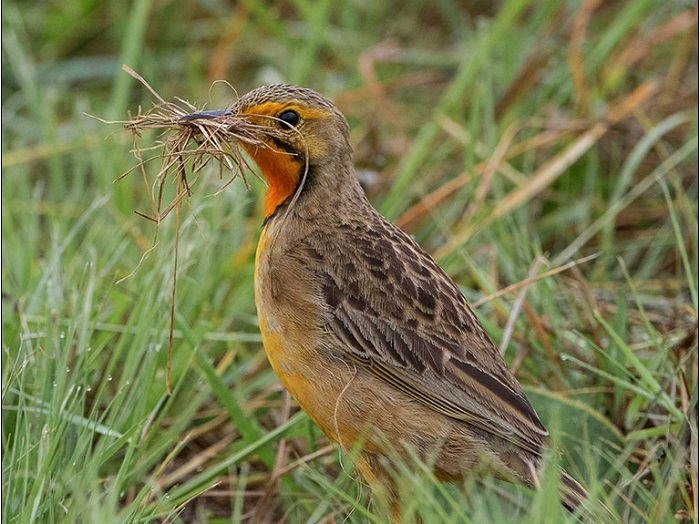
Rietvlei Nature Reserve, Gauteng
Photo by Neels Jackson
Further Resources
Species text adapted from the first Southern African Bird Atlas Project (SABAP1), 1997.
The use of photographs by Colin Summersgill, Joanne Putter, Johan Heyns, Lance Robinson, Les Underhill, Neels Jackson, Rene Navarro, Rick Nuttall, Roelof van der Breggen, Sharon Stanton, and Tony Archer is acknowledged.
Other common names: Orangethroated Longclaw (Alt. English); Oranjekeelkalkoentjie (Afrikaans); iNqomfi (Zulu); Inqilo (Xhosa); Sentinelle du Cap (French); Kapgroßsporn (German); Kaapse Langklauw Unha-longa-de-garganta-laranja (Portuguese)
Recommended citation format: Tippett RM. 2026. Cape Longclaw Macronyx capensis. Biodiversity and Development Institute. Available online at https://thebdi.org/2026/02/06/cape-longclaw-macronyx-capensis/
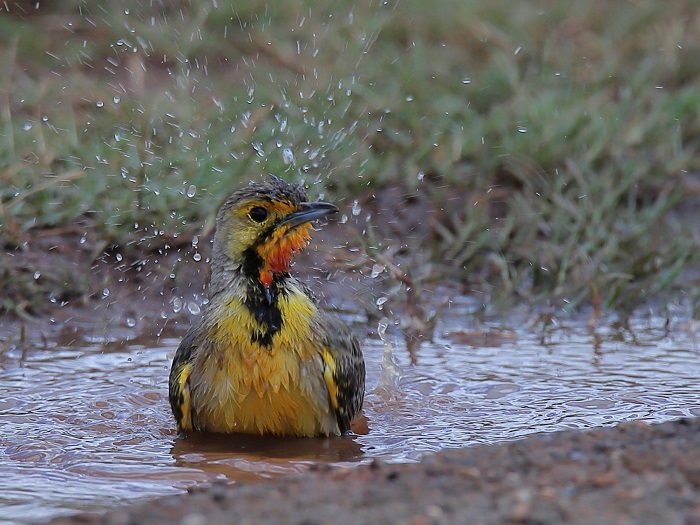
Rietvlei Nature Reserve, Gauteng
Photo by Johan Heyns
