
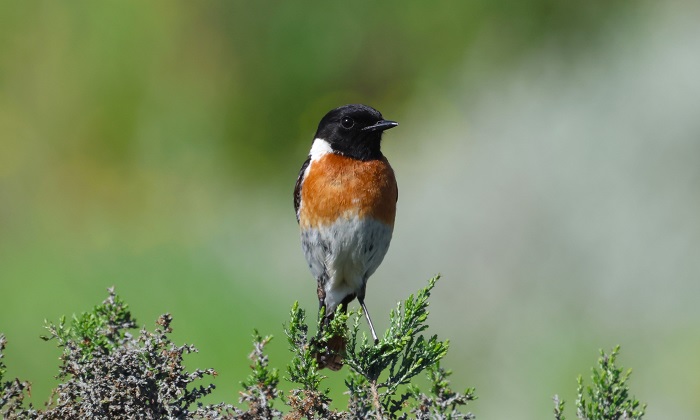
Cover image of African Stonechat by Gerald Wingate – Cape Town, Western Cape
The African Stonechat belongs to the family MUSCICAPIDAE. This group of songbirds in the order Passeriformes is commonly known as the ‘Old World Flycatchers and Chats’. Members of the group share a number of anatomical features, including the presence of a well-developed 10th primary feather in the wing and adaptations for insect eating. The family comprises around 353 species from 57 genera. Southern African representatives of this family include Flycatchers, Chats, Rock Thrushes, and Wheatears.
Identification
The African Stonechat is a conspicuous and easily recognisable species. The sexes differ in their plumage colouration.
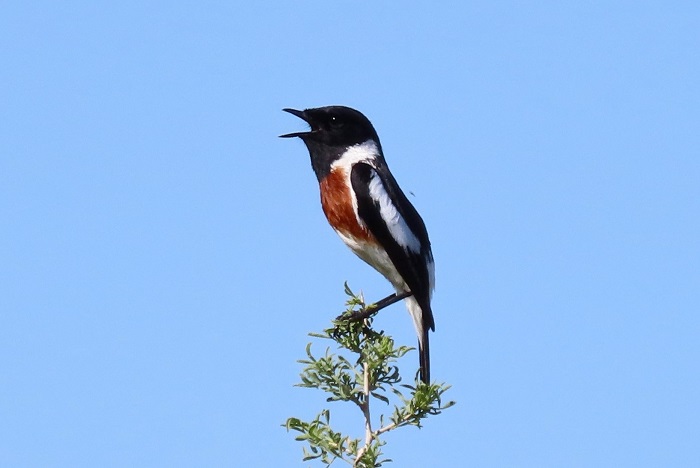
Cedarberg, Western Cape
Photo by Zenobia van Dyk
The adult male has an entirely black head and throat with conspicuous white patches on each side of the neck. The back is also black, but with variable brownish feather tips. The wings are black with an obvious white wing bar. The rump is white, and the tail is black. The Underparts, including the breast and flanks, are deep chestnut, transitioning to white on the belly and under tail coverts. The bill, legs, and feet are black, and the eyes are dark brown.
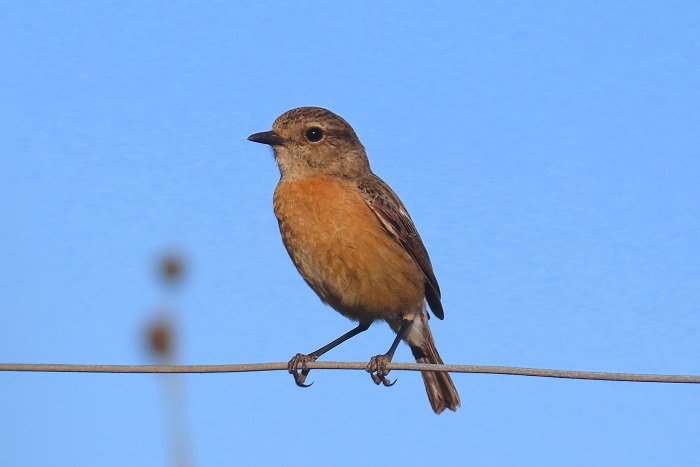
Near Humansdorp, Eastern Cape
Photo by Cobus Elstadt
In adult females, the upperparts, including the head, back and folded wings, are buff with dark brown streaking. The lores and ear coverts are dark brown. The rump is white, and the tail is dark brown. The breast and flanks vary from pale cinnamon to warm buff, paler on the belly and under tail coverts.
Juveniles resemble females, but their upper parts are dark brown with profuse pale buff spotting. The rump is pale rufous-buff, and the tail is dark brown. The throat is greyish, and the rest of the underparts are warm buff with darker mottling on the breast. The eyes are dark brown, and the legs are black.
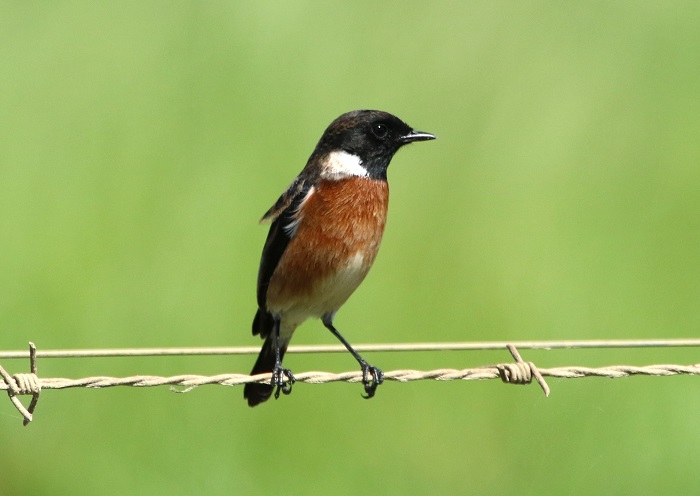
Near Riversdale, Western Cape
Photo by Attie van Aarde
The African Stonechat is most likely to be mistaken for the Whinchat (Saxicola rubetra), but the latter has a conspicuous white (male) or buff (female) supercilium and malar stripe. The Whinchat also has a white patch on either side of the tail base. The Whinchat is a rare vagrant to the region.
Status and Distribution
The African Stonechat is generally common to fairly common, but is uncommon in more marginal habitats such as the dwarf shrublands of the Nama Karoo. The African Stone Chat ranges across much of sub-Saharan Africa, but is patchily distributed in West Africa. It is distributed more continuously from north-east Africa down through central Africa to South Africa. It also occurs in Madagascar. In southern Africa, the African Stonechat is widespread in wetter regions and is absent from most of Namibia, the Kalahari Basin, and the southern and northern Karoo. Its occurrence is patchy in southern Mozambique.
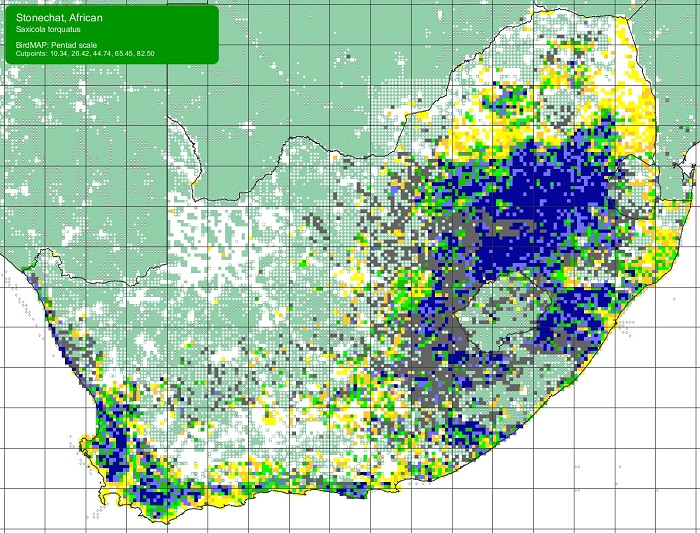
Details for map interpretation can be found here.
The African Stonechat is not threatened. It is well adapted to situations where irrigation promotes rank growth and has probably expanded its range into farming areas. However, the African Stonechat may be negatively affected by overgrazing.
Habitat
The African Stonechat frequents montane grassland, grassy hillsides, open grassland with scattered scrub and low bushes, fynbos shrublands, the edges of high altitude forest patches, marshy areas, swamp edges and cultivated lands. It is most common in relatively moist, open country, with rank growth and scattered shrubs.
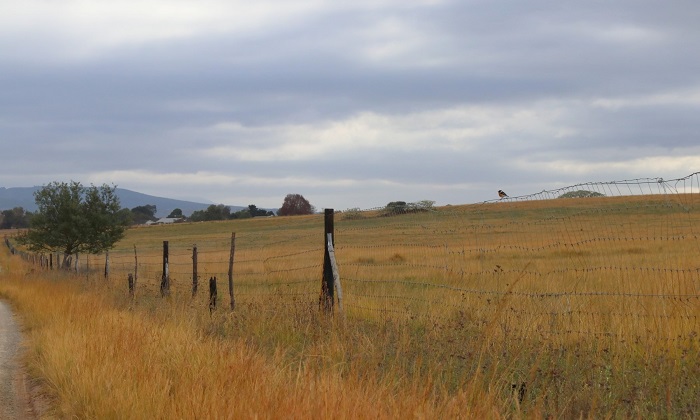
Midmar Nature Reserve, KwaZulu-Natal
Photo by Colin Summersgill
The African Stonechat is mostly a species of high-altitude grasslands, but in southern Africa it commonly occurs down to sea level. It is found in fynbos but is more common in agricultural areas within that biome. The African Stonechat’s occurrence in the Succulent Karoo and Little Karoo is mostly linked to scattered moist habitats and agriculture. In the Okavango Delta, Botswana, it is restricted to permanent wetlands and moist floodplains.
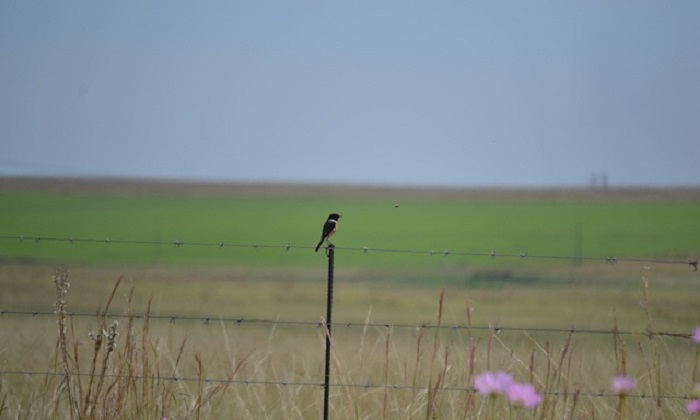
Near Secunda, Mpumalanga
Photo by Vaino Prinsloo
Behaviour
The African Stonechat is usually encountered in pairs or family groups. They perch prominently on tall, slender plants, bushes, posts, fence wires or telephone lines. The African Stonechat is often quite tame, but is usually very wary when breeding. It is an active and restless species. The flight is jerky and low, flashing the conspicuous white upper tail coverts and wing patches. The African Stonechat is frequently seen to flick its wings and tail.
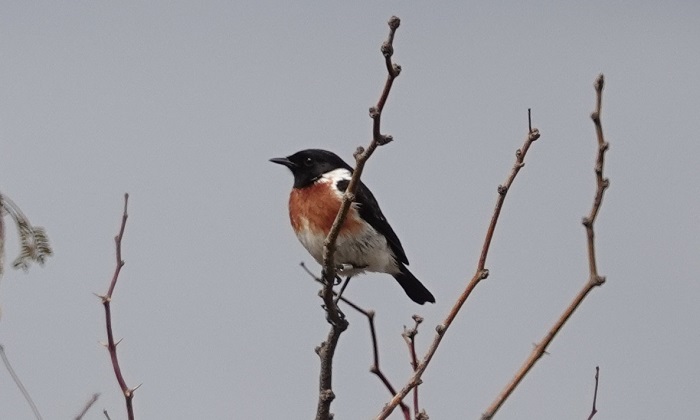
Near Vanrhynsdorp, Western Cape
Photo by Les Underhill
The African Stonechat does much of its hunting from a perch, but sometimes hawks prey in flight. Once prey has been spotted, it drops to the ground from a perch, either returning to the same perch or another nearby. The African Stonechat is also known to forage on rocky shores, hawking prey from perches on rocks or kelp. They may occasionally hover around 2 m above the ground on rapidly beating wings before dropping onto prey.
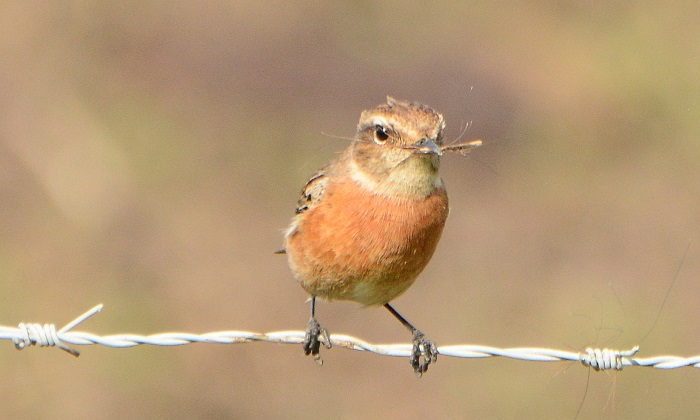
Near Sedgefield, Western Cape
Photo by Ryan Tippett
The Diet of the African Stonechat consists primarily of small to medium-sized arthropods. It is known to consume a wide range of insects and their larvae, including flies, termites, grasshoppers, ants, bugs, beetles, moths and butterflies. It also eats woodlice, millipedes, centipedes, spiders, solifuges, snails, small earthworms, small fish, and lizards, seeds and fruit.
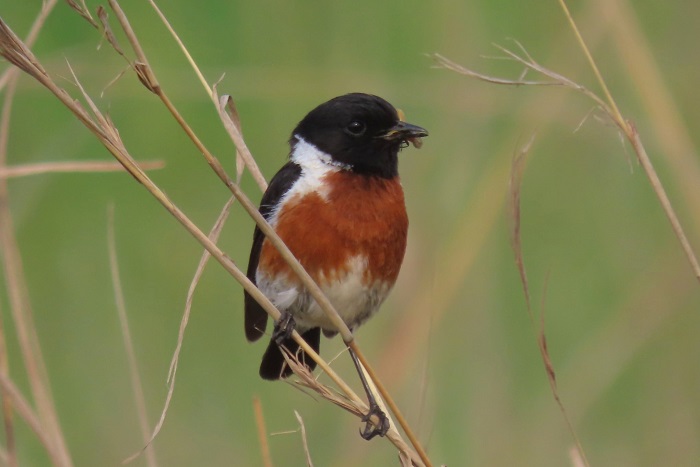
Midmar Nature Reserve, KwaZulu-Natal
Photo by Malcolm Robinson
The African Stonechat is monogamous, although on rare occasions 1 male may breed with 2 females. It is a solitary nester and pairs are territorial, often remaining on their territory throughout the year. During courtship, the male will chase the female, he may also hover above or crouch in front of her with his wings lowered, exposing the white wing patches and rump.
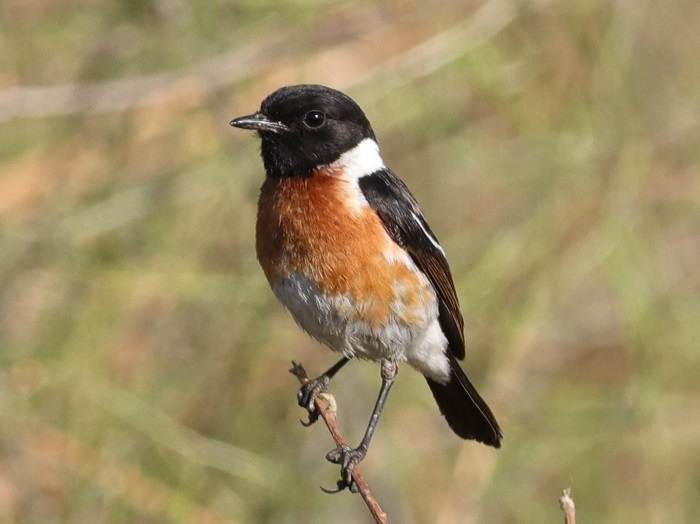
Bloemfontein, Free State
Photo by Dawie de Swardt
The African Stonechat Breeds mainly in spring and summer, with a peak in October in most areas. It breeds slightly later in higher-lying regions, where severe winter conditions at high altitudes are presumably responsible for a later season.
The nest is a deep cup of dry grass, rootlets and and other plant material. It is lined with hair, wool, thin roots, and occasionally feathers. The nest is built entirely by the female and is placed either on the ground or on a low bank, and is well concealed at the base of a grass tuft or similar plant.
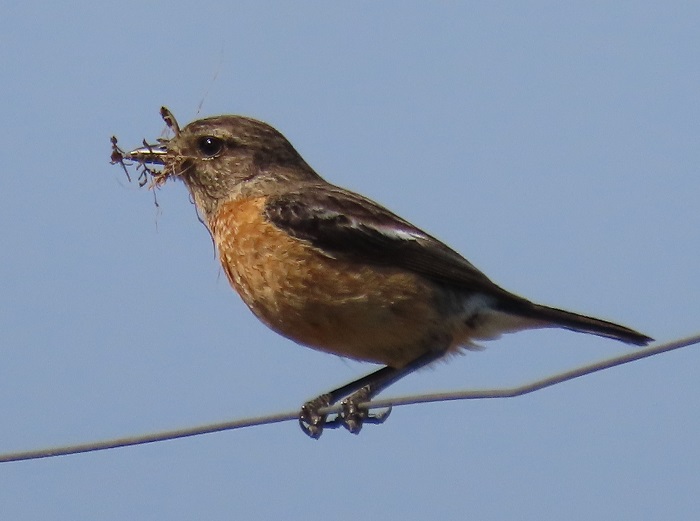
Near Scottburgh, KwaZulu-Natal
Photo by Mary Ellen Lindsay
2 to 5 eggs are laid per clutch, and the eggs are pinkish to greenish-blue, variably marked with red spots and freckling. The incubation period takes 14 to 15 days to completion, and all incubation is performed by the female. The newly hatched young are altricial and are fed by both parents, but brooded only by the female. The nestling period lasts for up to 16 days. Young birds are dependent on their parents for the first 2 or 3 weeks after leaving the nest. Broods of the African Stonechat are sometimes parasitised by Klaas’s Cuckoo (Chrysococcyx klaas), and the Red-chested Cuckoo (Cuculus solitarius).
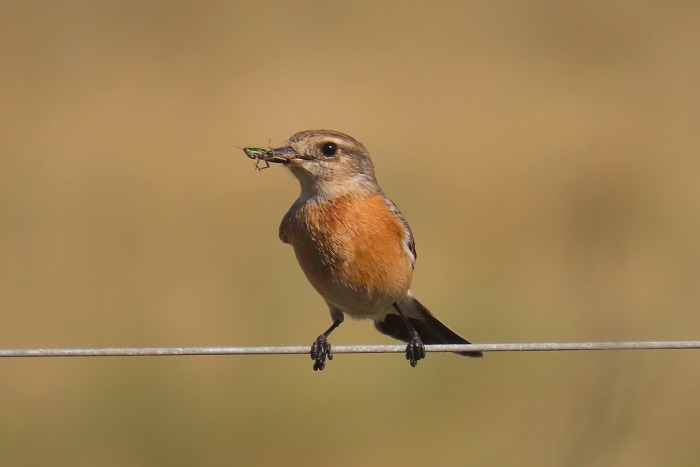
Near Alexandria, Eastern Cape
Photo by Cobus Elstadt
Further Resources
Species text adapted from the first Southern African Bird Atlas Project (SABAP1), 1997.
The use of photographs by Attie van Aarde, Cobus Elstadt, Colin Summersgill, Dawie de Swardt, Gerald Wingate, Les Underhill, Malcolm Robinson, Mary Ellen Lindsay, Vaino Prinsloo, and Zenobia van Dyk is acknowledged. Additional photographs by Ryan Tippett.
Other common names: Stonechat, Common Stonechat (Alt. English); Gewone bontrokkie (Afrikaans); isAncaphela, isAnqawane, isiChegu (Zulu); Ingcaphe, Isangcaphe (Xhosa); Tarier pâtre (French); Schwarzkehlchen (German); Aziatische Roodborsttapuit (Dutch); Cartaxo-comum (Portuguese)
Recommended citation format: Tippett RM. 2026. African Stonechat Saxicola torquatus. Biodiversity and Development Institute. Available online at https://thebdi.org/2026/01/27/african-stonechat-saxicola-torquatus/
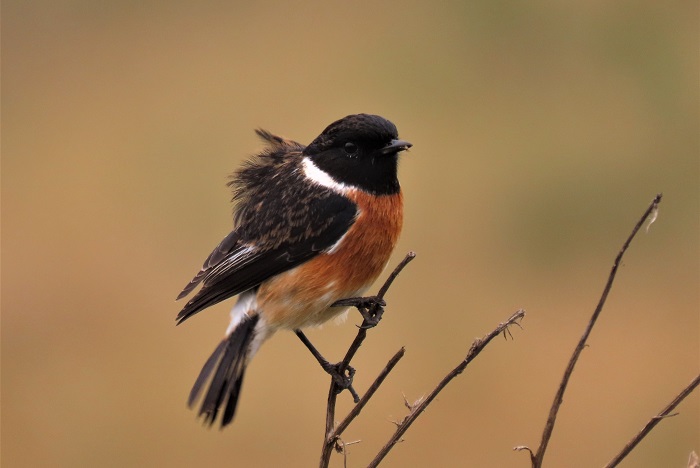
Tala Game Reserve, KwaZulu-Natal
Photo by Malcolm Robinson
