
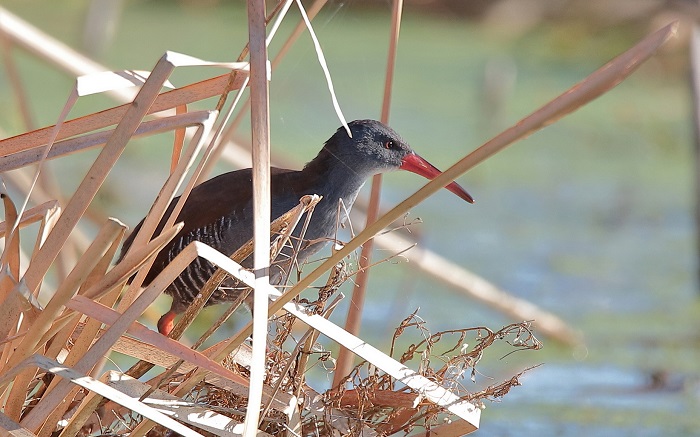
Cover image of African Rail by Johan Heyns – Marievale Bird Sanctuary, Gauteng
Rails belong to the Family: RALLIDAE. This family also includes Crakes, Swamphens, Flufftails, Gallinules, Moorhens and Coots etc. Their physiology is diverse, but most have laterally compressed bodies, short tails, short rounded wings and well developed legs and feet. The bill structure is variable. Most birds in this family inhabit wetlands or forest undergrowth and are usually vocal and highly secretive.
Identification
The African Rail is a fairly large and striking rallid. The sexes differ slightly in plumage colouration and males are slightly larger than females.
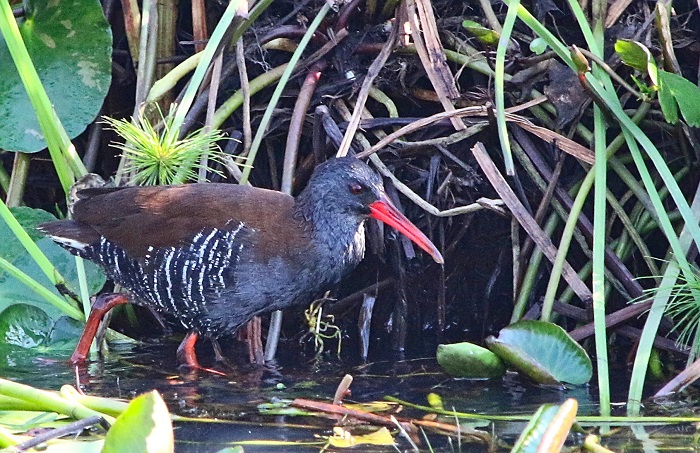
Port Edward, KwaZulu-Natal
Photo by Lia Steen
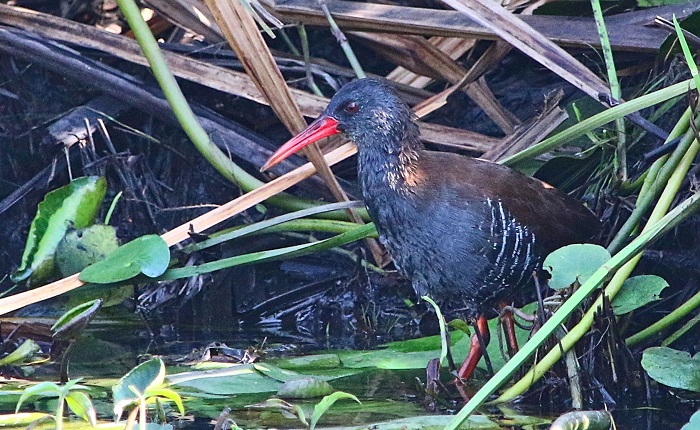
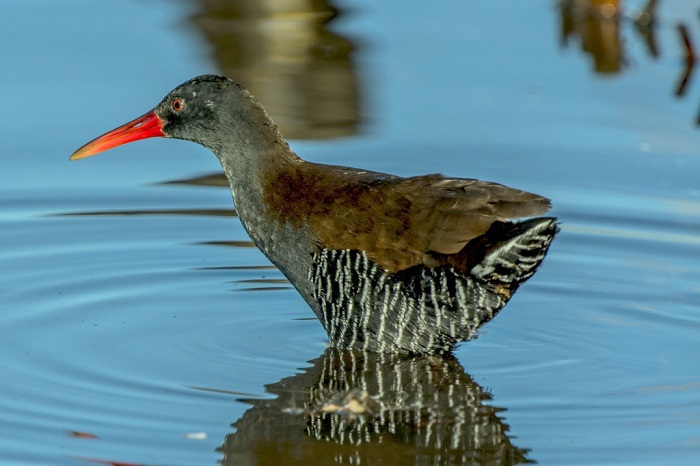
Adult males have dark brown upperparts, including the crown, hind-neck, back, wings, rump, and tail. The forehead and the sides of the head are dark grey, and the chin and throat are white. The front and sides of the neck and the breast are dusky grey. The flanks, thighs, belly, and undertail coverts are black with narrow white barring. The long, slender, and slightly decurved bill is bright red. The eyes are dark red, and the legs and feet are bright red with long toes.
Adult females resemble males but have shorter bills, and their bodies are less distinctly marked. Juveniles are darker and browner below than the adults, and they have blackish (not red) bills and dark brown legs and feet.
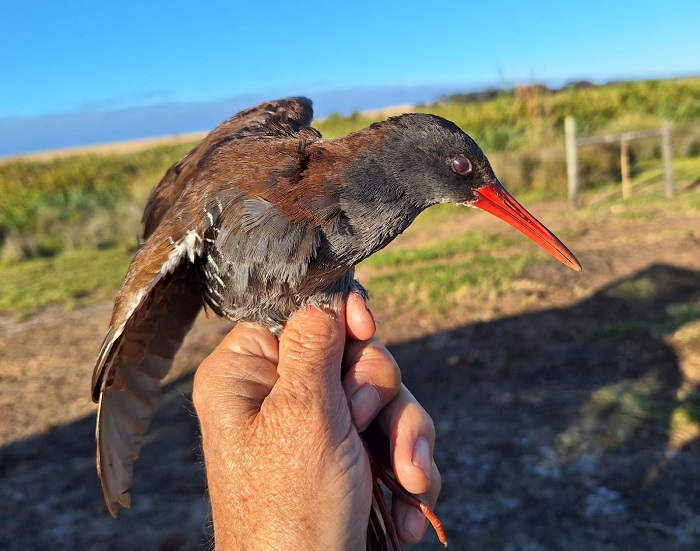
Nuwejaars Wetland Special Management Area, Western Cape
Photo by Dieter Oschadleus
If clearly seen, the African Rail is unlikely to be confused with any other southern African bird species. However, an obscured view or a fleeting glimpse may lead to confusion with the African Crake (Crex egregaria). Both carry similar patterning and colouration, but the African Crake is smaller and has black streaking on the back and grey legs. The African Crake also has a short grey bill with a red base.
Status and Distribution
The African Rail is endemic to sub-Saharan Africa. It is rare in West Africa with several isolated populations across the region. It is also uncommon in the Ethiopian highlands. The main range of the African Rail, where it occurs widely, extends from eastern DRC to central Kenya, and south through eastern and central Africa to the Western Cape province in South Africa.
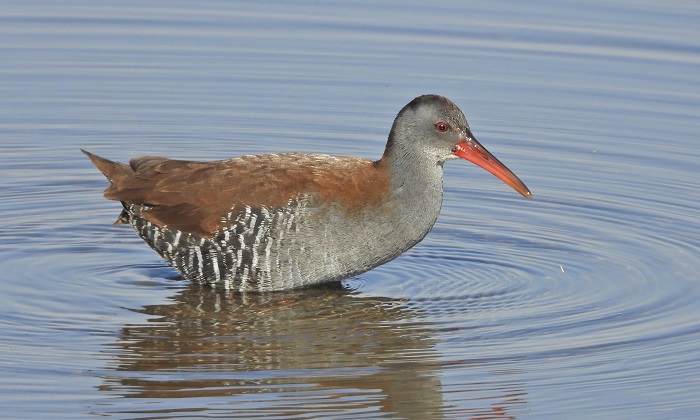
Marievale Bird Sanctuary, Gauteng
Photo by Ansie Dee Reis
The African Rail is largely absent from the driest regions of southern Africa, including the Kalahari and Namibia, but with scattered records from the central and north-eastern Karoo. It is locally distributed elsewhere, mainly in the north and east, extending along the littoral to the Western Cape.
Most records come from the higher-lying parts of Zimbabwe, the Okavango and associated wetlands in Botswana and the Caprivi, Gauteng and the northern Free State, KwaZulu-Natal, and the Western Cape Province.
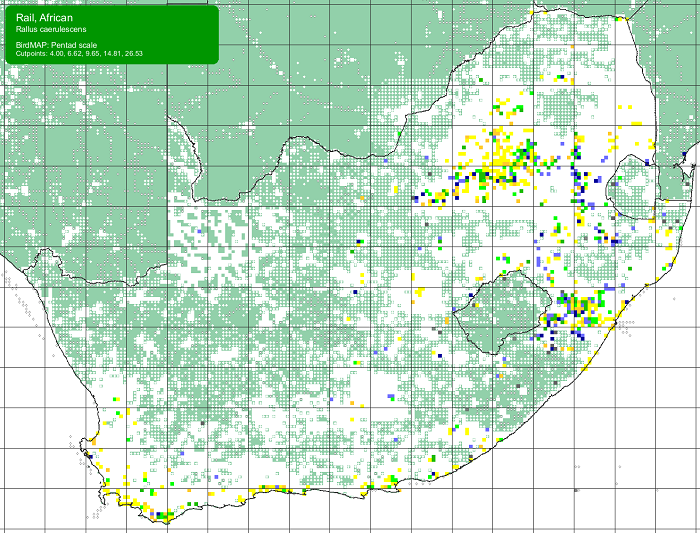
In southern Africa, the African Rail is uncommon to locally common. Its distribution is believed to be largely unchanged. Although the African Rail’s natural habitats are continually being reduced, it is under no immediate threat and can colonise relatively small, artificially created wetland patches. Its range is likely to have increased in parts of the Western Cape.
Port Edward, KwaZulu-Natal
Photo by Lia Steen
.
Habitat

Wakkerstroom, Mpumalanga
Photo by Ryan Tippett
The African Rail favours reedbeds (Typha spp and Phragmites spp) and dense, rank growth in perennial, semi-permanent or temporary swamps and marshes. It also occurs in suitable habitat alongside rivers, streams, pools, dams, pans, and lakes. The African Rail sometimes also inhabits paddy fields, and seasonally wet sugarcane bordering marshes. In southern Africa, the African Rail has been recorded up to 3000m above sea level.
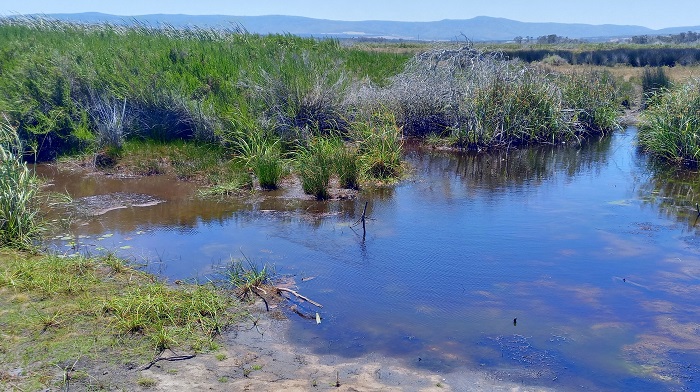
Photo by Ryan Tippett
Behaviour
The African Rail is usually found in pairs, although they are sometimes also solitary. They are somewhat crepuscular and are most lively at dusk; however, they are also active throughout the day. More often heard than seen, the African Rail is a retiring and skulking species, but is not shy within the shelter of dense vegetation. They spend most of their time in thick cover, but will on occasion reveal themselves at the edges of reedbeds or tracks through wetlands. They are most vocal during the cooler hours of the day and will occasionally call after dark.
Wilderness National Park, Western Cape
Photo by Jean Hirons
Within the cover of reedbeds, the African Rail’s movements are jerky, often while raising and flicking its tail. They walk more purposefully in the open, taking quick, long strides. When alarmed, the African Rail stands upright, flattens its plumage, and raises its tail. If a potential predator approaches, they will stand motionless before crouching flat until the threat has passed. The African Rail flies low with dangling legs, and they can also swim competently when needed. They climb well, too, sometimes clambering to the tops of tall reeds.
African Rails bathe in shallow water or over the stems of submerged vegetation in deeper water. Afterwards, they will move to a dry spot where they can sunbathe with the wings slightly spread.
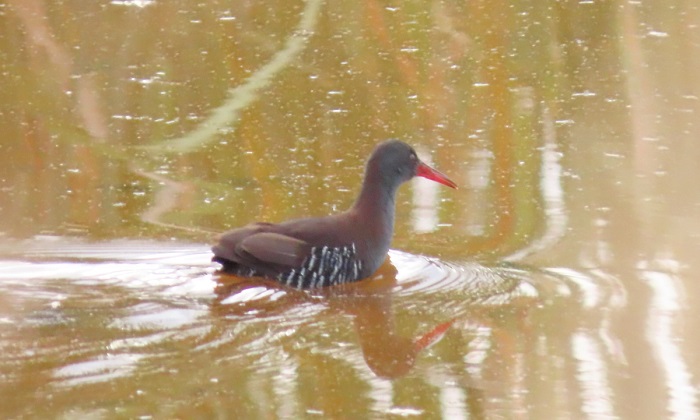
West Coast National Park, Western Cape
Photo by Colin Summersgill
The African Rail mostly forages in shallow water and in mud at the edges of reedbeds. They will also search for food on floating clumps of water plants, and occasionally on dry ground. They use their long bills to probe deeply into mud or grass tufts and will even plunge their heads and necks into shallow water to catch prey.
The African Rail is omnivorous, and their diet includes a range of insects, earthworms, crabs, spiders, small frogs and tadpoles, small fish, and plant matter, including seeds. They are also known to scavenge when the opportunity arises.
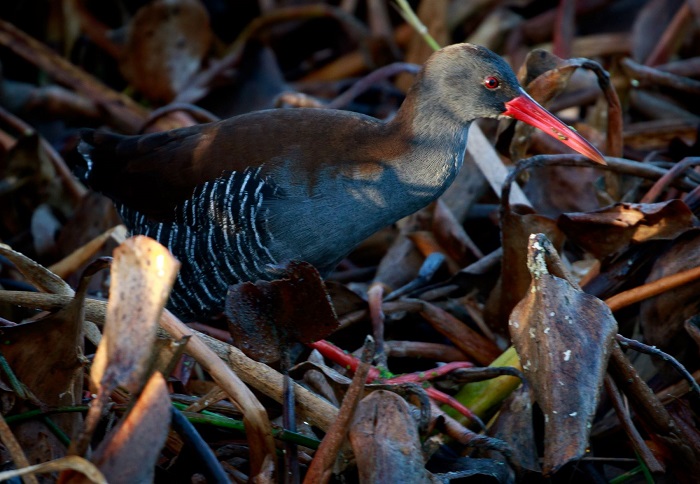
Umvoti River, KwaZulu-Natal
Photo by Georg Jacobs
The African Rail is a monogamous, solitary nester. Pairs become territorial when breeding, and frequently engage in fights with conspecifics by jumping up and attacking with the bill. Territorial pairs often call in duet. The size of breeding territories varies depending on conditions. In optimal habitat, up to 4 pairs may occupy a single hectare of reedbed.
The nest is a shallow bowl made from the leaves and stems of sedges, Bulrushes, and grasses. It is placed up to 400 mm above the water level and is very well hidden among marsh vegetation. 2 to 6 eggs are laid per clutch. The eggs are creamy-white with brown and grey speckles. Incubation duties are shared by both sexes, and the eggs hatch after 20 days. The newly hatched chicks are precocial and become fully fledged in 6 to 7 weeks.
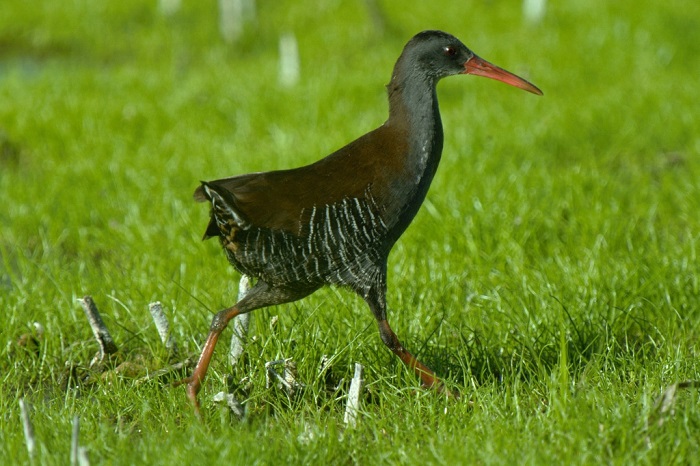
Wilderness National Park, Western Cape
Photo by Jean Hirons
Further Resources
Species text adapted from the first Southern African Bird Atlas Project (SABAP1), 1997. That text can be found here.
The use of photographs by Ansie Dee Reis, Colin Summersgill, Dembo Jatta, Dieter Oschadleus, Georg Jacobs, Jean Hirons, Johan Heyns, and Lia Steen is acknowledged. Additional photos by Ryan Tippett.
Other common names: African Water-Rail (Alt. English); Afrikaanse ral (Afrikaans); Nwatsekutseku (Tswana); isiZinzi (Zulu); Râle bleuâtre (French); Kapralle (German); Frango-d’água-africano (Portuguese); Afrikaanse Waterral (Dutch).
A list of bird species in this format is available here.
Recommended citation format: Tippett RM. 2026. African Rail Rallus caerulescens. Biodiversity and Development Institute. Available online at https://thebdi.org/2026/01/13/african-rail-rallus-caerulescens/
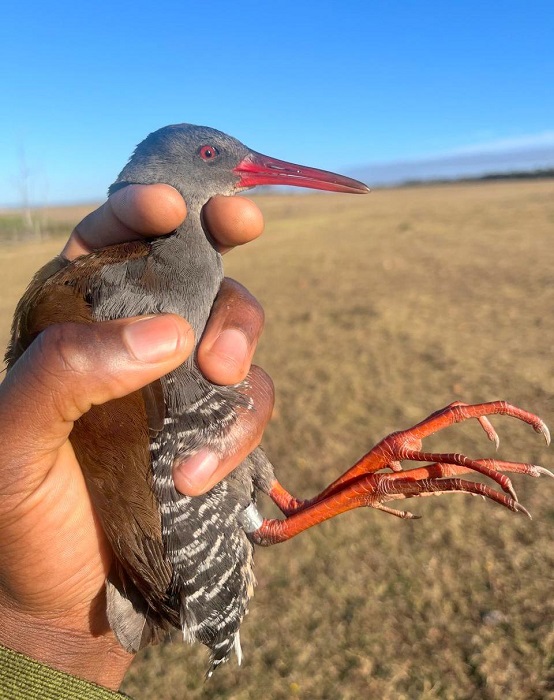
Nuwejaars Wetland Special Management Area, Western Cape
Photo by Dembo Jatta
.
