
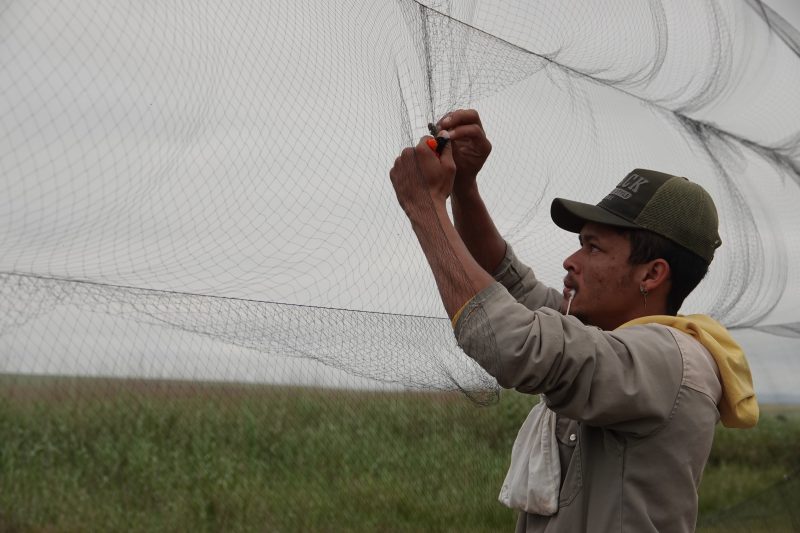
This was the first bird ringing visit to the Nuwejaars Wetlands SMA (Special Management Area). Our objective was to start the process of finding good ringing sites. We had several failures and a few successes!
One of the biggest successes was the discovery of the accommodation on the farm Hazevlakte. This is the view of the Nuwejaars River looking upstream …
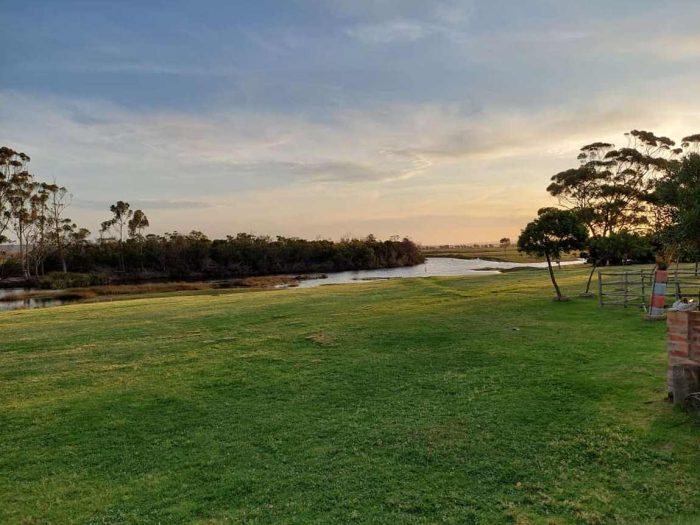
… and below is the view looking downstream …
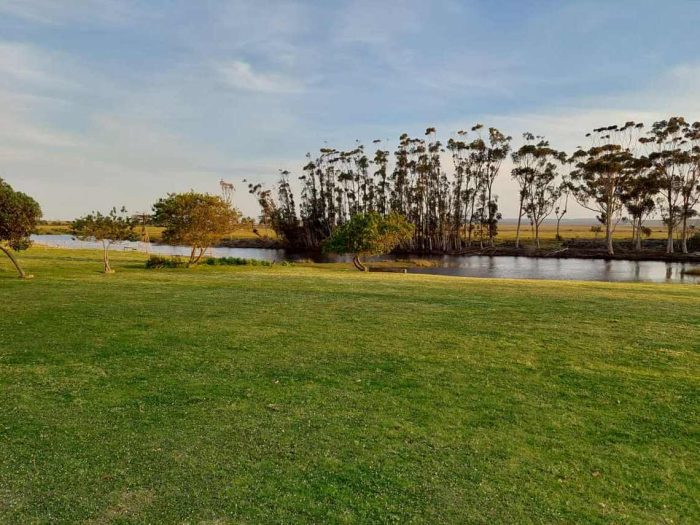
The eucalypts on the opposite bank are alien. Their redeeming feature is that they are used by African Fish-eagles, cormorants, etc.
The werf at Hazevlakte provides a variety of habitats for mist netting. We found that the species diversity extends beyond weavers, bishops, starlings and sparrows to include Blacksmith Lapwing. Southern Fiscal, Fiscal Flycatcher, Olive Thrush, Malachite Sundird and Cape Robin-chat.
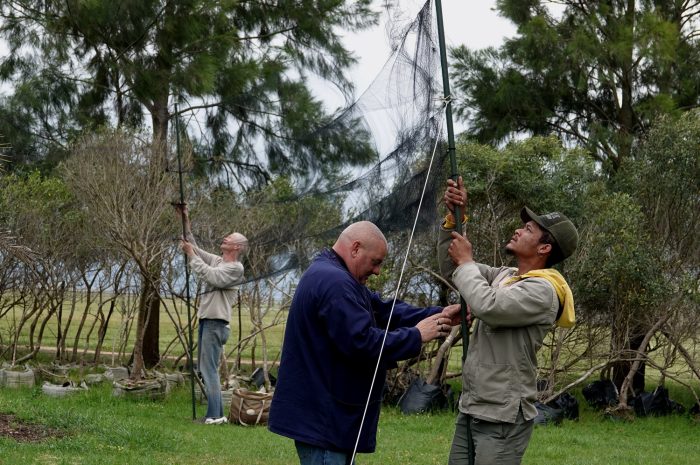
Here’s a … thanks, Ryan
mist net being set up in a patch of grass on the tree-lined edge of the werf at Hazevlakte on a misty morning. There are little grove of trees to the left of the photograph. Weavers, starlings and sparrows were nesting in these trees, and flying out to the irrigated fields in the background to feed.
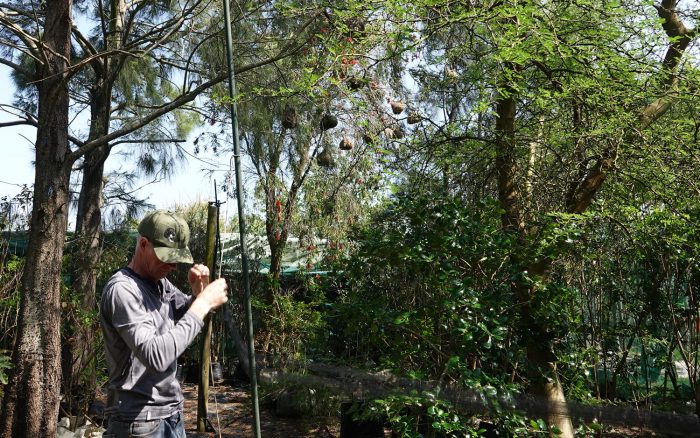
More mist nets being set up in the werf. Weaver nests in the background.
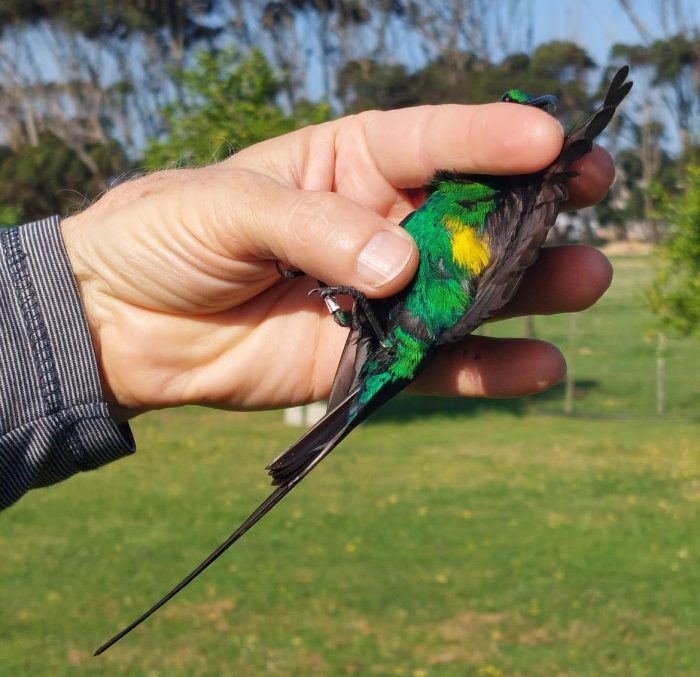
Male Malachite Sunbird, displaying one of his bright yellow pectoral patches.
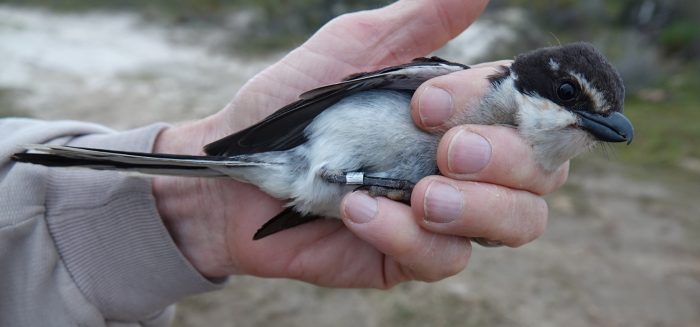
Southern Fiscal, a male because of the absence of a brown patch on his flanks/
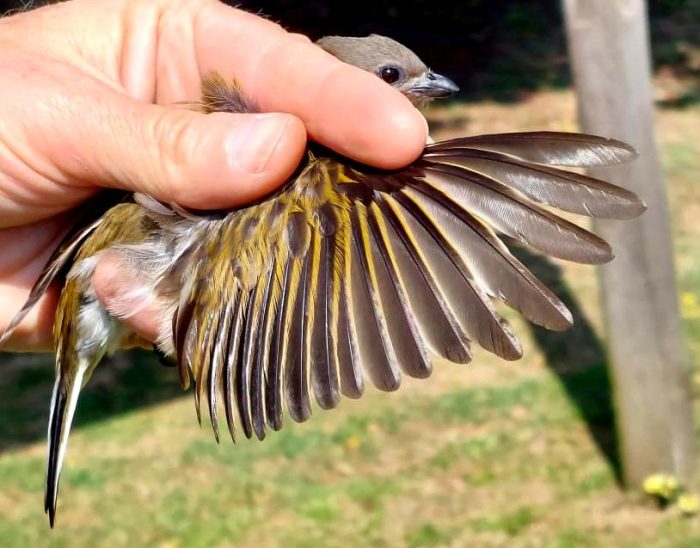
This Lesser Honeyguide was not in primary moult. Not surprising, because moult starts after the spring breeding season. Lesser Honeyguide is one of a tiny number of South African species with modelled estimates of the timing of moult, based on data collected during bird ringing. The mean starting date is estimated to be 8 January, and the duration is 140 days, so that 28 May is the mean completion date. There is a lot of individual variation. 140 days to replace primaries! That is four-and-a-half months. That is a pretty slow growth rate.
So the werf at Nuwejaars was declared a Potentially Important Ringing Site.
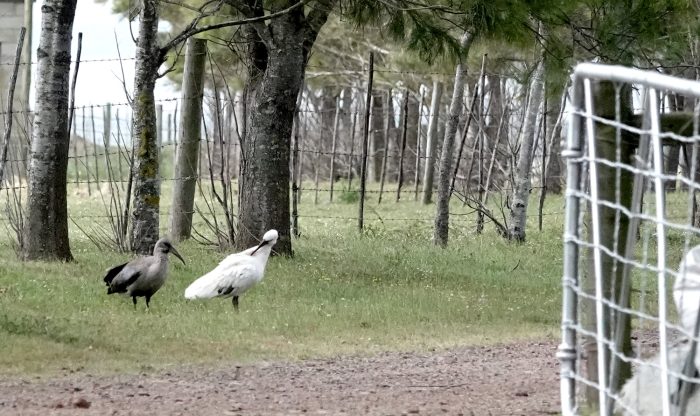
The werf at Hazevlakte has this negative bird that makes you wonder if your eyesight is going wonky. Unfortunately, we didn’t catch it, or any other Hadeda! [**Update : this leucistic Hadeda Ibis has been seen on almost all of our subsequent visit to Hazevlakte, and most recently on 22 September 2025**]
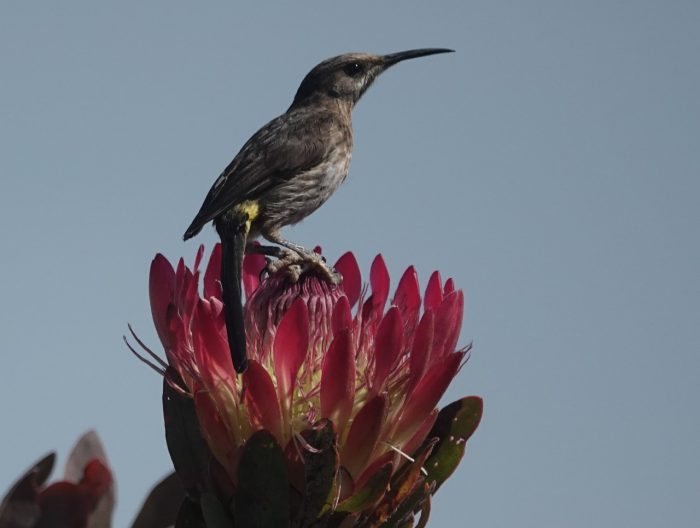
We did an exploratory trip one afternoon to a protea patch on the farm Zandvlakte. We caught four Cape Sugarbirds. These are quite likely the southernmost sugarbirds ever to be ringed! This locality was added to the list of discovered sites to be revisited on future trips, a second Potentially Important Ringing Site.
We tried several other sites, but none of them reached the threshold to become Potentially Important Ringing Sites.
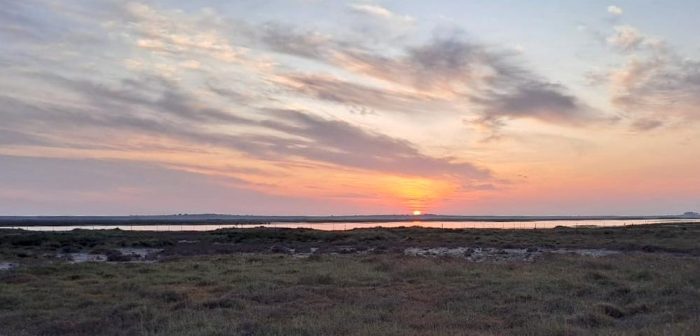
There were days when we caught the sunrise, and little else!
The table gives the total number of birds of each species handled.
| Species | Count |
| Blacksmith Lapwing | 1 |
| Lesser Honeyguide | 1 |
| Large-billed Lark | 1 |
| Capped Wheatear | 2 |
| Cape Robin-chat | 3 |
| Fiscal Flycatcher | 2 |
| Cape Wagtail | 2 |
| African Pipit | 1 |
| Southern Fiscal | 7 |
| Common Starling | 9 |
| Pied Starling | 11 |
| Cape Sugarbird | 4 |
| Malachite Sunbird | 6 |
| House Sparrow | 4 |
| Cape Sparrow | 14 |
| Cape Weaver | 30 |
| Southern Masked Weaver | 16 |
| Southern Red Bishop | 51 |
| Common Waxbill | 4 |
| Cape Canary | 1 |
| Olive Thrush | 1 |
| Cape White-eye | 2 |
| Southern Grey-headed Sparrow | 5 |
| Totals: 23 species | 178 |
Malachite Movement!
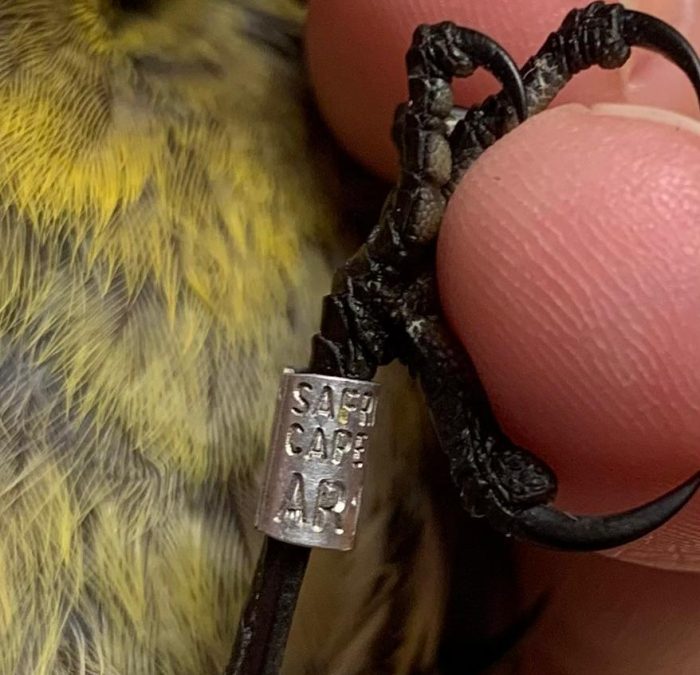
One of the six Malachite Sunbirds we ringed was a nestling at one of the less profitable sites! The date was 11 October 2024. This bird was found in a garden of a house near the southern tip of Africa, in L’Agulhas, 22 km from where it had been ringed. It was caught by a domestic cat, but not killed outright, but did not survive. Even though the story is tragic, it is an interesting example of juvenile dispersal.
Damselfly discovery
We did a ringing expedition to a site which turned out to be the poorest a site could possibly be. We had zero birds to ring. But we did have a damselfly to photograph. To everyone’s astonishment, the damselfly was identified as Spesbona. This species is classified as Endangered; it is extremely rare and localized. Before looking at the damselfly, look at the distribution map for the species …
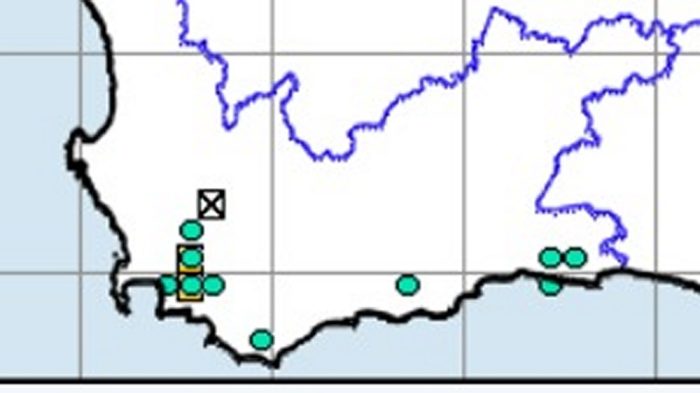
The new record is the southernmost, and a long way from the others, which are along the mountain chain between Knysna and Somerset West.
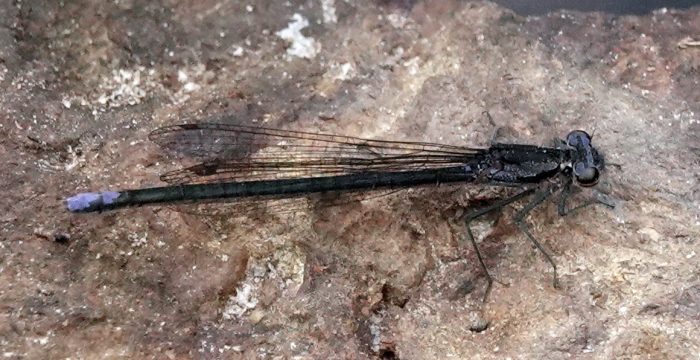
This is the Spesbona seen at Hazevlakte on the Nuwejaars Wetlands. In relation to most other species of dragonfly and damselfly, this is a species that is in flight relatively early, with a mid-October peak. You can read up about Spesbona in the Online Atlas of Dragonflies and Damselflies of South Africa, with the species text here.
Thanks
Erica Brink, Nuwejaars Wetlands Special Management Area, organized our accommodation with Karen Neethling at Hazevlakte. It turned out to be an inspired arrangement. Eugene Hahndiek helped us find ringing sites, and arranged access to them.