
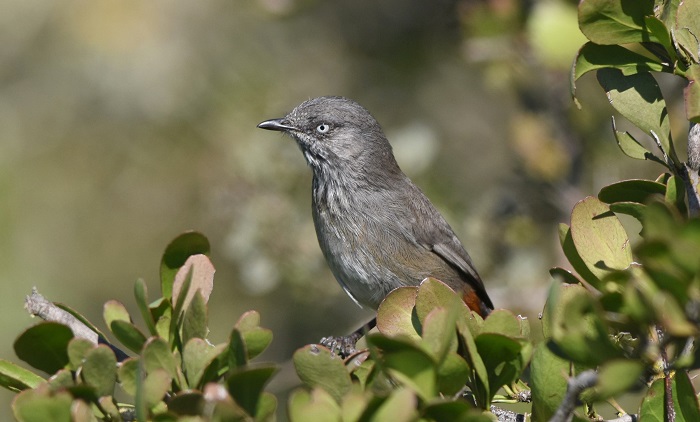
Cover image: Chestnut-vented Warbler by Gerald Wingate – Klipheuwel district, Western Cape – BirdPix No. 176803
Identification
The Chestnut-vented Warbler is easy to identify at all ages due to the distinctive chestnut vent. The crown and the rest of the upper parts are dull blue-grey to brownish grey. The forehead, ear coverts and sides of the neck are brownish grey. The chin and throat are white with bold black streaks. Underparts, including the breast and belly are grey. The vent and undertail coverts are bright chestnut and diagnostic. The tail is black with white tips. The eyes are white or cream coloured and the bill, legs and feet are blackish.
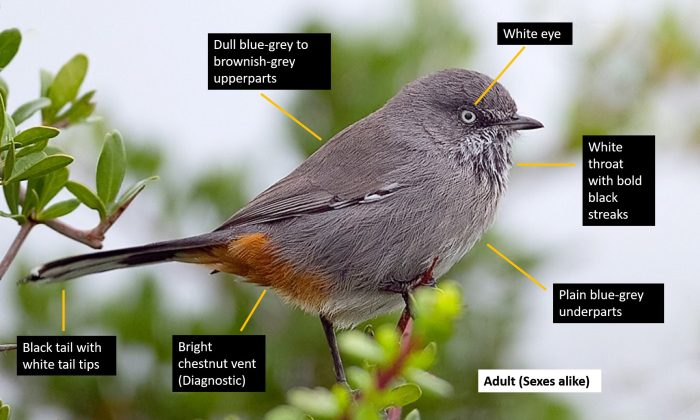
Addo Elephant National Park, Eastern Cape
Photo by Gregg Darling
Juveniles resemble the adults but the vent is dull, not bright rufous and they have less distinct streaking on the throat.
The Chestnut-vented Warbler is most similar to the related Layard’s Warbler (Sylvia layardi). The latter is slightly paler, with finer streaking on the throat and a white (not chestnut) vent.
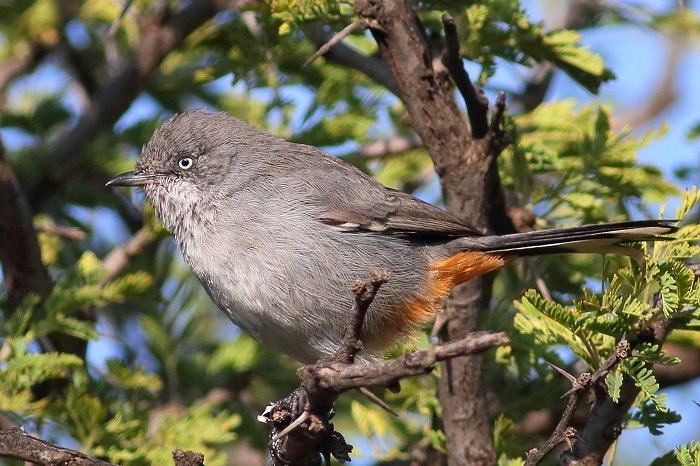
Near Hartebeespoort, North West Province
Photo by Andrew Keys
Status and Distribution
The Chestnut-vented Warbler is near-endemic to southern Africa, occurring elsewhere only in southern Angola and south-western Zambia. It is widespread in the drier western and central parts of southern Africa, but is absent from higher rainfall areas in the east and north-east of southern Africa. It is a common resident and is sedentary across its range.
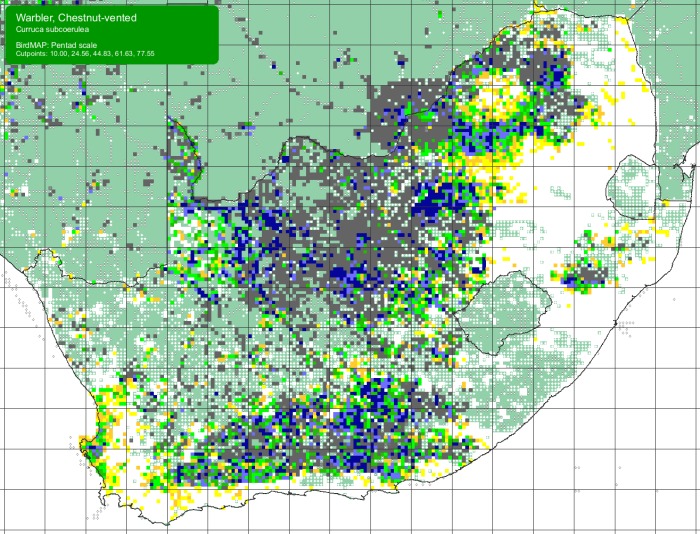
Details for map interpretation can be found here.
The range of the Chestnut-vented Warbler is not known to have differed from the present, and is unlikely to have changed significantly. Although it is near-endemic, its wide distribution in the arid and semi-arid regions suggests that the species is unlikely to be under threat in the foreseeable future.
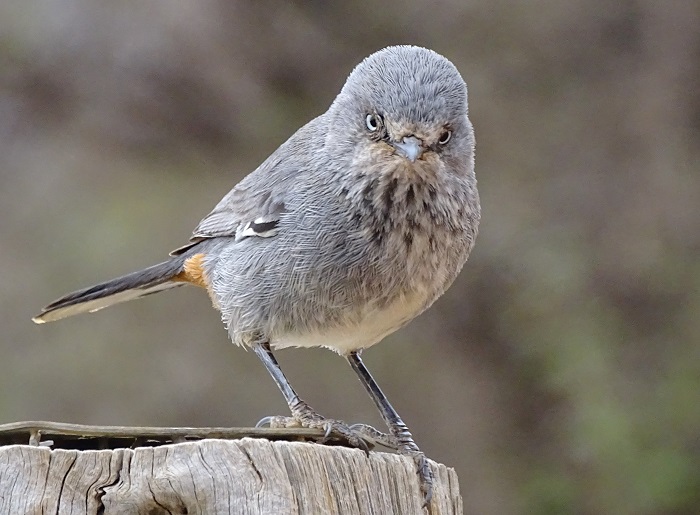
Pilanesberg National Park, North West Province
Photo by Wiekus Moolman
Habitat
The Chestnut-vented Warbler occurs in scrub and thickets, particularly along drainage lines. It has a preference for indigenous Vachellia (Acacia) thickets. In the Karoo it favours areas with taller bushes on plains and in drainage lines. It inhabits a range of vegetation types from thickets in open thornveld and savanna woodlands to bushy hillsides, semi-arid Karoo shrublands, as well as gardens on farms and in rural villages.
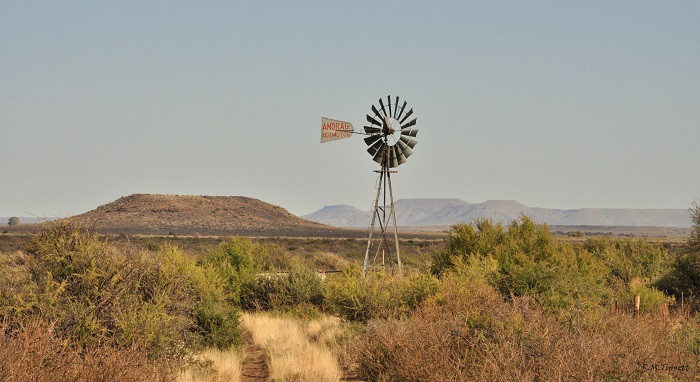
Photo by Ryan Tippett
Behaviour
The Chestnut-vented Warbler is usually encountered solitarily or in pairs. It is a skulking species that is often unwilling to show itself in the open. However, it is not shy and is rather inquisitive.
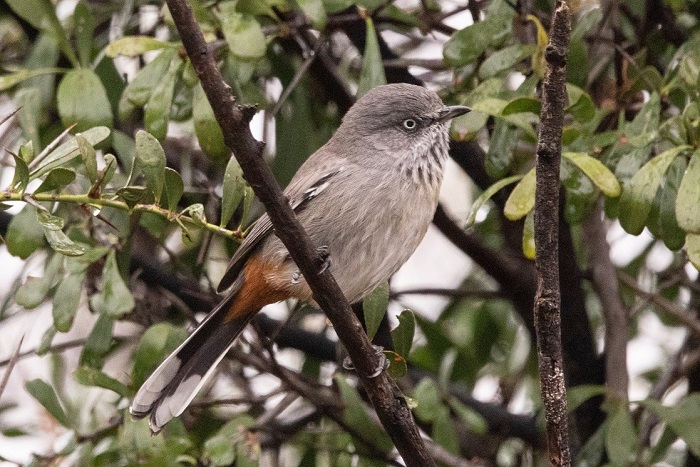
Mountain Zebra National Park, Eastern Cape
Photo by Lance Robinson
They fly low from bush to bush and search for food by restlessly moving through the foliage and branches of trees and bushes. Food is gleaned from bare branches and occasionally from leaves. They will sometimes also hawk small insects in flight. The Chestnut-vented Warbler frequently utters its distinctive cheriktiktik call while foraging.
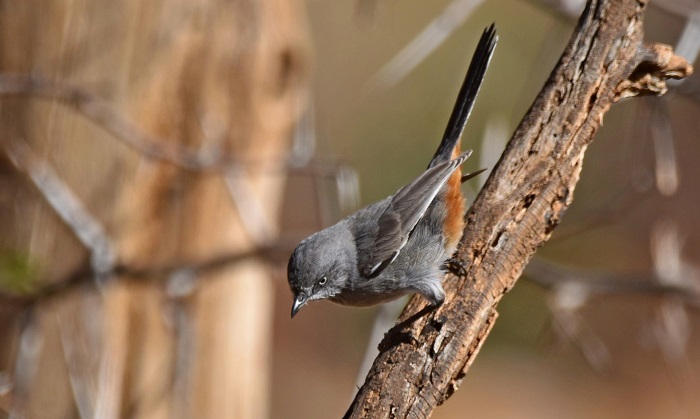
Camdeboo National Park, Eastern Cape
Photo by Jorrie Jordaan
This species eats mainly invertebrates such as spiders, ticks, moths, mantids, small beetles, caterpillars and termites. Also consumes small berries when available, and nectar, especially of various Aloe species.
The Chestnut-vented Warbler breeds from August to April in southern Africa but varies somewhat from region to region due to rainfall. In drier areas, breeding is probably partly opportunistic after rain. The nest is a cup of dry grass, rootlets and spider web, lined with plant down and fibres. Nests are usually located 1.5 to 3m above the ground amongst the slender outer branches of a bush or tree, and often in a clump of mistletoe.
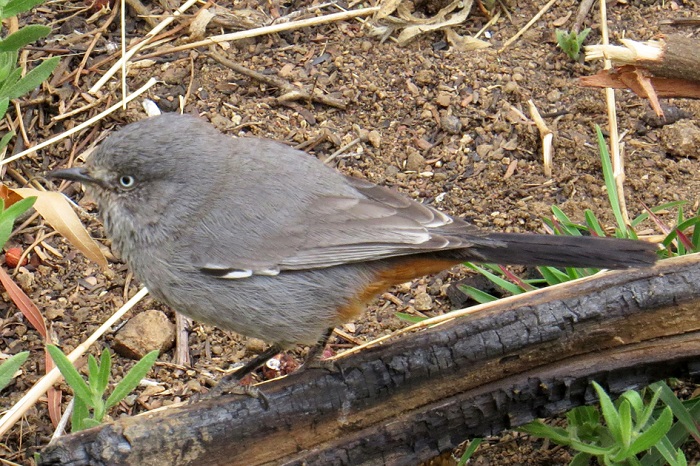
Pilanesberg National Park, North-West Province
Photo by Deon Van der Hoven
Two to four white eggs with greenish-brown to blue-grey blotching are laid per clutch. Incubation begins after the second egg has been laid, and incubation duties are shared by both sexes. The incubation period lasts from 13 to 16 days. Newly hatched young are altricial and the nestling period lasts for up to 15 days, during which time they are fed and cared for by both parents.
Broods of the Chestnut-vented Warbler are sometimes parasitised by the Diederik Cuckoo (Chrysococcyx caprius), and less often by the Jacobin Cuckoo (Clamator jacobinus).
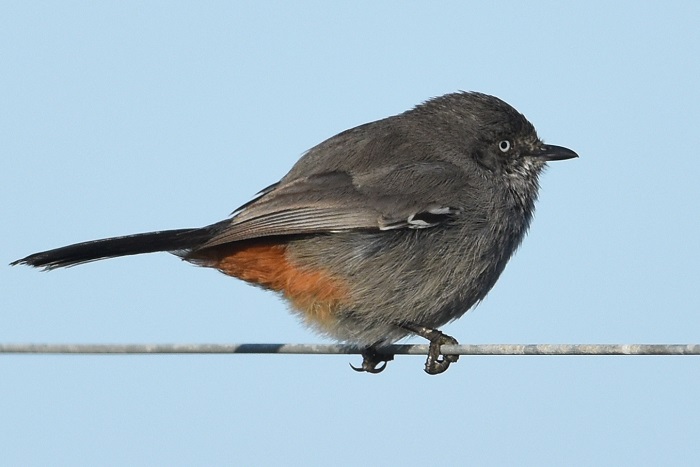
West Coast National Park, Western Cape
Photo by Gerald Wingate
Further Resources
Species text adapted from the first Southern African Bird Atlas Project (SABAP1), 1997.
The use of photographs by Andrew Keys, Deon Van Der Hoven, Gerald Wingate, Gregg Darling, Jorrie Jordaan, Lance Robinson and Wiekus Moolman is acknowledged.
Virtual Museum (BirdPix > Search VM > By Scientific or Common Name).
Other common names: Chestnut-vented Tit-Babbler, Titbabbler, Rufous-vented Warbler (Alt. English); Bosveldtjeriktik (Afrikaans); Parisome grignette (French); Kaapse Meeszanger (Dutch); Meisensänger (German); Felosa-chapim-dos-bosques (Portuguese).
A list of bird species in this format is available here.
Recommended citation format: Tippett RM 2024. Chestnut-vented Warbler Sylvia subcaeruleum. Biodiversity and Development Institute. Available online at https://thebdi.org/2024/03/23/chestnut-vented-warbler-sylvia-subcaeruleum/
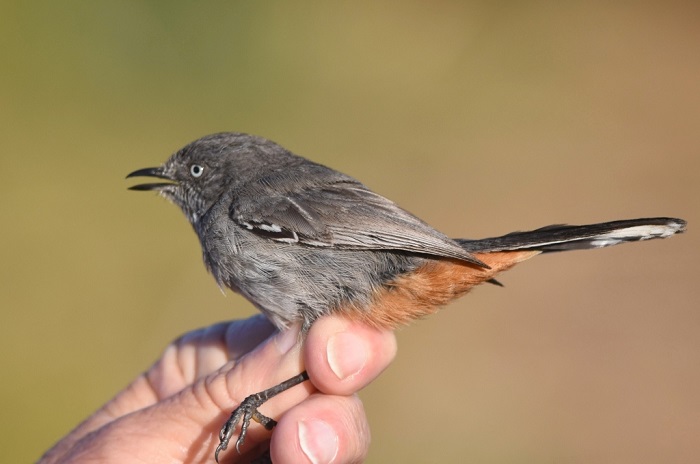
Vanschoorsdrif, Western Cape
Photo by Gerald Wingate
