
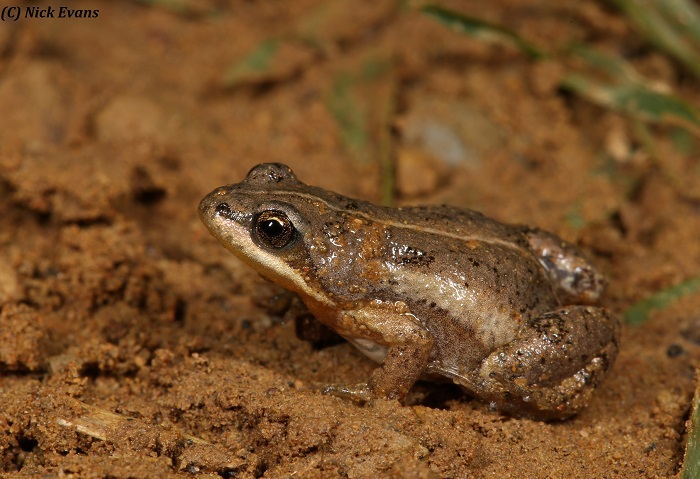
Cover photo by Nick Evans.
Find the Rhythmic Caco in the FBIS database (Freshwater Biodiversity Information System) here.
Family Pyxicephalidae
Habitat
The Rhythmic Caco inhabits flooded grassy areas in mid- to high-altitude grassland areas.
Behaviour
The call is distinctive. It consists of a series of pulsed notes ending in a series of chirps. The call is rhythmical, hence the species name.
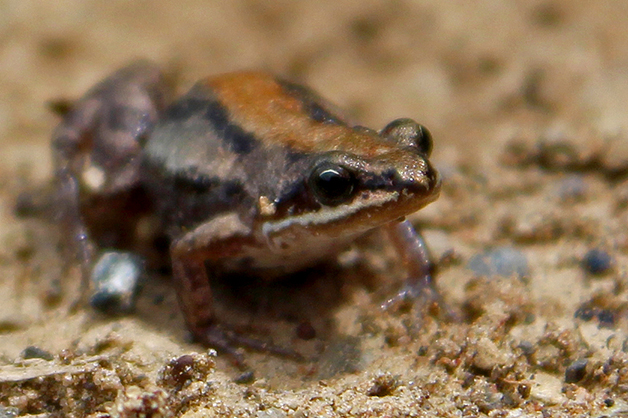
Near Mooi River, KwaZulu-Natal
Photo by Faansie Peacock
Status and Conservation
Very little is known about the Rhythmic Caco. The conservation status of C. rhythmum is considered Data Deficient.
Distribution
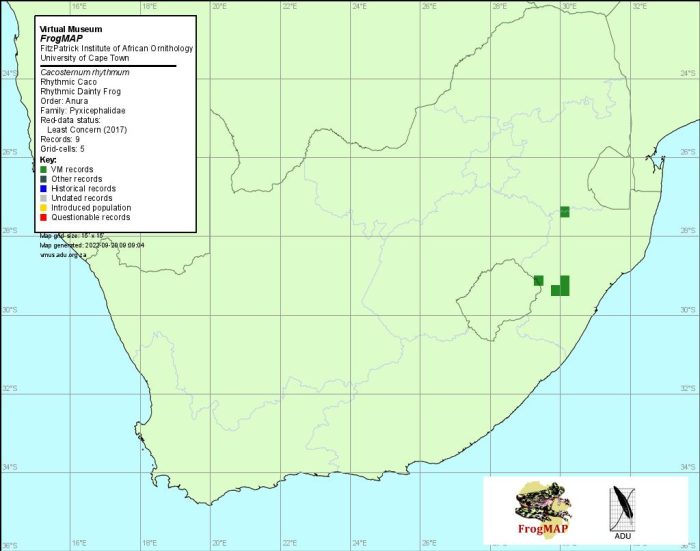
The Rythmic Caco is known only from a handful of locations in the KwaZulu-Natal Midlands and from Wakkerstroom in Mpumalanga. The species is endemic to South Africa.
Further Resources
The use of photographs by Faansie Peacock and Nick Evans is acknowledged.
Rhythmic Caco Cacosternum rhythmum Channing et al., 2013
Other Common Names: Ritmiese Blikslanertjie (Afrikaans)
Recommended citation format: Tippett, RM. (2025). Rhythmic Caco Cacosternum rhythmum. Biodiversity and Development Institute, Cape Town. Available online at https://thebdi.org/2022/02/20/rhythmic-caco-cacosternum-rhythmum/
References:
Minter, LR; Burger, M; Harrison, JA; Braack, HH; Bishop, PJ; Kloepfer, D. (Editors). (2004). Atlas and Red Data Book of the Frogs of South Africa, Lesotho and Swaziland. Smithsonian Institution, Washington, and Avian Demography
Unit, Cape Town.
Carruthers, V; du Preez, L. (2017). Frogs of southern Africa: A Complete Guide. Struik Nature, Cape Town.
Channing, A. (2001) Amphibians of Central and Southern Africa. Protea Book House, Pretoria
