
Find the Hewitt’s Moss Frog in the FBIS database (Freshwater Biodiversity Information System) here.
Family Pyxicephalidae
HEWITT’S MOSS FROG – Anhydrophryne hewitti
(FitzSimons, 1947)
Habitat
A. hewitti inhabits pockets of forest and dense natural vegetation alongside streams in ravines and valleys in mountainous terrain. It may be found amongst the leaf litter on the forest floor, in wet mossy embankments near waterfalls and rapids, or in small pools on the walls of rocky kloofs (Lambiris 1989a). Annual rainfall is >750 mm over most of its range.
Behaviour
Breeding takes place during spring and summer (October–January). Males call from concealed positions under vegetation. The female deposits 14–40 eggs in a shallow depression in soft, wet mud under a rock, fern, moss or leaf litter. Development is direct and metamorphosis takes place within three weeks (Wager 1965, 1986). Prey includes amphipod and isopod crustaceans (Wager 1965). Predators have not been recorded.
Status and Conservation
A. hewitti has a relatively wide extent of occurrence in KwaZulu-Natal. Much of its range at higher altitudes is protected. Presently, it does not appear to require any special conservation action.
Distribution
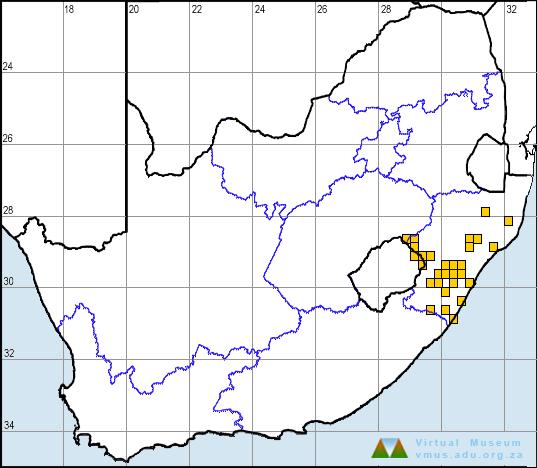
A. hewitti is endemic to KwaZulu-Natal, where it is fairly widely distributed in suitable habitats in the midlands and on the lower slopes of the Drakensberg mountains up to 2700 m a.s.l. (Lambiris 1989a). The atlas distribution map is rather patchy, reflecting, to some extent, the distribution of the preferred habitat of this species. The scarcity of recent records is probably due to inadequate sampling rather than the disappearance of the species at localities from which it was previously known. This species is easily identified by its appearance and its call, and the atlas records are therefore reliable.
Further Resources
Virtual Museum (FrogMAP > Search VM > By Scientific or Common Name)
More common names: Natal Moss Frog, Natal Chirping Frog (Alternative English Names); Natalse Kwetterpadda, Hewitt se Mospaddatjie (Afrikaans)
Recommended citation format for this species text:
Channing A, Tippett RM. Hewitt’s Moss Frog Anhydrophryne hewitti. BDI, Cape Town.
Available online at http://thebdi.org/2022/02/08/hewitts-moss-frog-anhydrophryne-hewitti/
Recommended citation format:
This species text has been updated and expanded from the text in the
2004 frog atlas. The reference to the text and the book are as follows:
Channing A 2004 Anhydrophryne hewitti Hewitt’s Moss Frog. In Minter LR
et al 2004.
Minter LR, Burger M, Harrison JA, Braack HH, Bishop PJ, Kloepfer D (eds)
2004. Atlas and Red Data Book of the Frogs of South Africa, Lesotho and
Swaziland. Smithsonian Institution, Washington, and Avian Demography
Unit, Cape Town.
