

View the above photo record (by John Wilkinson) in FrogMAP here.
Find the Argus Reed Frog in the FBIS database (Freshwater Biodiversity Information System) here.
Family Hyperoliidae
ARGUS REED FROG – Hyperolius argus
Peters, 1854
Habitat
Within the atlas region, this lowland species occurs in Coastal Bushveld-Grassland, a mosaic of vegetation types found from sea level to an altitude of 300 m, along the coast of northern KwaZulu-Natal. It breeds in shallow, often temporary, pans, vleis and marshes, where floating and emergent peripheral plants such as Phragmites spp., Nymphea spp., Cyperus papyrus and Typha latifolia provide call sites for males (Lambiris 1989a; Passmore and Carruthers 1995; Channing 2001; pers. obs.).

Photo by Ryan Tippett
Behaviour
Nothing appears to be known of the non-breeding habits and habitat of this species. Breeding begins after the first rains have fallen in spring, and continues throughout summer. During the day, frogs may be found hiding amongst vegetation at the breeding site, especially in Pistia stratiotes and Nymphea spp., and occasionally under logs or stones in the vicinity. At night, males form fairly large choruses and call from slightly elevated positions on emergent or floating vegetation. Amplexus is axillary, and c.200 eggs are laid in clusters of c.30, attached to submerged or emergent vegetation (Channing 2001; pers. obs.).

Photo by Trevor Hardaker
Predators include various fish, birds, snakes, terrapins, spiders and other frogs, while prey consists mainly of insects.
Status and Conservation
A major threat to H. argus is habitat loss through urbanization, water drainage and afforestation (Lambiris 1989a; pers. obs.). In several parts of KwaZulu-Natal, plantings of exotic Eucalyptus have lowered the water table to such a degree that many pans within the coastal dune forest have completely disappeared (pers. obs.). At the southernmost limits of the species’ distribution, populations are threatened by rapid urban expansion, resulting in range contractions. An additional threat is the introduction of exotic predatory fish, such as the bass Micropterus salmoides, which are avid predators of both tadpoles and adult frogs.
In areas not affected by human activities, H. argus is locally abundant and populations often consist of hundreds of individuals. The species occurs in several private and provincial nature reserves in KwaZulu-Natal and therefore does not appear to warrant additional conservation action at present.

Photo by Luke Kemp
Distribution
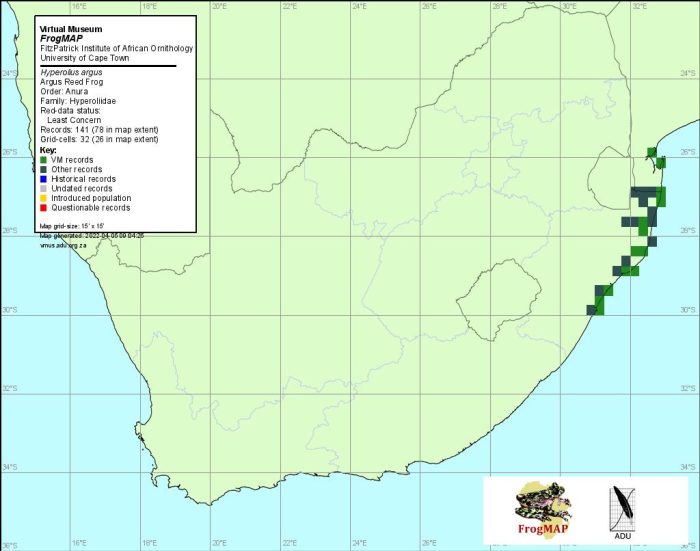
H. argus is distributed from the coastal lowlands of southern Somalia, southward through Kenya, Tanzania, Malawi, eastern Zimbabwe and Mozambique (Poynton and Broadley 1987). In the atlas region it is restricted to the coastal plain of KwaZulu-Natal, occurring as far south as Durban (2930DD). Earlier records in southern Africa were incorrectly referred to H. puncticulatus (Poynton 1964; Wager 1965) owing to the close morphological similarity of the two species. However, the species are ecologically separated, with H. puncticulatus occurring only in forest habitat in Malawi and on the coast of Tanzania and Kenya (Poynton 1986; Poynton and Broadley 1987).
The atlas records are reliable but incomplete; more thorough sampling will undoubtedly fill many of the present gaps in the known range of this species.
Further Resources
Virtual Museum (FrogMAP > Search VM > By Scientific or Common Name)
More common names: Argus Sedge Frog, Yellow Spotted Reed Frog, Golden Sedge Frog (Alternative English Names); Argusrietpadda (Afrikaans)
Recommended citation format for this species text:
Bishop PJ, Tippett RM. Argus Reed Frog Hyperolius argus. BDI, Cape Town.
Available online at http://thebdi.org/2022/02/04/argus-reed-frog-hyperolius-argus/
Recommended citation format:
This species text has been updated and expanded from the text in the
2004 frog atlas. The reference to the text and the book are as follows:
Bishop PJ 2004 Hyperolius argus Argus Reed Frog. In Minter LR
et al 2004.
Minter LR, Burger M, Harrison JA, Braack HH, Bishop PJ, Kloepfer D (eds)
2004. Atlas and Red Data Book of the Frogs of South Africa, Lesotho and
Swaziland. Smithsonian Institution, Washington, and Avian Demography
Unit, Cape Town.
