
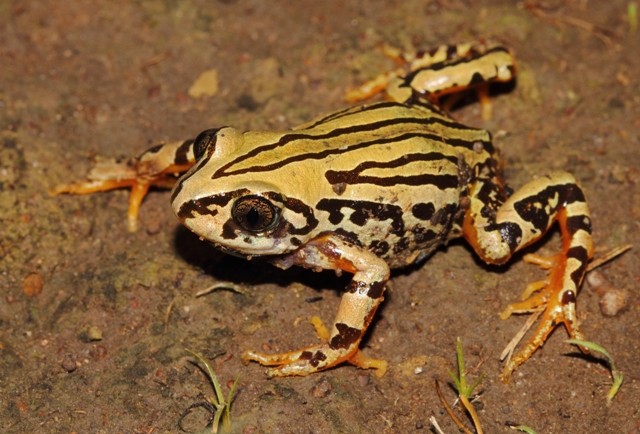
Cover photo by Alison Sharp.
Find the Rattling Frog in the FBIS database (Freshwater Biodiversity Information System) here.
Family Hyperoliidae
Identification
The Rattling frog attains a length of 44mm. The dorsal surface is smooth, and the markings on the back consist of 3 black longitudinal stripes, each split along its length, on a yellowish-brown to grey background. The undersides are pale cream and granular, often with fine dark mottling between the granules. The male’s throat disk is dark. The limbs are long and slender with bright yellow feet.
Habitat
The Rattling Frog inhabits the Grassland Biome over most of its range, but is also found in Fynbos in the Western Cape Province. In disturbed areas, it also occurs in pasture, clearings in forested areas (e.g., Tsitsikamma) and the grassy corridors between plantations of exotic trees. It occurs at altitudes ranging from near sea level to 1700 m.
Breeding habitats include pans, ponds, dams, and marshes in open grassland or grassy fynbos. During daytime in the breeding season, these frogs may be found under loose stones or tufts of grass near water (Wager 1986).
Behaviour
During the non-breeding season, this frog is terrestrial, hibernating in holes made by other animals or under logs or rocks. De Waal (1978) reported that individuals of this species are often found hibernating deep in the burrows of the Giant Girdled Lizard Cordylus giganteus. Rose (1962) obtained numerous specimens from amongst the roots of decaying Restionaceae reeds.
Breeding begins with the first good spring rains and extends into February. Male Rattling Frogs often call from concealed positions in or under grass tufts where they sit upright to allow full movement of the large, inflated vocal sac. On dark, warm, still evenings, they tend to be less shy, and males have been observed calling 300 mm above the ground, clinging to grass stems or bulrushes. They are agile, climbing from one grass stem to the next with the greatest of ease. As is the case with Kassina senegalensis, S. wealii seldom hops or jumps, but walks with a few quick paces, pausing intermittently.
Male Rattling Frogs call from the water’s edge or several meters from the water. Pairs will often enter amplexus some distance from the water, and then make their way to the oviposition site, where the female will lay her eggs in shallow water. The eggs are 1.7 mm in diameter, surrounded by capsules of 2.4 mm diameter, and are attached to vegetation and other objects underwater. The clutch contains 100–500 eggs (Wager 1965; Channing 2001). Tadpoles develop slowly, and metamorphosis is completed after about eight weeks (Wager 1965).
When threatened, these frogs often sham death by lying on their backs with feet tucked in. A few moments after being released they quickly turn over and walk away. The skin contains small amounts of toxic peptides that can cause severe physiological reactions if eaten by a predator (Roseghini et al. 1988).
Status and Conservation
Although the Rattling Frog is not abundant throughout its range, large breeding populations were encountered at several places during the atlas period, for example, at Dullstroom, Mpumalanga Province, and Boesmansberge, Eastern Cape Province. S. wealii occurs in several provincial nature reserves and national parks, and is not threatened.
Distribution
The Rattling Frog is endemic to the atlas region. In the Western Cape Province, it is distributed along the coastal plain to the east of Cape Town. In the Eastern Cape Province, the distribution broadens north-eastward into southern KwaZulu-Natal Province and northward into the eastern and northern parts of the Free State Province. A single recent record exists from Lesotho (2927DC), but the species probably occurs more widely in that country. In the interior, the distribution extends north-eastward through Gauteng, north-western KwaZulu-Natal, central Mpumalanga and western Swaziland. The most northerly record was from 2430DD. The two historical records from the Richards Bay area (2832AB, AD) are disjunct from the main distribution.
The atlas data are accurate and comprehensive, but incomplete in places such as Lesotho.
Further Resources
The use of photographs by Alison Sharp is acknowledged.
Rattling Frog Semnodactylus wealii (Boulenger, 1882)
Other Common Names: Weale’s Long-toed Frog; Running Frog (Alternative Common Names); Ratelpadda (Afrikaans)
Recommended citation format: du Preez, LH; Tippett, RM. (2025). Rattling Frog Semnodactylus wealii. Biodiversity and Development Institute, Cape Town. Available online at https://thebdi.org/2021/11/18/rattling-frog-semnodactylus-wealii/
This species text has been updated and expanded from the text in the
2004 frog atlas: du Preez, LH. (2004). Rattling Frog Semnodactylus wealii. In Minter LR et al 2004.
References:
Minter, LR; Burger, M; Harrison, JA; Braack, HH; Bishop, PJ; Kloepfer, D. (Editors). (2004). Atlas and Red Data Book of the Frogs of South Africa, Lesotho and Swaziland. Smithsonian Institution, Washington, and Avian Demography
Unit, Cape Town.
Carruthers, V; du Preez, L. (2017). Frogs of southern Africa: A Complete Guide. Struik Nature, Cape Town.
Channing, A. (2001) Amphibians of Central and Southern Africa. Protea Book House, Pretoria
