
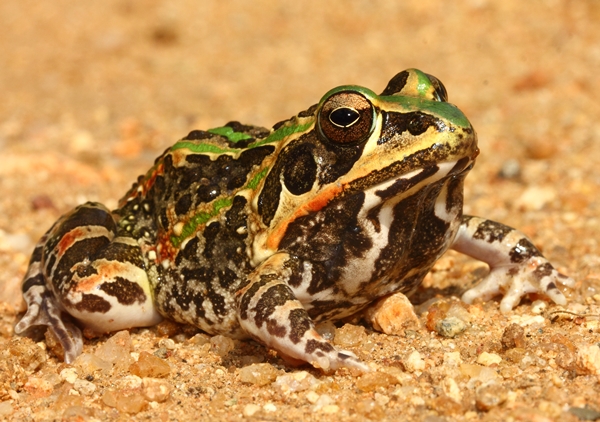
View the above photo record (by Vaughan Jessnitz) in FrogMAP here.
Find the Ornate Frog in the FBIS database (Freshwater Biodiversity Information System) here.
Family Ptychadenidae
ORNATE FROG – Hildebrandtia ornata
Peters, 1878
Identification
Habitat
In South Africa, the species inhabits a variety of bushveld vegetation types in the Savanna Biome, particularly areas with deep, sandy soils. It breeds in shallow temporary pans in dry, open woodland, often with emergent grass, and has also been recorded calling from pools on top of granite inselbergs (Jacobsen 1989; Lambiris 1989a; Channing 2001).
Behaviour
Due to the fossorial habit of the species, the frogs are rarely seen above ground, except during the rainy season when adults are sometimes seen crossing roads in wet weather, or feeding on alate termites when they emerge en masse. In Kruger National Park, adults have been found under rocks and logs during the dry season, within 50 m of their breeding site (H. Braack pers. comm.).
Breeding usually occurs in early summer but may take place in mid- to late summer if rains are delayed (Amiet 1974; Rödel 2000). H. ornata is an explosive breeder. Strong choruses develop immediately after heavy rain but die away within a relatively short period.
At Hans Merensky Reserve, males started to call at dusk as they approached the breeding site and took up positions c.50 cm from the water’s edge. Amplexus is axillary and may take place early in the evening: two amplexing pairs were observed at 19:00. Several newly laid batches of eggs, found in a grassy pan on the reserve, each consisted of a single layer of eggs forming one large, floating mass. Two batches of eggs laid in captivity numbered 838 and 1171 respectively. The mean diameter of the eggs was 1.96 mm (5.12 mm including jelly capsule, n = 20).Embryos emerged from the capsules after 36 hours (L.R.M. pers. obs.).
H. ornata tadpoles are voracious predators, feeding on the tadpoles of other species. Cannibalism has been reported, although this behaviour may be a laboratory artefact (Lambiris 1989a; Rödel 2000). The tadpoles are also reported to scavenge (Channing 2001).
Much remains to be learned about the behaviour and general biology of this species.
Advertisement Call
Status and Conservation
H. ornata occurs throughout Kruger National Park and in provincial and private nature reserves and protected areas outside the western boundary of the park. It also occurs in nature reserves in Limpopo and KwaZulu-Natal provinces and in Swaziland. H. ornata is not considered threatened, but is never abundant at any one locality. For this reason, surveys of population density and population monitoring are recommended.
Distribution
H. ornata has a wide distribution, from tropical West and East Africa, south as far as central Namibia and east through northern Botswana and Zimbabwe to Mozambique and South Africa (Poynton and Broadley 1985b).
In the atlas region, H. ornata has been recorded as far west as 2426BC (35 km northwest of Dwaalboom) and it follows the Limpopo River eastward through the northern and eastern parts of Limpopo Province. To the south it occurs east of the Great Escarpment, through eastern Mpumalanga and Swaziland to northern KwaZulu-Natal, and as far south as Mkuzi Game Reserve (2732CB).
The atlas data are reliable.
Further Resources
Virtual Museum (FrogMAP > Search VM > By Scientific or Common Name)
More common names: Skilderbontpadda (Afrikaans)
Recommended citation format for this species text:
Theron J, Minter LR, Tippett RM. Ornate Frog Hildebrandtia ornata. BDI, Cape Town.
Available online at http://thebdi.org/2021/11/11/ornate-frog-hildebrandtia-ornata/
Recommended citation format:
This species text has been updated and expanded from the text in the
2004 frog atlas. The reference to the text and the book are as follows:
Theron J, Minter LR 2004 Hildebrandtia ornata Ornate Frog. In Minter LR
et al 2004.
Minter LR, Burger M, Harrison JA, Braack HH, Bishop PJ, Kloepfer D (eds)
2004. Atlas and Red Data Book of the Frogs of South Africa, Lesotho and
Swaziland. Smithsonian Institution, Washington, and Avian Demography
Unit, Cape Town.

