

Cover photo by Luke Kemp.
Find the Arum Lily Frog in the FBIS database (Freshwater Biodiversity Information System) here.
Family Hyperoliidae
Identification
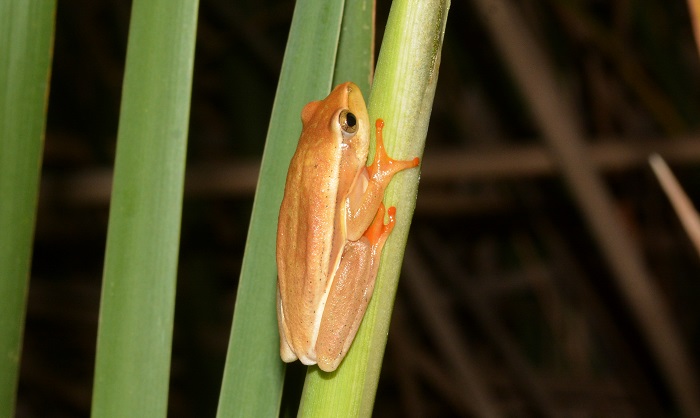
The Arum Lily Frog attains 43mm in length. The dorsal colour ranges from pale creamy-yellow to light brown. A broad, pale band and a fine dark line run from the nostril, through the eye and down the flanks. A series of very small black speckles may accompany these lines. Additional small dark spots are usually present on the back. The undersides are off-white with granular skin.
The hidden inner parts of the legs are red, and the webbing and discs on the feet are bright orange-red. The sexes are similar, but the throat of the breeding male is bright orange.

Kleinmond, Western Cape
Photo by Magriet Brink
Habitat
The Arum Lily Frog inhabits coastal vegetation types in the Fynbos Biome. As implied by its common name, it is often associated with Arum Lilies Zantedeschia aethiopica, frequently taking shelter within these flowers during the day. However, this is not necessarily its only, or even its preferred habitat. Arum Lilies are common along the southern and southwestern seaboard, occurring wherever there is sufficient moisture. A thorough investigation is needed to establish whether the association of H. horstockii with Arum Lilies can be attributed to choice or to chance.
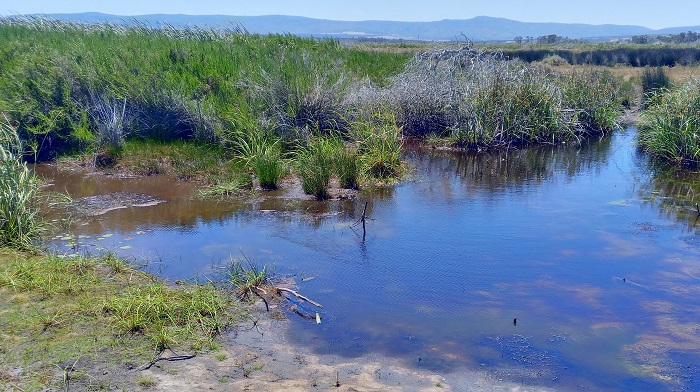
Photo by Ryan Tippett
Breeding habitat includes large or small pans, dams, marshes and even slow-flowing, quiet streams where there is sufficient emergent vegetation such as sedges, bulrushes and reeds. The water bodies may be slightly brackish, apparently without affecting the population density of the Arum Lily frog, but they appear to avoid deep water. Calling males have been found at sites densely infested with alien acacias (J.A. Harrison pers. comm.). During dry and non-breeding periods, individuals have been found in exposed positions far removed from the nearest breeding sites (Rose 1950; Wager 1986; pers obs.).
Behaviour
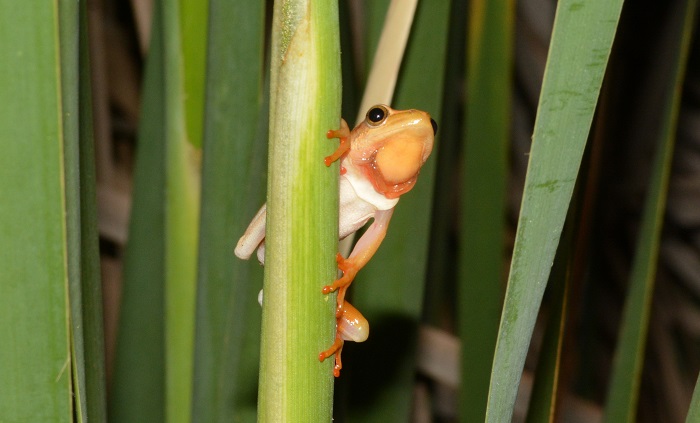
Nuwejaars River, Western Cape
Photo by Ryan Tippett
The following life history information is based on Rose (1950), Passmore and Carruthers (1995), Channing (2001), and personal observations.
Although the Arum Lily Frog occurs mostly in a winter-rainfall region, breeding takes place during spring and summer (September–January). Males usually call from elevated positions above water, generally on sedges, reeds, shrubs and grasses, but may also call from water-lily pads at water level. Less frequently, they call from elevated positions some metres from water, especially in dense stands of reeds. The advertisement call is sometimes interspersed with territorial calls. Calling usually begins soon after dark, but sporadic calling may sometimes be heard in the late afternoon on overcast, rainy days. Non-calling males are sometimes found on the perimeter of breeding groups.

Noordhoek, Western Cape
Photo by Melanie Cornelius
Spawning has been recorded during October and November, with clutches of 10–30 eggs attached to the roots and stems of plants below water level. Eggs have a diameter of 2 mm within 4-mm jelly capsules, and are a whitish-cream colour with a brown hemisphere.
The Arum Lily Frog is known to feed on a variety of small flying insects. Predators include the Whiskered Tern Chlidonias hybridus (Steyn 1966; Craig 1974), Water Mongoose Atilax paludinosus, and the Cape River Frog Afrana fuscigula.
Advertisement Call
The call of the Arum Lily Frog has been described as a long, harsh bleat and is given from floating or emergent vegetation.
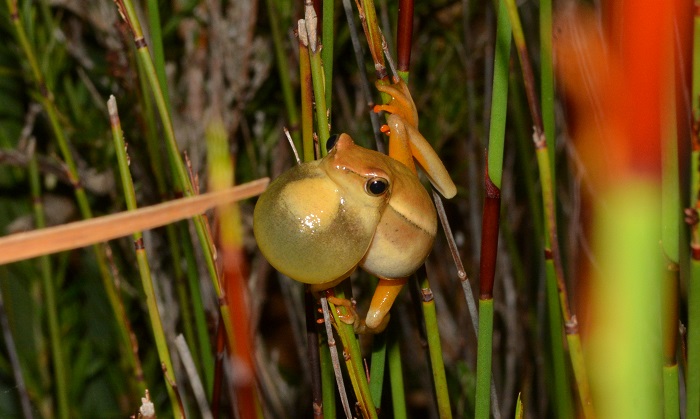
Nuwejaars River, Western Cape
Photo by Ryan Tippett
Status and Conservation
The Arum Lily Frog has been recorded in a number of protected areas, including Tsitsikamma, Wilderness, Cape Peninsula and Agulhas national parks, De Hoop and Goukamma provincial nature reserves, and Buffalo Hills Private Nature Reserve. The species is protected against collection by provincial nature conservation regulations.
Although several localities at which H. horstockii was recorded in the late 1970s have disappeared under agricultural and urban development (e.g., Plettenberg Bay), it appears to be maintaining healthy population levels at the remaining localities. It may even be increasing its range in certain areas, although the new records may be due to inadequate surveying in the past. The species does not seem to be under any immediate threat, but population monitoring in conservation areas is recommended.
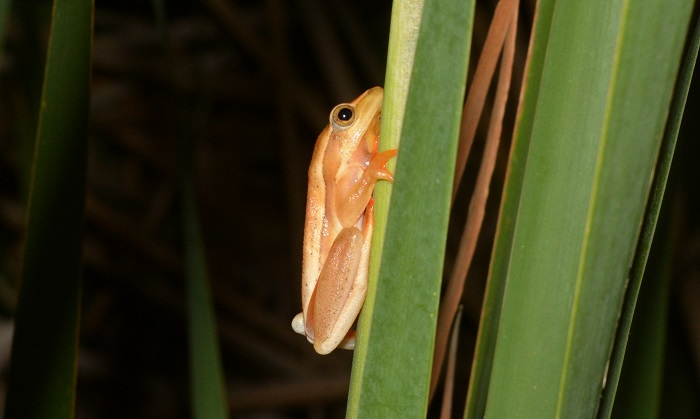
Nuwejaars River, Western Cape
Photo by Ryan Tippett
Distribution
The Arum Lily Frog is endemic to the Western Cape Province of South Africa, occurring along the southern seaboard from Cape Town (3418AB) in the west, to the Humansdorp district (3424BB) in the east. Previously, the eastern limit was thought to be at the Tsitsikamma National Park, but a specimen in the Port Elizabeth Museum was collected from Humansdorp in 1965, and a population near Cape St Francis was recently discovered (T. Hardaker pers. comm.). For many years, this species was thought to be divided into eastern and western sub-populations. However, the atlas survey has shown that its distribution is virtually continuous across its range. Recent atlas records have extended the range of this species inland as far as Swellendam and environs (3420AA, AB), where several adults and juveniles have been found (N.I. Passmore pers. comm.).

The range of H. horstockii is at a southerly extreme, lying in the area between the coast and the southern mountain ranges. Most of the range has winter rainfall, but toward the east, rainfall is transitional between a summer and winter pattern, with rainfall at any time of year.
The Water Lily Frog is an unmistakable species that does not occur with any similar congeners. The atlas records are reliable, but the gaps in distribution probably indicate a need for more thorough surveys in those areas.
Further Resources
The use of photographs by Luke Kemp, Magriet Brink, and Melanie Cornelius is acknowledged. Other images by Ryan Tippett.
Arum Lily Frog Hyperolius horstockii (Schlegal, 1837)
Other Common Names: Arum Lily Reed Frog; Horstock’s Reed Frog (Alternative English Name); Aronskelkrietpadda (Afrikaans)
Recommended citation format: Braack, HH; Tippett, RM. (2025). Arum Lily Frog Hyperolius horstockii. Biodiversity and Development Institute, Cape Town. Available online at https://thebdi.org/2021/10/30/arum-lily-frog-hyperolius-horstockii/
This species text has been updated and expanded from the text in the
2004 frog atlas: Braack, HH. (2004). Arum Lily Frog Hyperolius horstockii. In Minter LR et al 2004.
References:
Minter, LR; Burger, M; Harrison, JA; Braack, HH; Bishop, PJ; Kloepfer, D. (Editors). (2004). Atlas and Red Data Book of the Frogs of South Africa, Lesotho and Swaziland. Smithsonian Institution, Washington, and Avian Demography
Unit, Cape Town.
Carruthers, V; du Preez, L. (2017). Frogs of southern Africa: A Complete Guide. Struik Nature, Cape Town.
Channing, A. (2001) Amphibians of Central and Southern Africa. Protea Book House, Pretoria
