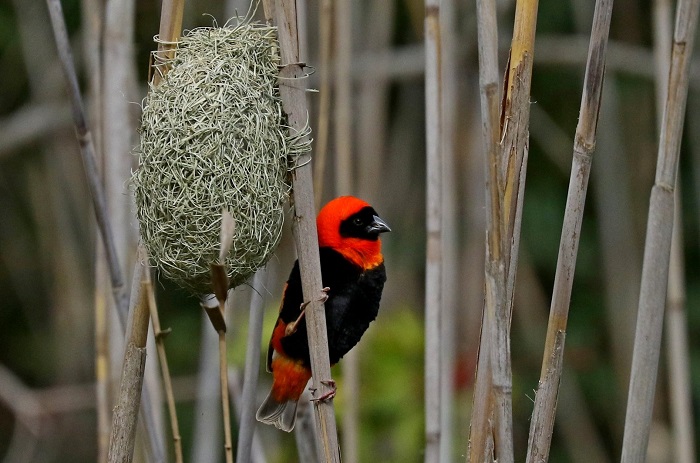
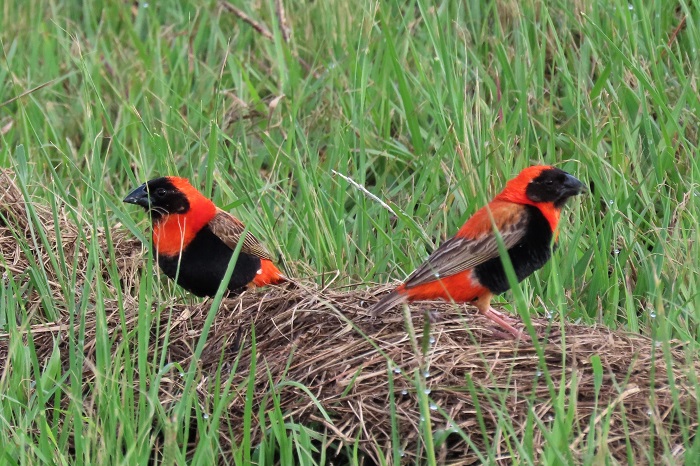
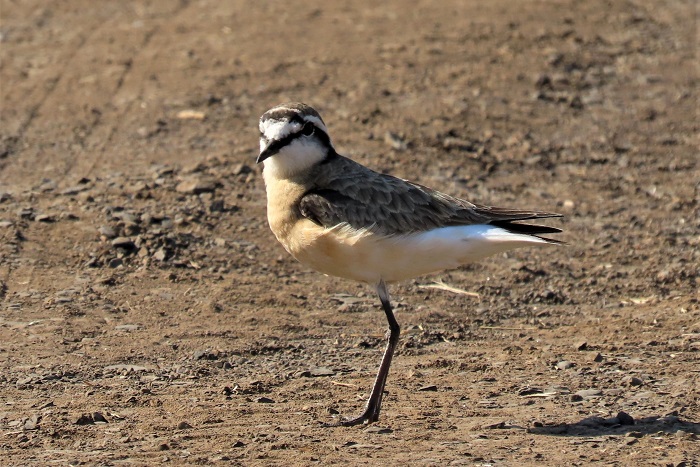
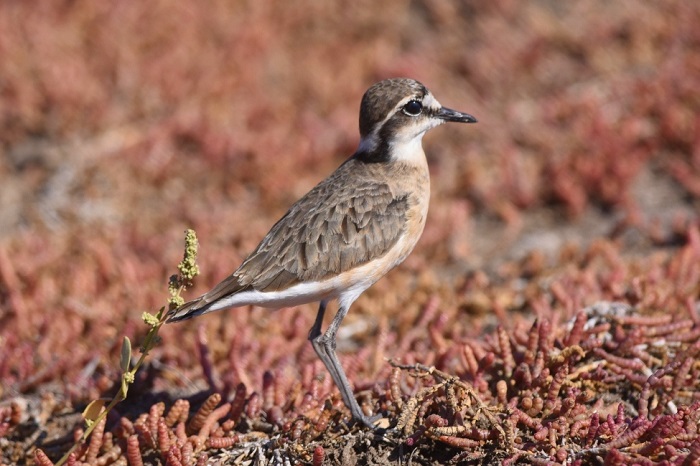
The RAVE continues at Botuin, Vanrhynsdorp. (RAVE = Ringing, Atlasing, Virtual-museuming Expedition.) This is the report on activities on Days 5, 6 and 7, Friday, Saturday and Sunday. The report on the first four days, Monday to Thursday, is here.
Atlasing
On Friday we did our first atlas checklist for SABAP2. It was for pentad 3125_1855. It lies along the R27 between Vanrhynsdorp and Nieuwoudtville, near the foot of Vanrhyns Pass. The most famous landmark in the pentad is the Bagdad Cafe, which lies at the centre of the pentad. The map and species list of the pentad are here. It currently has 23 full protocol checklists, spread out over nine of the SABAP2 years, with the first in 2009, so there is scope for an analysis of changes in species occurrence through time.
The pentad has a total of 145 species on full protocol checklists. Of these, 29 have been recorded once only. We added three more species to this category! Yellow-billed Kite, African Black Swift and Tractrac Chat. None of these are particularly surprising in the pentad; the surprise is that they have not been recorded before. It takes a lot of checklists to develop a comprehensive species list!
The most intriguing species of the pentad is the Cape (Glossy) Starling. It was first recorded here in 2020 (see BirdPix record 130035). There is a pair, which breeds, hanging out in the trees at the Bagdad Cafe. This is the easiest spot in the Western Cape to find this species; the alternative site is at Kliprand, farther north, and right on the border with the Northern Cape.
We also got the third Cardinal Woodpecker record for the pentad. It was added via a photo destined for BirdPix. One of the best birding spots within the pentad is where the Gemsbokriver Road cross a main drainage line running westward from the mountains. This drainage line is as busy for birds as the nearby R27 highway is for vehicles. There is continual movement of birds in both directions along this flighway.
During these three days, we also atlased pentad 3135_1810 at Dorningbaai and got 46 species, pentad 3135_1840 at Vanrhynsdorpand got 50 species, and the pentad in which Botuin is located, pentad 3135_1845 and got 67 species. The Botuin pentad has 249 full protocol checklists; since 2014 there have been multiple checklists per year, and this pentad is certainly a candidate for an analysis of a change in species composition through time.
OdonataMAPping
We did a trip to the Waterfall in the quarter degree grid cell 3118DD Bulshoek. Before our RAVE, the species list for this grid cell had 54 records identified to 23 species (and a few identified to genus).
We recorded 15 species. Of these four were new to the grid cell. The new species are highlighted in this list: Sooty Threadtail, Mountain Sprite, Orange Emperor, Common Thorntail, Cape Thorntail, Common Hooktail, Rock Hooktail, Darting Cruiser, Cape Skimmer, Little Scarlet, Orange-winged Dropwing, Red-veined Dropwing, Navy Dropwing, Highland Dropwing and Jaunty Dropwing.
The Cape Thorntail is endemic to the Western Cape.
Ringing : “lark day”
Friday was “lark day”. This involves setting up a very long line of mistnets in open scrubby habitat that no normal birdringer would consider intelligent. But it is the only way to catch larks. We caught three Karoo Larks and a Large-billed Lark. A lot of effort for what might be considered a small return. But the data collected off the birds is scarce and valuable. Maybe the exchange rate is one Karoo Lark = 100 Southern Red Bishops.
Karoo Lark, Large-billed Lark, and the start of setting up the long line of nets
ScorpionMAPping
An after dinner hunt on Friday evening revealed three species of scorpion, including this one:
It is Parabuthus calvus, which has recently been given the English name Bald Thicktail Scorpion. This South Africa’s rarest thicktail. This species lives in association with Harvester Ants (we have no idea yet of what the association achieves for either species!). Most scorpions are covered with sensory hairs, this one has almost none, hence the name “bald”.
The other two species are common: Uroplectes carinatus and Parabuthus capensis. A total of six species have been recorded in this quarter degree grid cell: 3118DB.
On Monday, 4 December, the RAVE moves from Botuin near Vanrhynsdorp, on to Vondeling Wine Farm, on the eastern edge of the Paardeberg and north of Wellington.
RAVE = RINGING, ATLASING AND VIRTUAL MUSEUMING EXPEDITION
The first four days of the BDI Rave were in November from the 27th to the 30th, at Botuin in Vanrhynsdorp. There is a report on this period here. The RAVE continues at other locations into December, until the 18th. Each report will have a link to the next period!
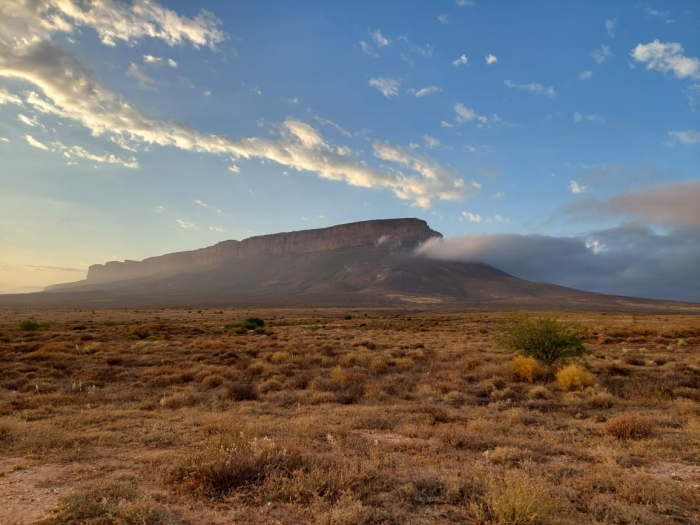
The beautiful Gifberg mountain near Vanrhynsdorp.
Our specific goals during a RAVE focus on ringing, atlasing and the Virtual Museum (VM). Through bird ringing, atlasing, and BioMAPping (for the Virtual Museum), we aim to:
obtain annual survival estimates of key species via recaptures of ringed birds.
build information on local movements of birds by systematically ringing at nearby sites.
strengthen our understanding of moult.
improve our knowledge of annual breeding success and the timing of breeding through a monitoring programme that estimates the percentage of juveniles in the populations at each site.
develop guides that will help ringers and trainee ringers to age and sex birds.
On the first four days of the RAVE, Monday the 27th to Thursday the 30th of December, the ringers handled a total of 302 birds of 28 different species. The numbers of each species are in the table here:
We are aiming to make it easier for beginner birders! Key to this is the production of “BDI-style” species texts on the BDI website. Each of the texts starts with an annotated photograph like this one for the Helmeted Guineafowl:
The BDI-style texts do not only focus on identification but provides all sorts of interesting information; to see the full text for this species, click here.
We added texts for five species during November 2023:
New Biodiversity Observations Papers in November 2023
Biodiversity Observations is an Open Access ejournal which focuses on the publication of descriptive papers which report observations relating to biodiversity. There is a summary of the activities of the journal for the period 2010-2022 here.
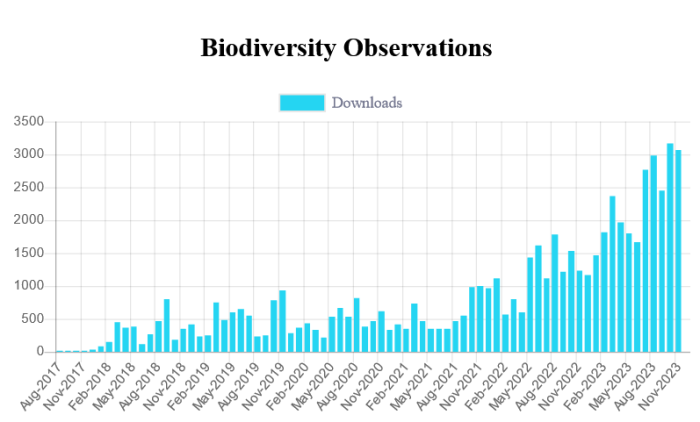
The graph below shows that Biodiversity Observations had its second best month ever for number of papers downloaded; 3069 downloads of papers were made. November didn’t quite manage to sneak ahead of October, which are 3173 downloads, 104 more.
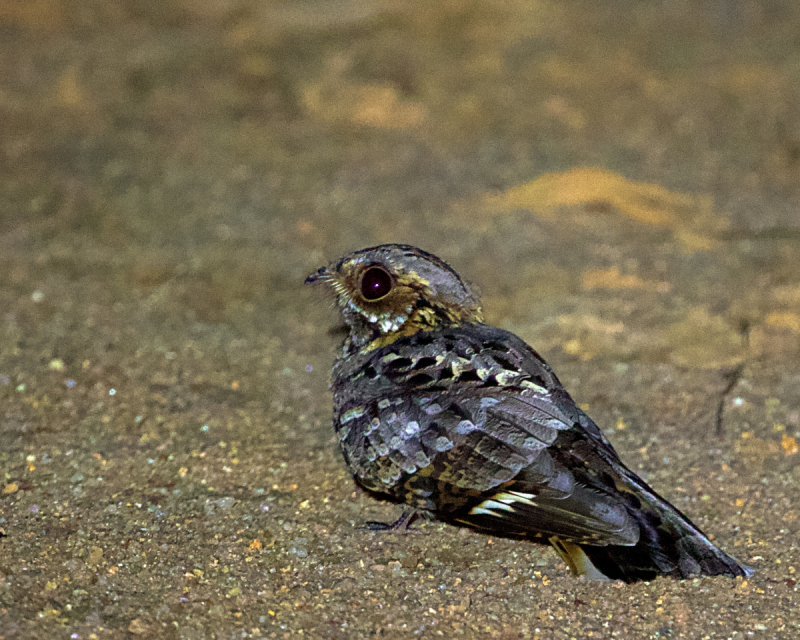
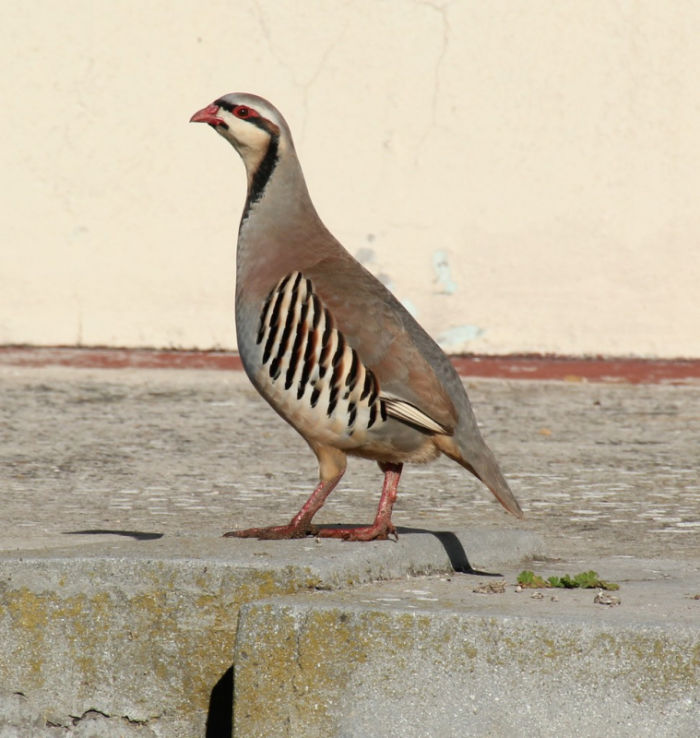
One of the most recent papers takes a look at the increase in abundance of Chukar Partridges Alectoris chukar and Fiery-necked Nightjars Caprimulgus pectoralis on Robben Island.
Chukar Partridge taking a stroll along the Faure Jetty on Robben Island. BirdPix Record 27667.
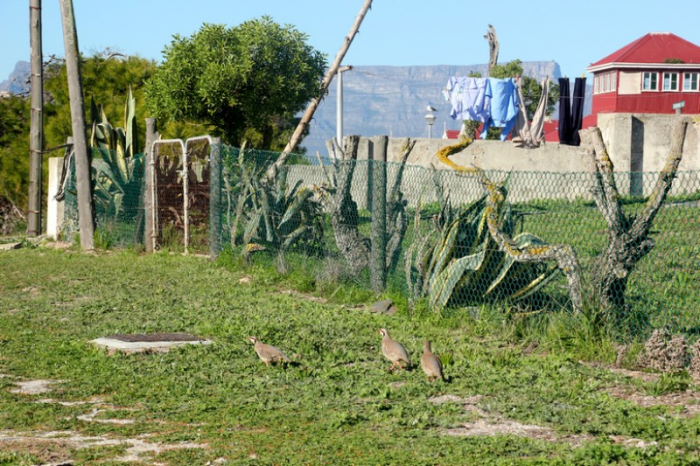
The near complete removal of feral cats Felis catus was one of five major drivers of change at Robben Island in the first decades of the 21st century. This new paper in BO demonstrates that the abundance of Chukar Partridge and of Fiery-necked Nightjar has increased during this period. You can read and download the paper (for free) here.
A group of Chukar Partridges seen on Robben Island.
The second paper published in Biodiversity Observations in November was entitled “Record of Progressive Greying in Laughing Dove Spilopelia senegalensis in Nigeria”. The website from which you download the paper is here. There is a plethora of terms which describe non-standard colour forms of birds. This paper helps unravel the complexity!
Bird Ringing
Bird ringing remains one of the most important research methods for discovering some of the most important basic information about each species. Conservation initiatives need a lot of information. Two key factors to understand are rates of survival and extent of movement. There is a discussion about the value of ringing here.
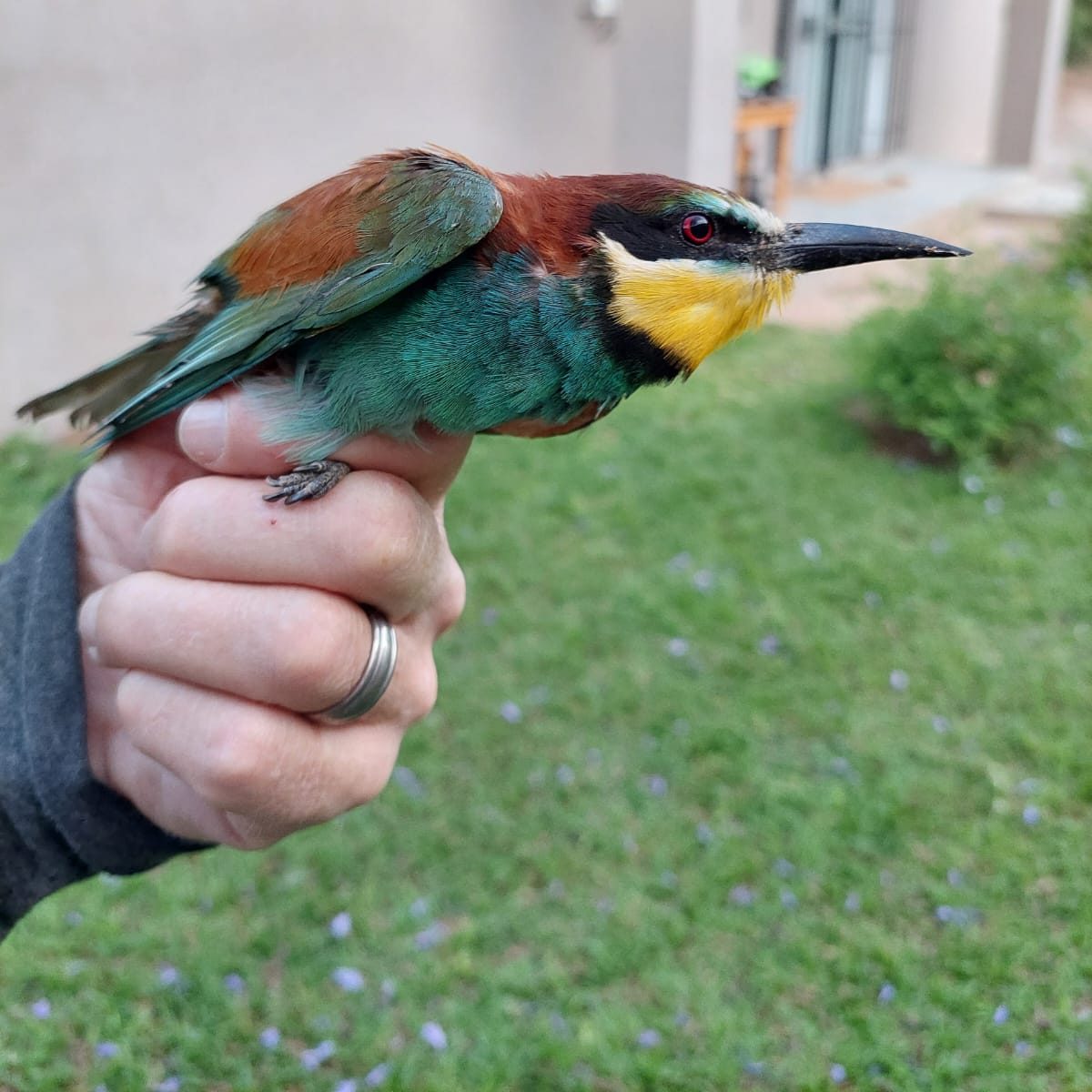
European Bee-eater ringed during the RAVE at Botuin, Vanrhynsdorp – November 2023.
There are three ringing courses planned for 2024. They are:
31 January to 6 February at BoTuin, Vanrhynsdorp, Western Cape
1 to 7 May at Ouberg Private Nature Reserve, Montagu, Western Cape
09 to 15 September at New Holme Lodge, near Hanover, Northern Cape.
More details are here. There is a broad description of the course activities here.
The first data collection spot on the RAVE was the low level bridge across the Olifants River, a kilometer from the turnoff to Algeria on the N7 from Cape Town north towards Namibia. These low level bridges are precious to OdonataMAPpers, because you get close to the river. We found only two of the 17 species recorded for this grid cell (3218BD Oliewenboskraal). They were the two most common species, Red-veined Dropwing (left below) and Navy Dropwing (right below).
Both dragonflies were pointing their abdomens towards the sun to minimize the amount of solar heating. It was a warm day!
Ringing
On the first four days of the RAVE, Monday 27 to Thursday 30 December, the ringers handled a total of 302 birds of 28 different species. The numbers of each species are in the table here:
The species with BDI-style texts are highlighted in red. Click on the species name and you get taken to the species text.
The standout species were Cape Sparrow (73), Southern Red Bishop (67) and Lark-like Bunting (61). So almost exactly two-thirds of the birds belonged to just three species. From a sciency perspective,these three species will provide the most valuable data. The total number of Lark-like Buntings ringed on previous ringing trips to Botuin is seven. Birding in the district suggests that there has been an irruption of this species into this area, probably because the past winter has been the wettest in decades, so that conditions were good for breeding. Overall, across all species, a larger proportion of the birds we have handled have been juveniles. The past breeding season was productive.
Of the 25 species with small numbers handled, the most interesting was probably the Red-billed Quelea (which ought not to be here). From the “ooh-aah” perspective, the European Bee-eater was the most spectacular:
Virtual Museum
On the first days of the RAVE, contributions have been made to LepiMAP, OdonataMAP, ReptileMAP and BirdPix.
These records of Cape Wagtail, Capped Wheatear and African Sacred Ibis were made at the rubbish dump which we need to pass through on the way to the Vanrhynsdorp Sewage Works.
Cover image by Lia Steen – Lake Chrissie, Mpumalanga – BirdPix No. 236
Identification
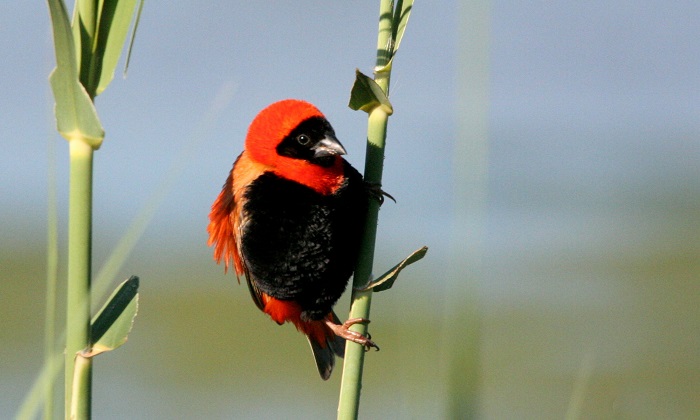
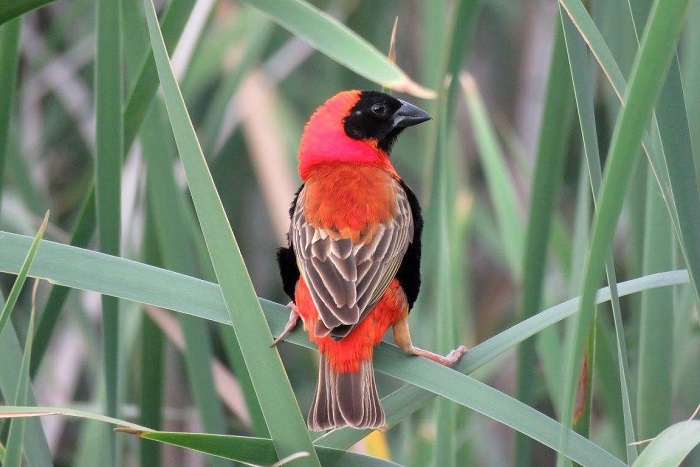
The Southern Red Bishop is one of the most distinctively plumaged birds in the region. In its scarlet and black breeding plumage, this is probably one of the most familiar southern African birds.
The Southern Red Bishop is sexually dimorphic with females looking quite different to the breeding males.
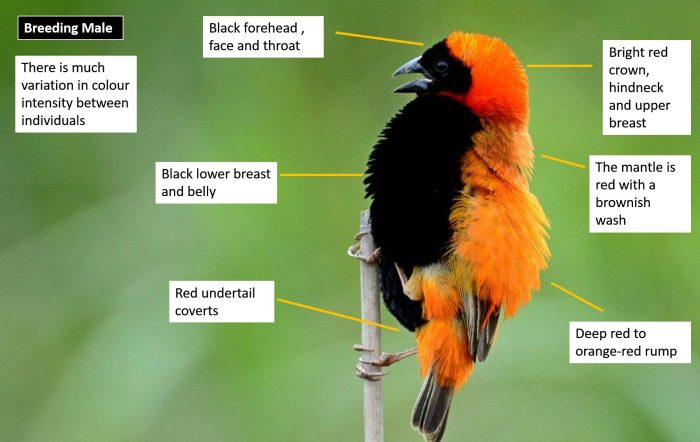
Breeding males are entirely black and bright red. Their foreheads, face and throat are black. The black face mask is encircled by red on the crown, hind neck and upper breast. The extent of black on the forecrown and throat varies individually. The mantle is red with a slight brownish wash, while the rump and upper tail coverts are deep red to orange-red. There is a considerable amount of variation in colour intensity between individuals. The lower breast and belly is black and the under tail coverts are red. The eyes, legs and feet are brown and the bill is black.
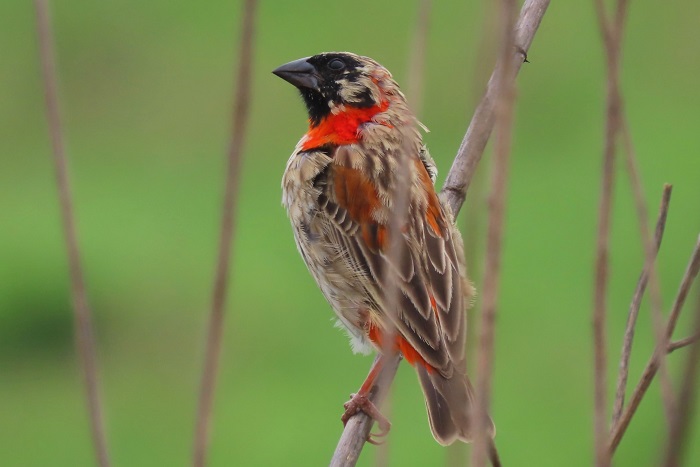
Southern Red Bishop (Euplectes orix) male starting to develop his breeding plumage. Thurlow Nature Reserve, KwaZulu-Natal Photo by Malcolm Robinson
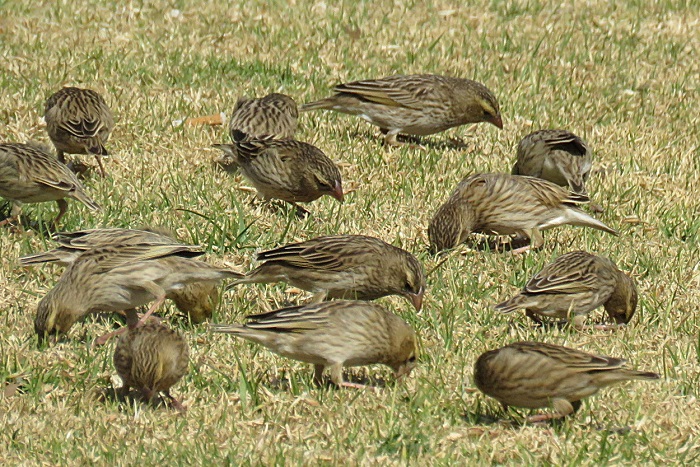
Non-breeding males have a pale buffy supercilium that contrasts with the brown lores, cheeks and ear coverts. The upper parts are buffy brown and the feathers have dark brown central streaks. The throat is whitish and the breast and flanks are buff coloured with dark brown streaking. The rest of the underparts are creamy-white. The bill, legs and feet are brown.
Adult females resemble the non-breeding males but show less heavy streaking on the breast and flanks.
Juveniles resemble females but have broad buffy margins to the feathers on the upper parts. The underparts are buff-coloured.
The Southern Red Bishop is unlike any other bird in southern Africa, except for the Black-winged Bishop (Euplectes hordeaceus) which, in southern Africa, occurs only in north-eastern Zimbabwe and adjoining Mozambique. Breeding males of the latter are larger, with black (not brown) wings and tails and a mainly red (not black) forehead.
Females and non-breeding birds are frequently overlooked or misidentified. This problem is compounded by the communal flocking and roosting behaviour of this species with other similar seed-eating birds.
Status and Distribution
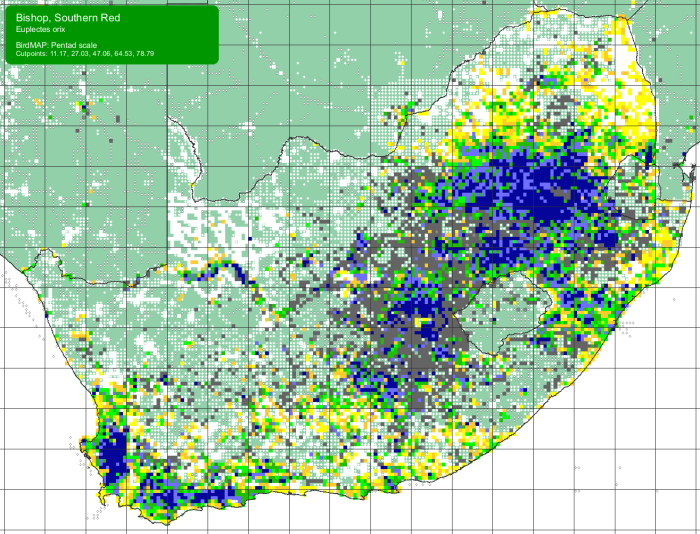
The Southern Red Bishop is Locally common to abundant, especially in the Western Cape and the grasslands of the eastern plateau of South Africa and Zimbabwe.
The Southern Red Bishop is distributed from south-western Kenya and southern Uganda across to Angola and throughout southern Africa. Within southern Africa it is localised in Namibia, and north-western and south-eastern Botswana. It is strangely uncommon in the Okavango Delta and is mostly absent from large parts of the Kalahari. The Southern Red Bishop is more wide-ranging in Zimbabwe, South Africa, eSwatini and Lesotho. This species is also quite localised in Mozambique, occurring mainly along river systems.
Crop farming and the construction of dams have allowed the Southern Red Bishop to greatly increase its distribution and abundance. Conversely, the draining of wetlands and the loss of reedbeds have caused some local reductions in numbers.
The crop-raiding habits of the Southern Red Bishop can bring it into conflict with farmers. It is an unprotected pest species in the Western Cape and in cereal and grain growing areas. Despite this, the Southern Red Bishop remains common and is not under threat.
SABAP2 distribution map for Southern Red Bishop (Euplectes orix) – November 2023. Details for map interpretation can be found here.
Habitat
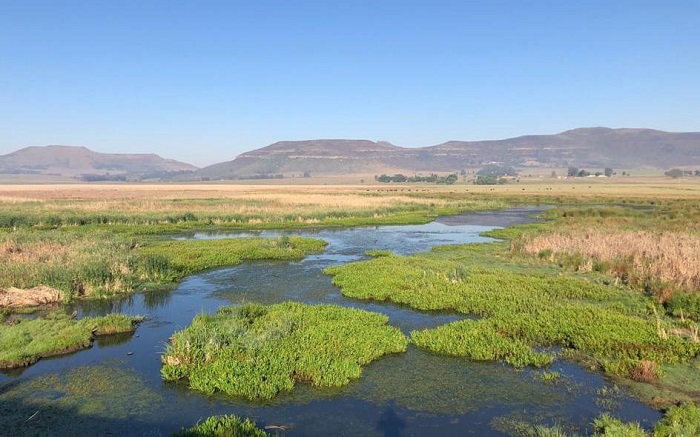
Southern Red Bishops breed in reedbeds in marshes and around rivers and dams, even small isolated patches of reeds or bulrushes. Away from breeding areas they are primarily a grassland species. However, the Southern Red Bishop inhabits a range of other vegetation types too, from savanna to the Karoo, fynbos and forest edge, provided there is enough grassy habitat in which to forage and access to reedbeds for breeding.
Breeding habitat Wakkerstroom, Mpumalanga Photo by Rowan Poortier
The Southern Red Bishop is closely associated with agriculture in many areas, especially where crops are well irrigated. It is often abundant in these areas.
Occasionally forages along the coast in the intertidal zone where they feed on kelp flies and small crustaceans among the washed up seaweed and other debris.
Behaviour
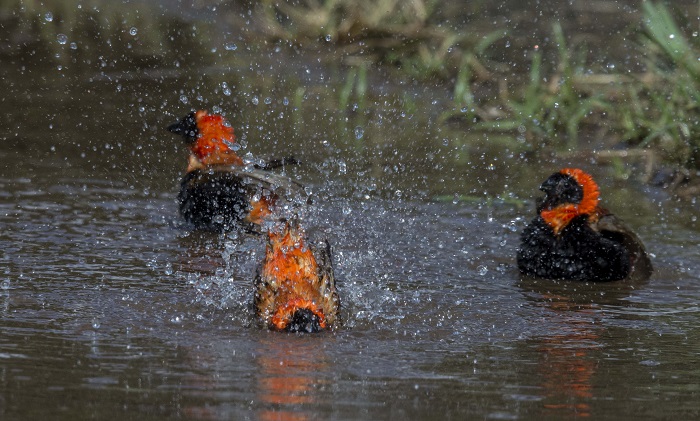
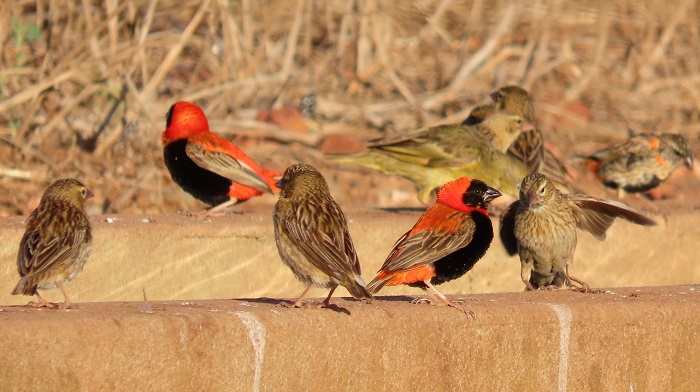
The Southern Red Bishop is gregarious throughout the year, forming large flocks in the non-breeding season, often with other seed-eating species like sparrows, canaries, weavers, queleas and other Euplectes species. Regularly bathes and drinks water, especially in arid areas. Southern Red Bishops typically roosts in reedbeds, often with other related species.
Feeds in flocks, both on the ground and perched in vegetation. They mainly consume grass and crop seeds, and other plant material. Invertebrates make up a relatively small part of the diet. Invertebrate food includes beetles and their larvae, caterpillars, dragonflies termites and spiders. Termite alates are caught on the ground or hawked aerially. They are also known to take small amounts of nectar.
Southern Red Bishops are colonial nesters, usually in reeds (Phragmites spp) and Bulrushes (Typha capensis). They are highly territorial, establishing small territories averaging 8 square meters in size. Males defend their territories against conspecifics and against the males of other Bishop, Widow and Weaver species. Males spend much time giving threat displays along their territory boundaries, by fanning their tails, stretching their necks and raising the red feathers surrounding the black face mask. Males may occasionally fight, sometimes falling together into the water below their nests. Once their territory boundaries become established the aggressive behaviour decreases.
When a female enters a territory, the courting male approaches in Bumble-flight with all body feathers raised, but especially the crown, rump and belly. He then perches and continues to display with his feathers raised. Copulation occurs after the female approves the nest he has built.
Southern Red Bishops are polygynous (males mate with multiple females during the breeding season), and successful males often attract 3 to 8 females.
Nests are constructed entirely by the males and they can produce up to 13 nests per season. It usually takes the males 2 to 3 days to build a nest but they can sometimes complete one within 24 hours. The nest is a tightly woven, upright oval, made from strips of reed leaves or grass blades. The nest is made with a side-top entrance under a porch. Nest entrances are often orientated away from the direction of the prevailing rain. The female adds the nest lining, composed of plant down and grass seed-heads.
In the winter rainfall region of South Africa, the breeding season is largely from August to December. Breeding starts later in the summer rainfall regions, mainly from October to March. Breeding is later still in Namibia and Zimbabwe and runs from December to April.
1 to 5 eggs are laid per clutch, usually laid on successive days. The eggs are usually plain, pale bluish green to turquoise in colour. Incubation generally starts before clutch completion and lasts for around 12 days. Incubation is performed solely by the female. The newly hatched young are fed by the female only, on regurgitated insects and seeds. The nestlings are ready to leave the nest about 15 days later. Southern Red Bishops are sometimes double brooded particularly if the first clutch fails. Predation is the main cause of breeding failure in the Southern Red Bishop. Known nest predators for this species include Rats, Monitor lizards, snakes, various Mongoose species and other birds such as the Burchell’s Coucal (Centropus burchelli).
Southern Red Bishop broods are regularly parasitised by the Diderick Cuckoo (Chrysococcyx caprius). However, male bishops regularly attack Cuckoos near breeding colonies. Their defensive efforts are quite successful as high rates of parasitism are found only at small colonies.
Further Resources
Species text adapted from the first Southern African Bird Atlas Project (SABAP1), 1997.
The use of photographs by Dave Rimmer, Derek Kennedy, Johan and Estelle van Rooyen, Jorrie Jordaan, Lia Steen, Malcolm Robinson, Pieter Cronje, Rowan Poortier and Tony Archer is acknowledged.
Virtual Museum (BirdPix > Search VM > By Scientific or Common Name).
Other common names: Rooivink (Afrikaans); iBomvana (Zulu); Intakomlilo (Xhosa); Thaga (Tswana); Oryxweber (German); Euplecte ignicolore (French); Grenadierwever (Dutch); Cardeal-tecelão-vermelho (Portuguese).
Recommended citation format: Tippett RM 2023. Southern Red Bishop Euplectes orix. Biodiversity and Development Institute. Available online at http://thebdi.org/2023/03/20/orange-river-white-eye-zosterops-pallidus/
List of bird species in this format is available here.
Cover image of Wattled Starling by Ryan Tippett – Carnarvon District
Starlings belong to the family STURNIDAE. All members of the family, which also includes Mynas, are collectively known as starlings. They are small to medium-sized passerine birds known for their often iridescent plumage, complex vocalisations, and their distinctive, swarming behaviour, known as murmurations. Most have strong bills of medium length that are arched on the culmen. They have moderately long and strong legs with large, strong feet. Wing and tail shape are variable.
Starlings are native to Europe, Asia, and Africa, as well as northern Australia and the islands of the tropical Pacific. Several European and Asian species have been widely introduced around the world. The family contains 125 species from 36 genera.
Identification
The Wattled Starling is a distinctive and easily recognisable species with a slender, compact body and marked sexual dimorphism.
Breeding males have featherless black and yellow heads with variable black wattles on the crown and throat. The overall body colouration is pale greyish-white with contrasting black flight feathers and a conspicuous white rump.
Non-breeding males have completely feathered, pale grey heads and a small triangular patch of bare yellow skin behind the eye. The lores are black and they have a short, black malar stripe starting at the base of the bill.
Females resemble non-breeding males, but have dark brown wing and tail feathers. Some old females resemble breeding males in terms of plumage coloration, and can even develop bald pigmented areas and small wattles. The bill of both sexes is pale horn-grey.
Juveniles are similar to the females, but recently fledged birds have yellow bills.
Status and Distribution
The Wattled Starling is a locally common and highly nomadic species. It occurs throughout most of southern and east Africa and parts of west Africa, Madagascar and the Arabian peninsular. It has been recorded over most of southern Africa but is sporadic in many areas. Its core range is on the South African central plateau from Limpopo to the Northern and Eastern Cape.
SABAP2 distribution map for Wattled Starling (Creatophora cinerea) – downloaded in October 2023. Details for map interpretation can be found here.
It has been suggested that the Wattled Starling has become more common in the Western Cape, but in general neither its distribution nor abundance has changed. Past records show that the Wattled Starling has always been erratic and unpredictable in its occurrence. The Wattled Starling is considered valuable to agriculture, but is known to sometimes cause damage to vineyards. The species is not threatened and is perhaps the most numerous starling in Africa.
Habitat
Arid grassland and Karoo scrub habitat. Near Vanwyksvlei, Northern Cape Photo by Ryan Tippett
The Wattled Starling is a bird of lightly wooded savannas, dry grasslands, Karoo scrub, drier fynbos and cultivated lands. It prefers fairly arid habitats with short grass and usually avoids well developed closed woodlands.
Arid savanna habitat. Mokala National Park, Northern Cape Photo by Karis Daniel
Behaviour
Wattled Starlings normally appear and disappear erratically, mostly in response to food supplies such as locust swarms and the emergence of termite alates. They are highly gregarious at all times and are almost always found in groups, and sometimes in very large flocks. They fly with rapidly beating wings, often in tight flocks and they sometimes perform murmerations in the late afternoon around breeding colonies.
Wattled Starling (Creatophora cinerea) performing murmerations near a large breeding colony. Carnarvon district, Northern Cape Photo by Ryan Tippett
They form huge roosts in reedbeds or trees, often numbering in the hundreds or thousands. Wattled Starlings often roost in association with other starling species. They bath and sunbathe frequently and anting has been recorded in captivity.
Mostly forages on the ground, walking about quickly, pecking and probing for food. The Wattled Starling is the only African starling that probes into grass matts to catch insect larvae and other burrowing animals. Occasionally forages in the rocky intertidal zone along the coast, and at abattoirs and rubbish heaps. Often associates with game and domestic stock such as cattle, sheep and rhinos to catch disturbed insects, and they have been observed removing ticks from cattle.
Wattled Starlings drink nectar from a variety of indigenous and exotic tree species. Also eats seeds, crushed maize, small fruits, grapes and figs, as well as the arils of the alien Rooikrans Acacia cyclops. They consume a wide variety of insects including locusts, termites, flies and beetles. They are erratically associated with locust swarms in some areas but large flocks and breeding colonies form around locust swarms in the Karoo.
Wattled Starlings are monogamous and highly colonial nesters. Breeding is closely synchronised within the colony. The onset of breeding is in response to abundant food, and may be suddenly abandoned at egg or chick stage if food supplies dwindle. Some breeding sites are used infrequently, while others may be used in most years.
The nest is built by both sexes and is a robust, domed mass of sticks, with a small entrance on the side or near the top. Nests can often be clustered together in a single, interlocking mass, with up to 5 separate chambers. Several nests or nest clusters may be placed in one tree. The nest floor is lined with grass and feathers. Nests are typically placed in trees, 2 to 8 m above the ground, and frequently in trees that carry thorns.
Eggs are laid from September to October in the winter rainfall region, and from January to March in the summer rainfall areas. Opportunistic breeding at other times is considered exceptional. 2 to 5, mostly plain, pale blue eggs are laid per clutch. The incubation period lasts about 11 days and incubation is shared by both sexes. Eggs hatch synchronously within the colony, however, newly hatched young are undescribed. The nestlings are able to fly after only 19 to 22 days. They are fed by both parents and are given mostly insect prey, particularly locust nymphs, crickets, earth worms, various caterpillars and also some berries.
Species text adapted from the first Southern African Bird Atlas Project (SABAP1), 1997.
The use of photographs by Ansie Dee Reis, Anthony Paton, Dave Rimmer, Derek Solomon, Karis Daniel, Maans Booysen, Tino Herselman and Tony Archer is acknowledged.
Virtual Museum (BirdPix > Search VM > By Scientific or Common Name).
Other common names: Lelspreeu (Afrikaans); iMpofazana (Zulu); Unowambu, Uwambu (Xhosa); Étourneau caronculé (French); Lappenstar (German); Lelspreeuw (Dutch); Estorninho-carunculado (Portuguese)
Recommended citation format: Tippett RM 2023. Wattled Starling Creatophora cinerea. Biodiversity and Development Institute. Available online at https://thebdi.org/2023/11/24/wattled-starling-creatophora-cinerea/
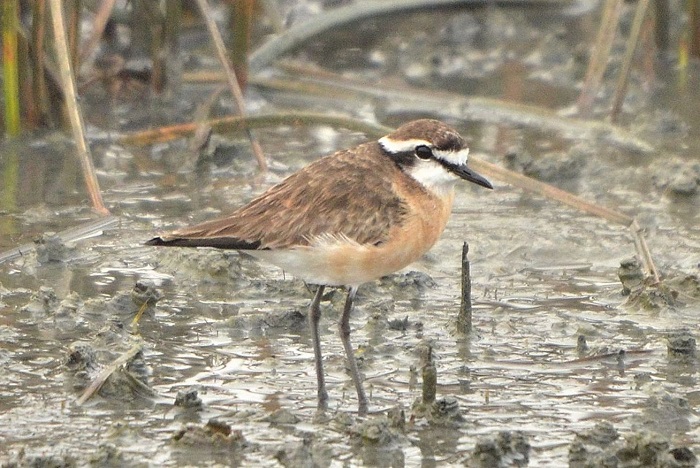
Cover image: Kittlitz’s Plover by Malcolm Robinson – Albert Falls Nature Reserve, KwaZulu-Natal – BirdPix No. 261565
Identification
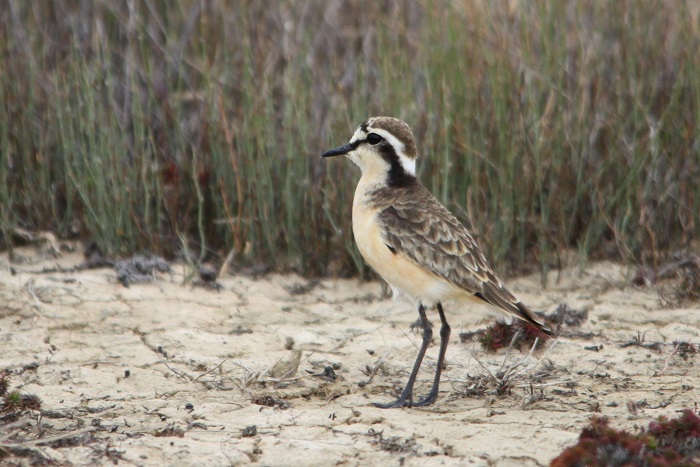
Kittlitz’s Plover is one of the smaller plover species with separate breeding and non-breeding plumage. The sexes are similar and differ only slightly in breeding plumage with females having a narrower black bar across the forehead and a marginally paler breast.
Breeding birds have distinctively patterned heads. They have a white forehead with black lores and a black frontal bar across the forehead. This frontal bar is separated from the dusky-brown crown by a narrow white line. There is a further black band that runs from each eye, down the sides of the neck and around to join on the hind neck. The supercilium is white and broad, extending from above the eye and reaching around the head to form a white collar. The rest of the upper parts are sooty-brown with pale, sandy feather margins. The chin and upper throat are white and the breast and upper belly range in colour from pale buff, to yellowish-brown, to pale chestnut, fading to white on the lower belly and flanks.
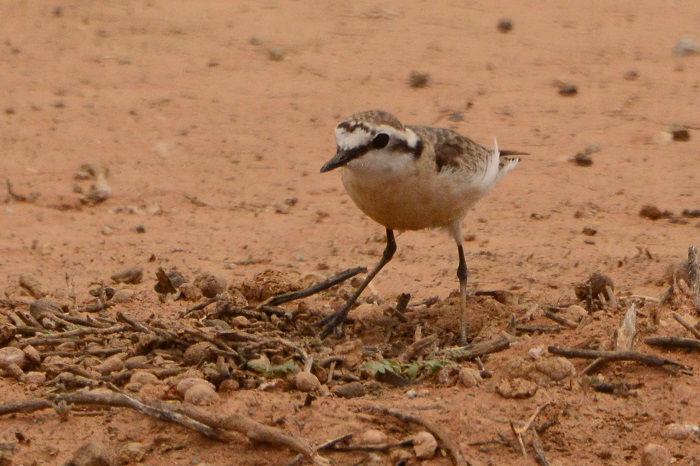
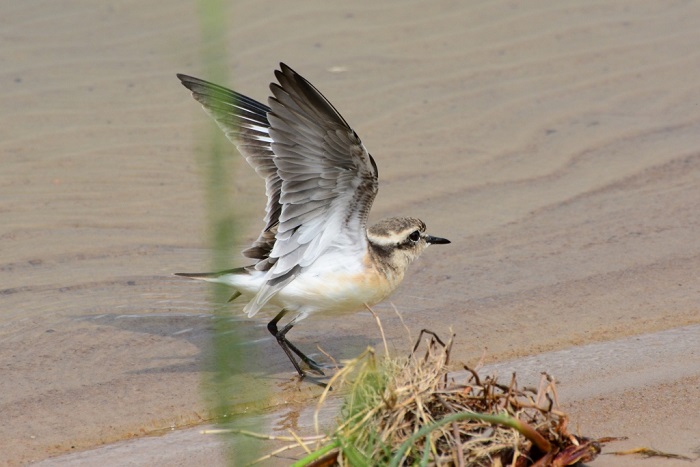
Non-breeding birds lack the black head markings which are instead replaced with sooty-brown, and they have a buffy-yellow supercilium and collar. The underparts are also paler and less extensively buff.
Regardless of season the bill and legs are black (legs can have a greenish hue) and the eyes are dark brown.
Juveniles resemble the non-breeding adults but are paler and have less defined head markings.
Kittlitz’s Plover could be mistaken for other small plover species, especially in non-breeding plumage but the combination of greenish-black legs and pale nuchal collar distinguish it from all but the White-fronted Plover (Charadrius marginatus). The White-fronted Plover lacks the distinctive black-and-white head markings, and has dark shoulder patches. Non-breeding and juvenile White-fronted Plovers have white, not buffy, nuchal collars.
The Kittlitz’s Plover is a locallycommon resident, local nomad and intra-African migrant. Its movements, however, are poorly understood.
It occurs from the delta of the Nile River southwards, throughout sub-Saharan Africa and Madagascar. It is only absent from the equatorial rain forests. It is widespread in southern Africa but is scarce in the arid regions of Botswana, Namibia and the north-western parts of the Northern Cape province. In these areas it is restricted to ephemeral or seasonal pans.
SABAP2 distribution map for Kittlitz’s Plover (Charadrius pecuarius) – November 2023. Details for map interpretation can be found here.
Away from the coast, Kittlitz’s Plover was historically restricted to natural pans and floodplains, but the construction of dams has enabled it to expand its range and increase its numbers substantially. It is not considered threatened.
Habitat
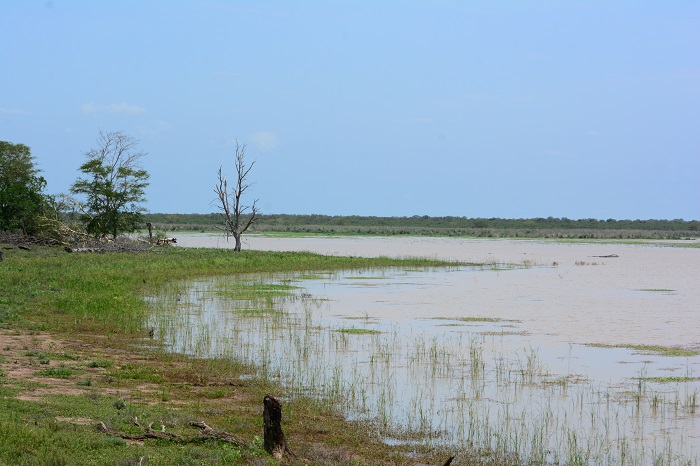
Kittlitz’s Plover favours open habitats with wet or dry mud or sand, and short vegetation, usually close to water.
Habitat – West Coast National Park, Western Cape Photo by Ryan Tippett
Along the coast it occurs at estuaries, salt-marshes and seaweed-strewn beaches. Inland it inhabits natural pans and river flood plains and has adapted well to artificial water bodies, including farm dams, sewage works and commercial saltpans. It occurs less often on airfields, golf courses, overgrazed pastures and ploughed fields. For breeding, Kittlitz’s Plover prefers waterbodies with wide, gently sloping, and exposed shorelines. It avoids mountainous regions, forest and other well wooded habitats.
Along the coast, birds move onto estuarine mudflats during winter, possibly because of reduced competition from Palaearctic migrants, but possibly also to avoid harsh interior winters and associated food shortages.
Habitat – Mkhuze Game Reserve, KwaZulu-Natal Photo by Ryan Tippett
Behaviour
During the non-breeding season Kittlitz’s Plover is usually found in groups of 2 to 5 birds but flocks can occasionally number into the hundreds. Roosts communally at night on wide, bare and open shorelines. They often roost in a hoof print or other similar hollow. They sometimes roost in mixed flocks with White-fronted, Common Ringed and Three-banded Plovers.
Kittlitz’s Plover locates food visually, foraging in the typical plover ‘run-stop-start’ manner. It feeds both day and night, and often forages in mixed-species flocks with other small waders. It is aggressive towards conspecifics and other species with similar diets such as the Curlew Sandpiper and Common Ringed Plover, but is also chased by other larger wader species like the Grey Plover, Blacksmith Lapwing and White-fronted Plover.
The diet of Kittlitz’s Plover consists of small terrestrial and marine invertebrates. These include small beetles, crickets, insect larvae, spiders, bristle worms, molluscs, crabs and other crustaceans, and occasionally seeds.
Breeding occurs at various times across southern Africa. In the winter rainfall region breeding takes place after the rains from August through to March with an October to January peak. In the rest of southern Africa they breed opportunistically throughout the year with a distinct peak from July to October prior to the start of the summer rains.
Kittlitz’s Plovers are monogamous and territorial. Initial courtship and pair formation takes place 3 to 4 weeks before the pair establishes a breeding territory. They nest solitarily or in loose groups. Males are responsible for maintaining territories which they only defend during the day.
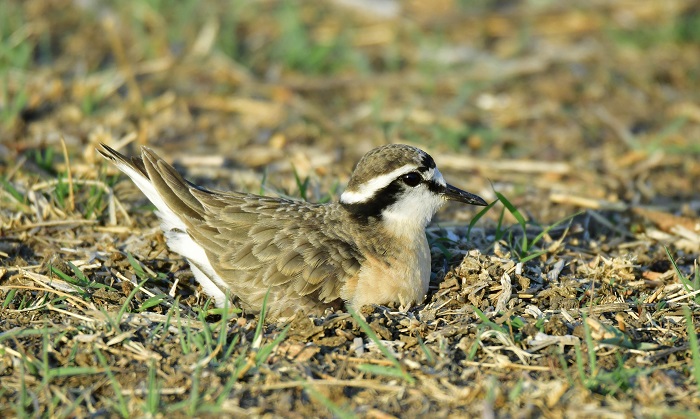
The nest is a simple scrape in bare, dry ground, or sometimes on a raised mound. The nest scrape is left bare or variably lined with sand, pebbles, mud, shell pieces, animal dung or fragments of vegetation. 1 to 3 eggs are laid per clutch. and eggs are laid at 1 or 2 day intervals. The eggs are buff coloured with variable dark brown or black mottling. Incubation begins upon clutch completion and lasts from 22 to 28 days. Incubation duties are shared by both sexes, the females by day, and males at night.
If the incubating bird leaves the nest during the day they will partially cover the exposed eggs and hatchlings by kicking sand or other loose material over the nest, and uncovers them upon returning. During hot weather the incubating bird may crouch over the eggs and hatchlings to shade them, sometimes first soaking the belly feathers in water to further cool the eggs.
In defence of their young the adults will perform distraction displays such as ‘false brooding’ and ‘injury feigning’, to draw the predators attention away from the young or eggs.
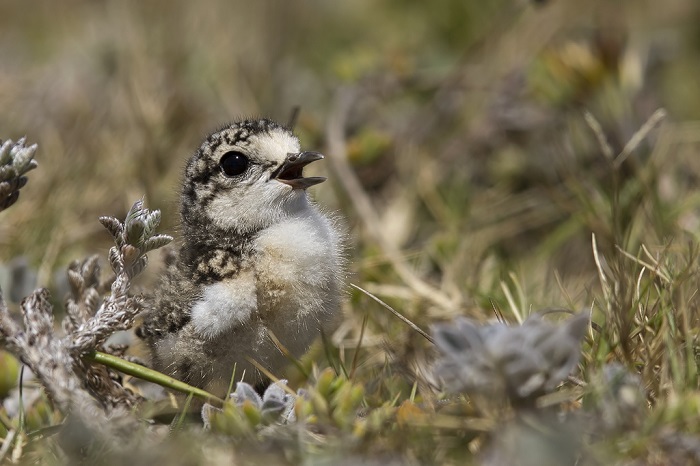
Newly hatched young are precocial and are covered in down. They are partly brooded for the first 24 hours and do not feed, they then leave the nest and forage for themselves under parental supervision. The young are fully grown at around 60 days or so.
Species text from the first Southern African Bird Atlas Project (SABAP1), 1997.
The use of photographs by Colin Summersgill, Desire Darling, Gerald Wingate, Johan Heyns, John Todd, Keir Lynch, Kevin Nel, Malcolm Robinson, Tino Herselman and Tony Archer is acknowledged.
Virtual Museum (BirdPix > Search VM > By Scientific or Common Name).
Other common names: Geelborsstrandkiewiet (Afrikaans); Herdersplevier (Dutch); Pluvier pâtre (French); Hirtenregenpfeifer (German); Borrelho-do-gado (Portuguese)
A list of bird species in this format is available here.
Recommended citation format: Tippett RM 2023. Kittlitz’s Plover Charadrius pecuarius. Biodiversity and Development Institute. Available online at https://thebdi.org/2023/11/20/kittlitzs-plover-charadrius-pecuarius/
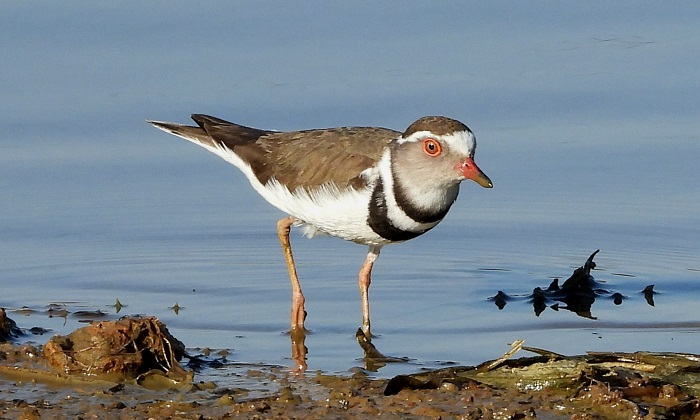
The undersides are white, broken only by the aforementioned double black breast bands on the upper breast and lower throat. The chin and throat is greyish-white and the remainder of the face and neck is greyish-brown. The upperparts and crown are dark greyish-brown. There is a white head-band stretching from the forehead and supercilium to meet on the lower hind neck. In flight the Three-banded Plover is seen to have white underwings and a wedge-shaped tail.
The bill is coral-red with a black tip. The eyes are yellow-brown with a red eye ring and the legs and feet are reddish-pink. The sexes are alike.
Juveniles resemble adults but are duller and the feathers on the upper parts and breast bands are edged in pale brown and they have less distinct facial markings. They also have duller, more orange coloured legs and eye-rings.
The Three-banded Plover is a common to very common resident and local migrant.
It is widespread across sub-Saharan Africa, ranging almost continuously from Ethiopia across to Gabon and down to South Africa and is also widespread on Madagascar. It is found throughout southern Africa except the very driest parts of Botswana, Namibia and the Northern Cape. It is scarce in high mountainous and heavily wooded or forested regions, but is liable to turn up almost anywhere there is suitable habitat.
SABAP2 distribution map for Three-banded Plover (Charadrius tricollaris) – November 2023. Details for map interpretation can be found here.
The Three-banded Plover has expanded its distribution greatly since the advent of dam building throughout Southern Africa. Previously its range would have been notably more fragmented. The Three-banded Plover has a healthy conservation status and is not threatened.
Habitat
Habitat – Ndumo Game Reserve, KwaZulu-Natal Photo by Ryan Tippett
The Three-banded Plover occurs in the widest range of aquatic habitats of any wader in Southern Africa. It makes extensive use of artificial waterbodies, especially farm dams and even visits puddles formed by leaking pipes in arid areas. Its choice of wetland habitat is almost independent of vegetation type.
It is frequent along the open mud or sand shores of any freshwater habitat, favouring pools, streams and seeps, as well as sandbanks along larger rivers, farm dams and sewage works. It is sometimes found along the coast where it visits rock and tidal pools, estuaries and lagoons, but is rare along open coastlines.
Habitat – Mkhuze Game Reserve, KwaZulu-Natal Photo by Ryan Tippett
Behaviour
The Three-banded Plover is typically encountered singly, in pairs, or in groups of up to 10 or so birds. It is less gregarious than other small plovers but occurs in loose flocks of varying sizes when not breeding. It is found in pairs during the breeding season.
Three-banded Plovers are partial intra-African migrants in response to seasonal rainfall but its movements are poorly understood. It is largely sedentary in areas of higher rainfall.
The Three-banded Plover bobs its head and body up and down when disturbed. It is alert but is often fairly confiding. The flight is rocking and erratic and it raises and lowers its tail repeatedly upon landing.
They are active both day and night, foraging with the typical plover ‘stop-start’ running action. Prey is located visually and pecked from the substrate. The Three-banded Plover consumes a variety of terrestrial and aquatic invertebrates, including insects, crustaceans, small molluscs and worms.
Breeding occurs in southern Africa throughout the year. At the onset of the breeding season males perform courtship displays with the breast touching the ground and the tail raised and sometimes fanned.
Three-banded Plovers are monogamous, territorial and solitary nesters and territories are maintained throughout the breeding cycle. Breeding territories are established along 80-150 m of shoreline and are defended from rivals by flying or running at conspecifics with a crouched posture, and with flank feathers fluffed out, frequently while emitting a rattling call.
The nest is a simple scrape in the substrate and is usually situated close to water. Nests are lined with bits of vegetation, dried mud or pebbles. 1 to 2 (rarely 3) eggs are laid per clutch and are laid at 1 or 2 day intervals. Incubation likely begins once the final egg has been laid and incubation duties are shared by both sexes. Females incubate the eggs during the day, whilst males spend their days defending the territory. Males then take their turn to incubate at night, when females head off to feed. The incubating bird sits tight, sometimes allowing intruder to within 3 m before running away.
On hot days the incubating female sometimes crouches over the eggs and occasionally soaks her belly feathers with water to cool down the eggs.
Newly hatched young are precocial and covered in down. They are brooded frequently by both parents, usually in response to intruders, rain or low temperatures. The adults Parent crouch up and down to encourage chicks to be brooded. The young are fully fledged at around 31 days, but may remain with their parents for a further 10 days or so.
Three-banded Plovers are often double, or sometimes even triple-brooded, meaning they attempt to breed more than once during the breeding season. Female are sometimes known to lay a second clutch well before the first brood is fully fledged.
Species text from the first Southern African Bird Atlas Project (SABAP1), 1997.
The use of photographs by Andre Kok, Ansie Dee Reis, Attie van Aarde, Graham Bull, Janet du Plooy, Josu Meléndez, Karis Daniel, Neels Putter, Richard Johnstone and Terry Terblanche is acknowledged.
Virtual Museum (BirdPix > Search VM > By Scientific or Common Name).
Other common names: Driebandstrandkiewiet (Afrikaans); Inqatha (Xhosa); N’wantshekutsheku, Xitsekutseku (Tswana); Driebandplevier (Dutch); Pluvier à triple collier (French); Dreiband-Regenpfeifer (German); Borrelho-de-três-golas (Portuguese)
A list of bird species in this format is available here.
Recommended citation format: Tippett RM 2023. Three-banded Plover Charadrius tricollaris. Biodiversity and Development Institute. Available Online at https://thebdi.org/2023/11/14/three-banded-plover-charadrius-tricollaris/
Cover image by Colin Summersgill – Bisley Valley Nature Reserve, KwaZulu-Natal – BirdPix No. 248466
Identification
Guineafowl are quintessentially African birds, easy to identify and familiar to many.
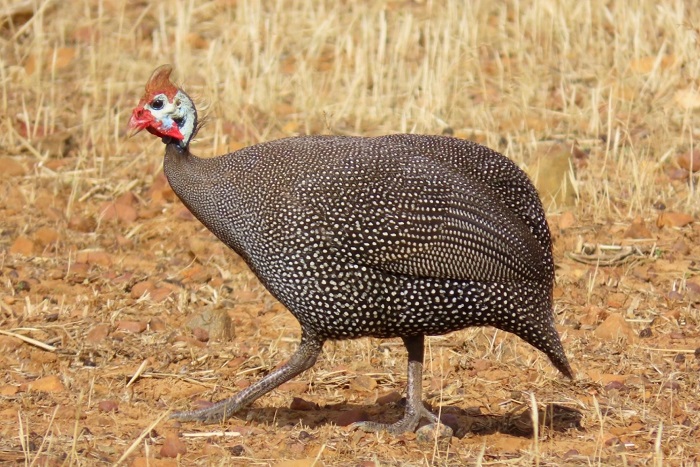
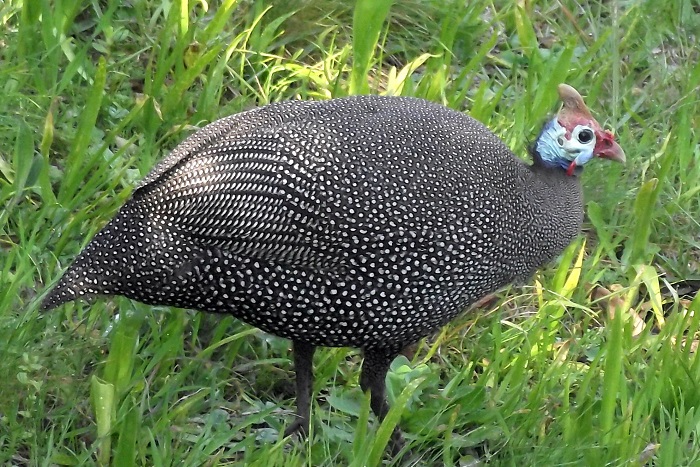
The Helmeted Guineafowl is a distinctive and easily recognisable species. It has an unusual body-shape which is laterally compressed with a disproportionately small head. Adults have a large, horn-like, bony casque or ‘helmet’ on the head, and long, pendulous blue wattles with red tips on the sides of the face.
The base of the casque is surrounded by bare red skin extending to the cere and hind crown. The rest of the head and upper neck is powder-blue and un-feathered. The entire plumage on the body is black, with dense white spotting. The bill is horn-grey, the eyes are brown and the legs and feet are dark brown to blackish.
The sexes are alike in plumage colouration, but differ in that males have a larger casque. Juveniles have browner bodies with a reduced casque and the upper neck and throat are feathered.
The Helmeted Guineafowl is locally common to abundant throughout its range. It is probably Africa’s most widespread and well-known gamebird, occurring virtually throughout sub-Saharan Africa. It is found across most of southern Africa and the only extensive areas where it is absent are in some of the arid and semi-arid regions of southern Namibia, south-western Botswana and parts of the Northern Cape province. In these areas it is probably limited by the availability of drinking water and safe elevated roosts.
SABAP2 distribution map for Helmeted Guineafowl (Numida meleagris) – October 2023. Details for map interpretation can be found here.
The Helmeted Guineafowl is particularly common in savannas interspersed with agricultural fields. Habitat modification due to cultivation, has dramatically increased its range. The Helmeted Guineafowl has become commensal with humans and now inhabits most agricultural regions as well as suburban parks and gardens.
The range of the Helmeted Guineafowl increased dramatically during the 20th century. The reasons are likely a combination of natural expansions, translocations, increased artificial water points in dry regions, and the availability of telephone poles in treeless areas for roosting on. Prior to this the Helmeted Guineafowl was not found south of the Orange River or west of Graaf-Reinet.
The species has, however, undergone dramatic local extinctions in Lesotho and parts of the eastern Cape due to heavy hunting pressure from humans and domestic predators, as well as from severe habitat degradation. An additional treat to the Helmeted Guineafowl is the introduction of domesticated guineafowl from West Africa, which could lead to wild populations becoming less viable in the future.
Habitat
The Helmeted Guineafowl’s natural habitat includes grassland and savannas, particularly along rivers and around wetlands, but occupies most open-country terrain, from semi-desert to the base of high mountains, forest edges, thicket and fynbos.
Adults occur in pairs or small groups during the breeding season and in small to large flocks during the remainder of the year. The Helmeted Guineafowl is mostly resident but the formation of large non-breeding flocks throughout its range implies some degree of seasonal movement.
They are reluctant to fly and only take flight if alarmed or to reach the roost. Helmeted Guineafowl roost in trees, and on telephone poles in arid, treeless areas. Some roost sites are used continuously for many years. Flocks descend from the roost at first light, before heading to drinking water. During the hottest part of the day, flocks move into thick vegetation or dense grass where they remain until it cools down in the late afternoon. Flocks drink mostly in the early morning and late afternoon. They return to the roost site just before sunset.
Forages by scratching or digging at the soil surface or leaf litter with its feet, in much the same way a chicken would. Helmeted Guineafowl are omnivorous, feeding on a wide range of insects (including pest species) and other invertebrates, as well as seeds, grain, bulbs, weeds, tubers and berries. They are largely vegetarian during the non-breeding season but as the breeding season approaches their diet shifts to invertebrates, especially grasshoppers, termites and other insects. Helmeted Guineafowl also consume large numbers of ticks and are very effective in helping to control tick numbers.
Before the onset of the breeding season flock sizes begin to decreases steadily as pairs split away from the flock. The urge to pair-up is stimulated by the first heavy rains.
Helmeted Guineafowl are monogamous once a mate has been chosen. Evidence shows that pairs can remain together for as long as 4 years. Males are alert and will defend their mate aggressively. Males lose around 15% of their body weight through the early stages of the breeding season as they spend far less time feeding themselves, rather engaging in courtship-feeding where they catch and drop food in front of the female, while giving a Humpback display and courting call. Females on the other hand increase in weight as they spend most of their time feeding and preening.
The female selects a suitable nest site site, most often in tall grass or under a bush, typically in thick bush near the edge of open areas. The nest is well hidden and is a simple scrape in the ground, thinly lined with feathers and grass stems. The female adds additional material during incubation.
The laying dates of the Helmeted Guineafowl vary from region to region. Eggs are laid from January to March in Namibia, Botswana and Zimbabwe, and from October to March in Eastern South Africa. In the winter-rainfall regions of the Western and Eastern Cape, most egg-laying takes place from September to December to take advantage of food abundance following the winter rains.
6 to 12 eggs are laid per clutch. The eggs are pale brown to white with speckles and are among the thickest-shelled of all eggs relative to size. This is thought to provide some protection from veld fires and predation by small carnivores. Incubation starts only once the full clutch has been laid and the incubation period lasts up to 27 days. All incubation is performed by the female. She leaves the nest to forage only for short periods during day. Males abandon the females during incubation and begin to associate and mate with unpaired females. Males usually return to the female and young soon after hatching. The males then become very involved in parental care, guiding chicks to food during the day and brooding them at night. The females spend this time regaining their condition. Although most eggs hatch, chicks may die of starvation, exposure or predation if the male does not return to help the female with brooding.
Freshly hatched chicks are covered in down, their faces are striped pale brown and buff and there is a single dark brown stripe on the crown. The back is mottled brown and grey, with a central brown stripe, bordered by two black-edged, buffy stripes. The throat is whitish, and the belly is buff coloured. Their legs and bill are reddish brown. Helmeted Guineafowl chicks are precocial, and able to self-feed within 24 hours. The young are able to fly well enough to join their parents at the roost from around 3 weeks old.
Both parents are very aggressive towards potential predators of their young, and will drive off animals as large as jackals, baboons and even humans. Before attacking, the wings are arched and spread while the bird emits a growling call.
Further Resources
This species text is adapted from the first Southern African Bird Atlas Project (SABAP1), 1997.
The use of photographs by Cobus Elstadt, Colin Summersgill, Dane Paijmans, Desire Darling, Dewald du Plessis, Dieter Oschadleus, Fanie Rautenbach, Len de Beer, Lia Steen, Malcolm Robinson, Neels Putter and Sybrand Venter is acknowledged.
Virtual Museum (BirdPix > Search VM > By Scientific or Common Name).
Other common names: Gewone tarentaal (Afrikaans); iMpangele (Zulu) Impangele (Xhosa); Helmparelhoen (Dutch); Pintade de Numidie (French); Helmperlhuhn (German); Pintada da Guiné (Portuguese).
List of bird species in this format is available here.
Recommended citation format: Tippett RM 2023. Helmeted Guineafowl Numida meleagris. Biodiversity and Development Institute. Available online at https://thebdi.org/2023/11/08/helmeted-guineafowl-numida-meleagris/
Bird ringing remains one of the most important research methods for discovering some of the most important basic information about each species. Conservation initiatives need a lot of information. Two key factors to understand are rates of survival and extent of movement. There is a discussion about the value of ringing here.
Eastern Clapper Lark
There are three ringing courses planned for 2024. They are:
31 January to 6 February at BoTuin, Vanrhynsdorp, Western Cape
1 to 7 May at Ouberg Private Nature Reserve, Montagu, Western Cape
20 to 26 September at New Holme Lodge, near Hanover, Northern Cape.
More details are here. There is a broad description of the course activities here.
New Biodiversity Observations Papers in October 2023
Biodiversity Observations is an Open Access ejournal which focuses on the publication of descriptive papers which report observations relating to biodiversity. There is a summary of the activities of the journal for the period 2010-2022 here.
The graph below shows that Biodiversity Observations had its best month ever for number of papers downloaded; 3173 downloads of papers were made.
The latest paper in BO comes all the way from Iceland! And takes a look at the fauna and flora Vigur Island. This study presents the initial findings of a pilot intertidal inventory conducted on Vigur Island. The primary focus was to identify the flora species present in the intertidal zone, without delving into their distribution or coverage. Using transect and scanning methods, this inventory provides insights into the biodiversity of this coastal region. This preliminary assessment lays the groundwork for future comprehensive studies on the island’s intertidal biodiversity. You can read the full paper here.
The observer scans around the last quadrat of a transect in the intertidal zone of Vigur Island, Iceland
BDI-style Bird Species Texts
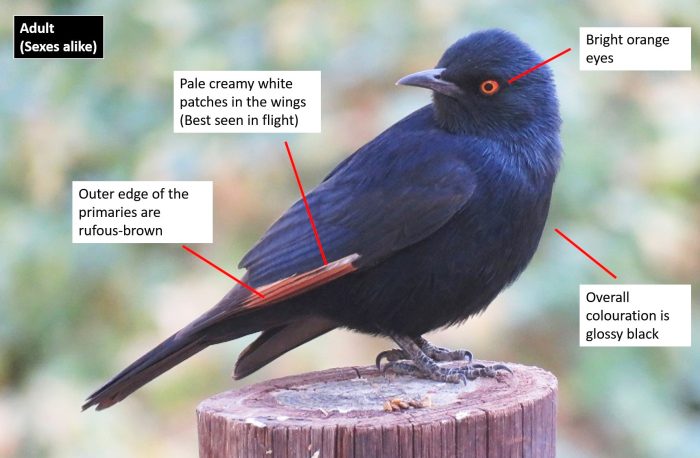
We are aiming to make it easier for beginner birders! Key to this is the production of “BDI-style” species texts on the BDI website. Each of the texts starts with an annotated photograph like this one for the Pale-winged Starling:
The BDI-style texts do not only focus on identification but provides all sorts of interesting information; to see the full text for this species, click here.
We added texts for four species during October 2023:
This brings the number of bird species with BDI-style species texts to 84. You can easily find all the texts for species which have been done so far here: Bird Species
The Virtual Museum
The Virtual Museum (VM) provides the platform for citizen scientists to contribute to biodiversity research and mapping projects. This innovative concept was originally developed by the Animal Demography Unit at the University of Cape Town (UCT) in 2005. It is now managed by the Biodiversity and Development Institute (an independent non-profit company) and the FitzPatrick Institute of African Ornithology (UCT).
Cover image: Namaqua Dove by Neels Jackson – Mapungubwe National Park, Limpopo – BirdPix No. 170565
Identification
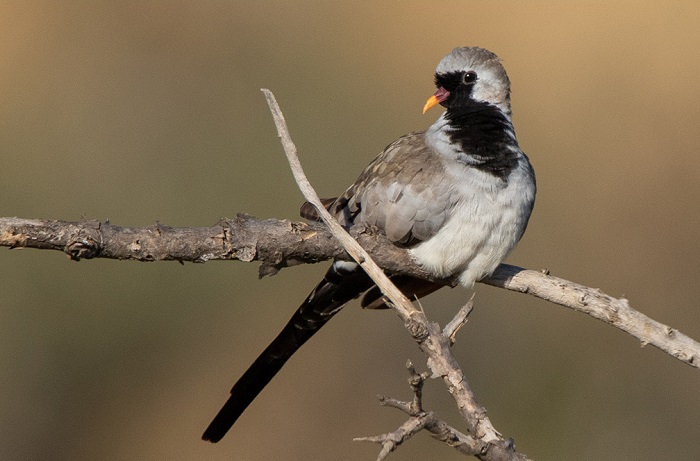
The Namaqua Dove is a distinctive, small and slender dove. It is in fact the smallest dove in Africa and the only one with a long tail. The Namaqua Dove is sexually dimorphic and the sexes have strikingly different plumage colouration.
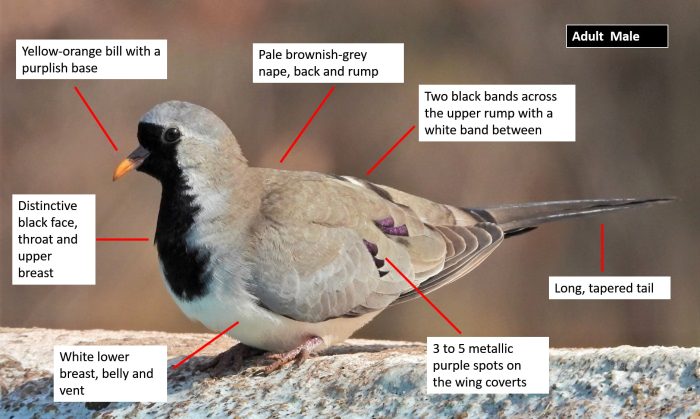
Males have a conspicuous and distinctive black face, throat and upper breast, the remainder of the head and neck is grey. The upperparts from the hind neck to the rump is pale brownish-grey. There are two black bands across the upper rump with a white band between. The tail is long and tapered with white outer tail feathers. The wing coverts pale grey to brownish-grey, with 3-5 metallic purple spots , that often appear black from a distance or in poor light. The lower breast, belly and vent are white, and the under tail coverts are black. The bill is yellow-orange with a purplish base. The eyes are dark brown and the feet are purple-brown. In flight both sexes show rufous wings.
Females are similar to the males, but have a blackish bill and lack the black face, throat and upper breast. Juveniles are heavily spotted with buff coloured feathers and dark brown barring.
The Namaqua Dove is not easily mistaken for another species.
Namaqua Dove (Oena capensis) juvenile Kgalagadi Transfrontier Park, Northern Cape Photo by Richard JohnstoneNamaqua Dove (Oena capensis) showing the rufous flight feathers. Mkhuze Game Reserve, KwaZulu-Natal Photo by Dave Rimmer
Distribution and Status
The Namaqua Dove is widespread in the Afrotropical region, and is also found in south-western Arabia, and on Socotra and Madagascar. While clearly favouring the dry interior, the Namaqua Dove is found virtually throughout southern Africa. It is fairly common to common in the drier regions and sedentary in the more mesic parts of its range. They are highly nomadic in arid zones, where they can be locally abundant at times.
SABAP2 distribution map for Namaqua Dove (Oena capensis) – October 2023. Details for map interpretation can be found here.
The provision of watering points in drier regions has probably been beneficial to the species. It seems to have declined in Lesotho and possibly in the Eastern Cape and other east coast areas, probably because of high human population densities.
Habitat – Mokala National Park, Northern Cape Photo by Karis Daniel
The Namaqua Dove has a clear preference for dry to semi-arid open woodlands and savanna. It is also common in Karoo shrublands and dry grasslands where patches of scrub or trees provide nest sites. They are commonly found around farmsteads in arid and semi-arid regions. Of the dove species in southern Africa, the Namaqua Dove is the one least associated with human habitation.
The Namaqua Dove is usually encountered solitarily or in pairs, but larger groups come together when drinking. Perches in the open, on leafless or dead branches. The flight is fast and direct, and fairly low to the ground. Upon landing, raises the tail then lowers it slowly.
Forages on open ground, often along the edges of roads and other open spaces. Walks about with short steps pecking items from surface. Eats almost exclusively tiny seeds, especially of grasses, sedges and annual shrubs. Drinks water mostly during the heat of the day.
The Namaqua dove is a monogamous, solitary nester. Breeding has been recorded throughout the year with a spring peak in the summer rainfall regions and a spring peak in the winter rainfall zone. Breeding is more opportunistic in arid areas with erratic rainfall. The nest is built by both sexes and is a flimsy saucer made of twigs, and fine pliable plant fibres, and is usually placed low down in shrub or thorn tree, typically around 1m above the ground. 1 to 2 unmarked yellowish-brown eggs are laid per clutch. Oval. Incubation usually starts once the first egg has been laid and incubation is performed by both sexes.
This species text is adapted from the first Southern African Bird Atlas Project (SABAP1), 1997.
The use of photographs by Andrew Hodgson, Ansie Dee Reis, Dave Rimmer, David McCarthy, Johan and Estelle van Rooyen, Karis Daniel, Mark Stanton, Neels Jackson, Philip Nieuwoudt, Richard Johnstone and Sybrand Venter is acknowledged.
Virtual Museum (BirdPix > Search VM > By Scientific or Common Name).
Other common names: Namakwaduifie (Afrikaans); isiKhombazane-senkangala (Zulu); Maskerduif (Dutch); Tourterelle masquée, Tourtelette masquée (French); Kaptäubchen (German); Rola-rabilonga (Portuguese)
Recommended citation format: Tippett RM 2023. Namaqua Dove Oena capensis. Biodiversity and Development Institute. Available Online at https://thebdi.org/2023/10/31/namaqua-dove-oena-capensis/
List of bird species in this format is available here.