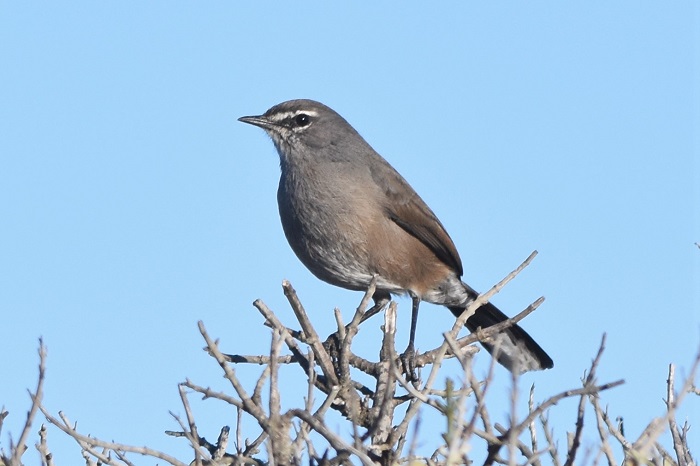
Grey-backed Cisticola (Cisticola subruficapilla)

Cover image: Grey-backed Cisticola by Gregg Darling – St. Francis Bay Air Field, Eastern Cape

Cisticolas belong to the Family CISTICOLIDAE. This is a group of small passerine birds found mainly in warmer southern regions of the Old World and contains around 168 species divided into 26 genera. This family is thought to have originated in Africa, which is home to the majority of species, but members of the family can also be found in Europe, tropical Asia, and Australasia. They were formerly included within the Old World warbler family Sylviidae.

Identification

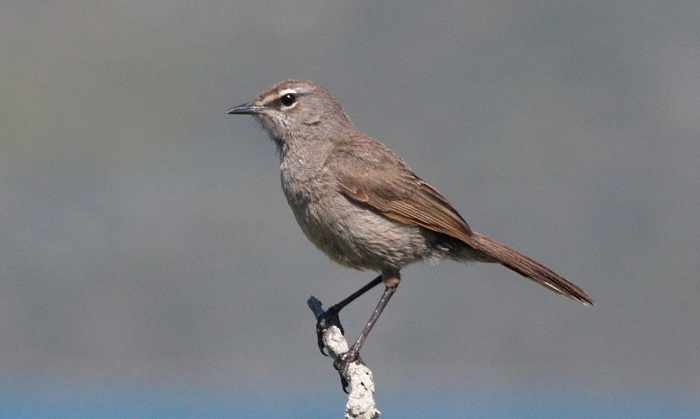
The head of the Grey-backed Cisticola has an indistinct eyebrow and a dark rufous crown, merging to grey on the mantle. The back is grey to brownish grey with dark blackish streaks. The underparts are a paler, plain brownish grey. Southern populations have grey underparts with fine blackish streaking on the breast, belly and flanks. The tail is longish and dusky-brown with buff tips and a black subterminal band.

Identification guide to Grey-backed Cisticola
Grey-backed Cisticola (Cisticola subruficapilla) 
Middelburg district, Eastern Cape
Photo by Tino Herselman

There is considerable variation in plumage with six subspecies in the region. Southern subspecies have grey upperparts streaked blackish, and finely streaked flanks. The northern subspecies are browner on the upperparts, and without streaking on the grey-buff underparts.

Cisticola subruficapilla
Grey-backed Cisticola (Cisticola subruficapilla)
Birds in the Western Cape are grey below with dark streaking on the undersides.
Riversdale district, Western Cape
Photo by Johan and Estelle van Rooyen

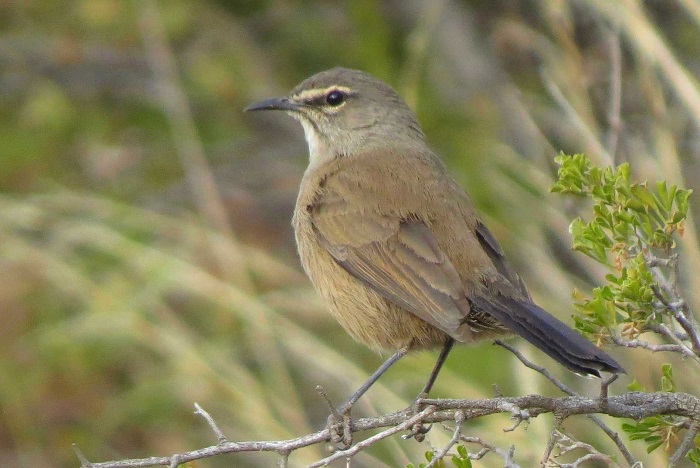
There is little seasonal variation in plumage and the sexes are alike. Immatures and juveniles are similar to the adults but are duller overall and with a yellowish wash to the underparts.

Grey-backed Cisticolla
Grey-backed Cisticola (Cisticola subruficapilla). Juvenile showing the yellow wash.
St. Francis Bay Air Field, Eastern Cape
Photo by Desire Darling

The Grey-backed Cisticola is usually the only ‘long-tailed’ cisticola within its range. It can be difficult to distinguish from the wailing cisticola (Cisticola lais) in the Eastern Cape, where the two species overlap slightly. The two species have similar calls, but are distinguished by different habitat requirements, and in the region of overlap, the Grey-backed Cisticola is grey ventrally whereas the Wailing Cisticola is buff-coloured. The Gey-backed Cisticola could also be confused with the Levaillant’s Cisticola (Cisticola tinniens), but that species has a more richly coloured crown and tail, as well as paler and whiter underparts.

Status and Distribution

Cisticola subruficapilla
Grey-backed Cisticola (Cisticola subruficapilla)
St. Francis Bay Air Field, Eastern Cape
Photo by Gregg Darling

The Grey-backed Cisticola is a locally common to very common resident and is near-endemic to southern Africa. It only extends beyond the sub region into southern Angola. It occurs from Namibia southwards to the Cape Peninsula, and eastwards through the Karoo to the south-western Free State and the Eastern Cape province. The northern population in Namibia appears to be well isolated from the southern populations.

SABAP2 distribution map for Grey-backed Cisticola
SABAP2 distribution map for Grey-backed Cisticola (Cisticola subruficapilla) – March 2024.
Details for map interpretation can be found here.

The historical distribution is not known to have differed from its present range. The Grey-backed Cisticola is able to occupy a variety of scrubby habitats and can therefore tolerate some vegetational changes. It is able to persist in a highly fragmented landscape. The Grey-backed Cisticola is not threatened.

Habitat

Habitat for this species
Habitat near Carnarvon, Northern Cape
Photo by Ryan Tippett

The Grey-backed Cisticola occurs in a wide range of habitats where low scrub is present. These include coastal and montane fynbos, shrubby Karoo plains, grass and scrub covered hillsides, ravines in semi-arid areas, grass covered dunes and saline grassland near estuaries.

It is most numerous in the Succulent and Nama Karoo biomes, followed by the Fynbos biome.

Habitat
Habitat near Montagu, Western Cape
Photo by Karis Daniel

Behaviour

Found singly, in pairs or family groups. The Grey-backed Cisticola is a fairly conspicuous species. The male makes distinctive display flights and calls from an exposed perch during the breeding season. It is frequently detected by its call, which can be heard throughout the year, but sings only in the breeding season.

Cisticola subruficapilla
Grey-backed Cisticola (Cisticola subruficapilla)
St. Francis Bay Air Field, Eastern Cape
Photo by Desire Darling

The Grey-backed Cisticola forages low down in shrubs and among grass tufts, but often perches conspicuously on top of vegetation. This is especially so when alarmed or calling. The Grey-backed Cisticola feeds entirely on small insects like termites, beetles, beetle larvae, caterpillars, small grasshoppers, bugs and likely also spiders.

Grey-backed Cisticola
Grey-backed Cisticola (Cisticola subruficapilla)
Lion’s Head, Western Cape
Photo by Itxaso Quintana

Breeding has been recorded between August and December. During courtship the male displays in bouncing flight over the female, while hovering and flicking his tail. The Grey-backed Cisticola is territorial and is a monogamous, solitary nester. The nest is a ball of dry grass and plant down with a side entrance. It is placed on or near the ground in a grass tuft or low shrub, with growing grass incorporated into the roof and sides. The nest is lined with soft plant down.

Cisticola subruficapilla
Grey-backed Cisticola (Cisticola subruficapilla)
Struisbaai district, Western Cape
Photo by Tino Herselman

2 to 4 eggs are laid per clutch. The eggs are laid at 1 day intervals and are whitish to pale greenish blue with reddish-brown and purplish spotting. Incubation begins upon completion of the clutch. Further details regarding incubation and the nestling period are unrecorded.

Grey-backed Cisticola
Grey-backed Cisticola (Cisticola subruficapilla) 
St. Francis Bay Air Field, Eastern Cape
Photo by Gregg Darling

Further Resources

Species text adapted from the first Southern African Bird Atlas Project (SABAP1), 1997.

The use of photographs by Desire Darling, Gregg Darling, Itxaso Quintana, Johan and Estelle van Rooyen, Karis Daniel and Tino Herselman is acknowledged.

Virtual Museum (BirdPix > Search VM > By Scientific or Common Name).

Other common names: Red-headed Cisticola (Alt. English); Grysrugtinktinkie (Afrikaans); Cisticole à dos gris (French); Rotsgraszanger (Dutch); Bergzistensänger (German); Fuinha-de-dorso-cinzento (Portuguese).

Recommended citation format: Tippett RM 2024. Grey-backed Cisticola Cisticola subruficapilla. Biodiversity and Development Institute. Available online at https://thebdi.org/2024/03/26/grey-backed-cisticola-cisticola-subruficapilla/

List of bird species in this format is available here.
Bird identificationbirding

Similar Species

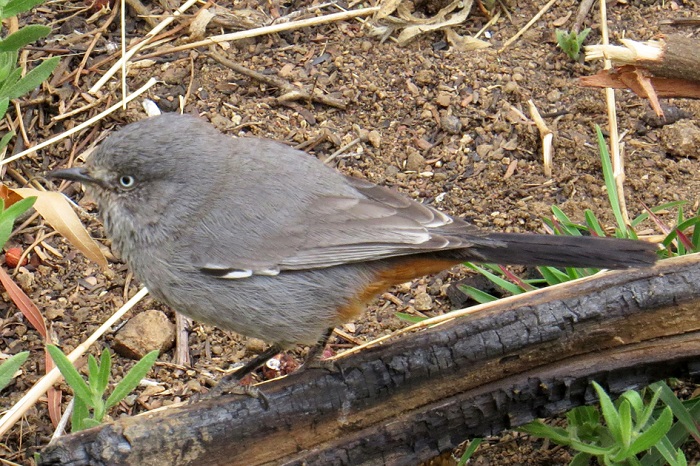
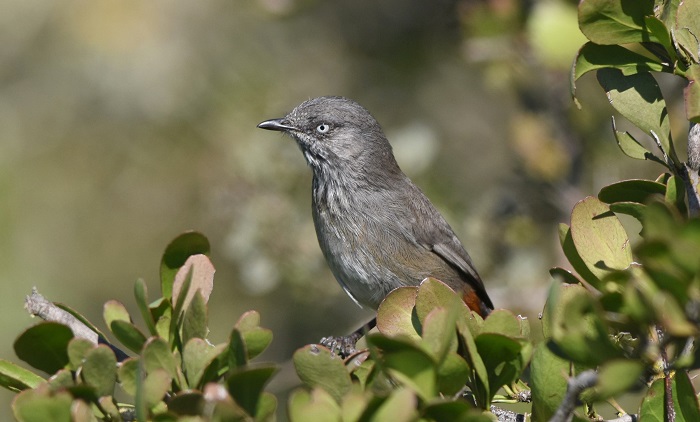
Chestnut-vented Warbler (Sylvia subcaeruleum)

Cover image: Chestnut-vented Warbler by Gerald Wingate – Klipheuwel district, Western Cape –  BirdPix No. 176803

Identification

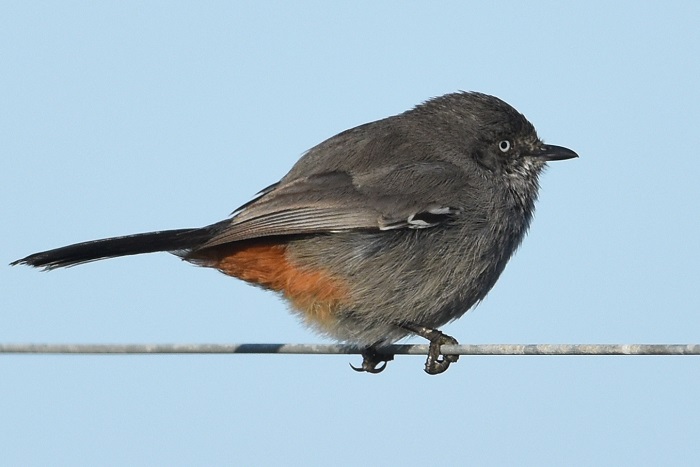
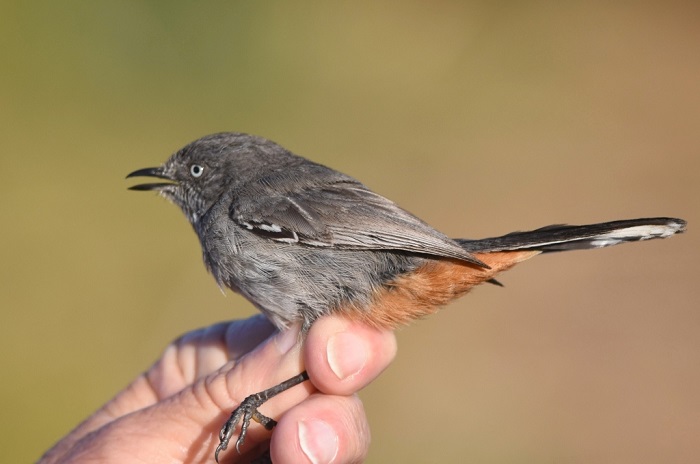
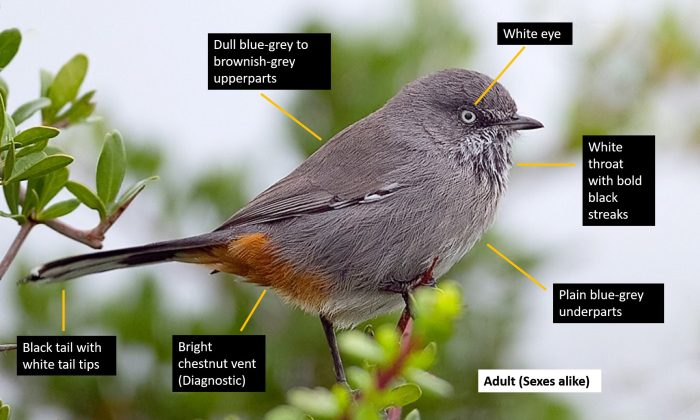
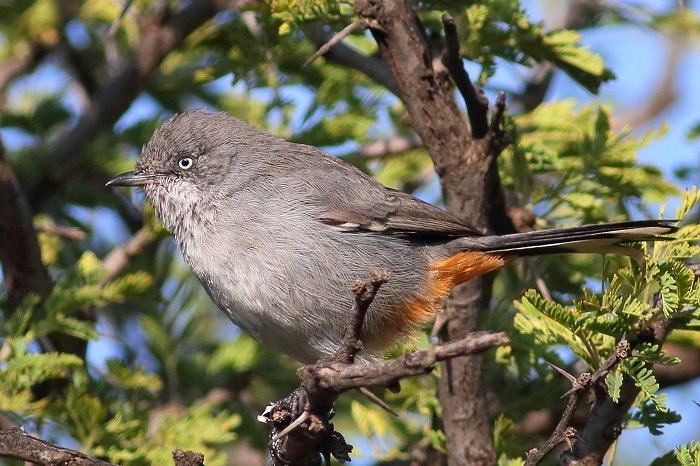
The Chestnut-vented Warbler is easy to identify at all ages due to the distinctive chestnut vent. The crown and the rest of the upper parts are dull blue-grey to brownish grey. The forehead, ear coverts and sides of the neck are brownish grey. The chin and throat are white with bold black streaks. Underparts, including the breast and belly are grey. The vent and undertail coverts are bright chestnut and diagnostic. The tail is black with white tips. The eyes are white or cream coloured and the bill, legs and feet are blackish.

Chestnut-vented Warbler (Sylvia subcaeruleum)
Addo Elephant National Park, Eastern Cape
Photo by Gregg Darling

Juveniles resemble the adults but the vent is dull, not bright rufous and they have less distinct streaking on the throat.

The Chestnut-vented Warbler is most similar to the related Layard’s Warbler (Sylvia layardi). The latter is slightly paler, with finer streaking on the throat and a white (not chestnut) vent.

Sylvia subcaeruleum
Chestnut-vented Warbler (Sylvia subcaeruleum) 
Near Hartebeespoort, North West Province
Photo by Andrew Keys

Status and Distribution

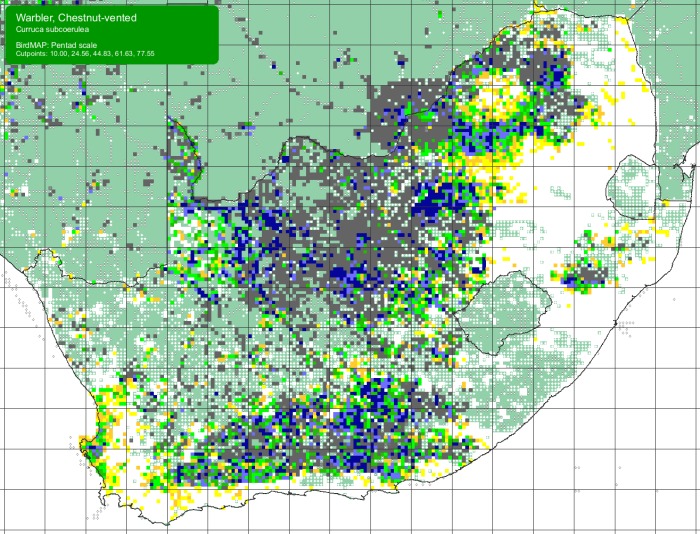
The Chestnut-vented Warbler is near-endemic to southern Africa, occurring elsewhere only in southern Angola and south-western Zambia. It is widespread in the drier western and central parts of southern Africa, but is absent from higher rainfall areas in the east and north-east of southern Africa. It is a common resident and is sedentary across its range.

SABAP2 distribution map for Chestnut-vented Warbler
SABAP2 distribution map for Chestnut-vented Warbler Sylvia subcaeruleum – March 2024.
Details for map interpretation can be found here.

The range of the Chestnut-vented Warbler is not known to have differed from the present, and is unlikely to have changed significantly. Although it is near-endemic, its wide distribution in the arid and semi-arid regions suggests that the species is unlikely to be under threat in the foreseeable future.

Sylvia subcaeruleum
Chestnut-vented Warbler (Sylvia subcaeruleum)
Pilanesberg National Park, North West Province
Photo by Wiekus Moolman

Habitat

The Chestnut-vented Warbler occurs in scrub and thickets, particularly along drainage lines. It has a preference for indigenous Vachellia (Acacia) thickets. In the Karoo it favours areas with taller bushes on plains and in drainage lines. It inhabits a range of vegetation types from thickets in open thornveld and savanna woodlands to bushy hillsides, semi-arid Karoo shrublands, as well as gardens on farms and in rural villages.

Habitat near Carnarvon, Northern Cape
Photo by Ryan Tippett

Behaviour

The Chestnut-vented Warbler is usually encountered solitarily or in pairs. It is a skulking species that is often unwilling to show itself in the open. However, it is not shy and is rather inquisitive.

Sylvia subcaeruleum
Chestnut-vented Warbler (Sylvia subcaeruleum)
Mountain Zebra National Park, Eastern Cape
Photo by Lance Robinson

They fly low from bush to bush and search for food by restlessly moving through the foliage and branches of trees and bushes. Food is gleaned from bare branches and occasionally from leaves. They will sometimes also hawk small insects in flight. The Chestnut-vented Warbler frequently utters its distinctive cheriktiktik call while foraging.

Chestnut-vented Warbler
Chestnut-vented Warbler (Sylvia subcaeruleum)
Camdeboo National Park, Eastern Cape
Photo by Jorrie Jordaan

This species eats mainly invertebrates such as spiders, ticks, moths, mantids, small beetles, caterpillars and termites. Also consumes small berries when available, and nectar, especially of various Aloe species.

The Chestnut-vented Warbler breeds from August to April in southern Africa but varies somewhat from region to region due to rainfall. In drier areas, breeding is probably partly opportunistic after rain. The nest is a cup of dry grass, rootlets and spider web, lined with plant down and fibres. Nests are usually located 1.5 to 3m above the ground amongst the slender outer branches of a bush or tree, and often in a clump of mistletoe.

Sylvia subcaeruleum
Chestnut-vented Warbler (Sylvia subcaeruleum)
Pilanesberg National Park, North-West Province
Photo by Deon Van der Hoven

Two to four white eggs with greenish-brown to blue-grey blotching are laid per clutch. Incubation begins after the second egg has been laid, and incubation duties are shared by both sexes. The incubation period lasts from 13 to 16 days. Newly hatched young are altricial and the nestling period lasts for up to 15 days, during which time they are fed and cared for by both parents.

Broods of the Chestnut-vented Warbler are sometimes parasitised by the Diederik Cuckoo (Chrysococcyx caprius), and less often by the Jacobin Cuckoo (Clamator jacobinus).

Chestnut-vented Warbler
Chestnut-vented Warbler (Sylvia subcaeruleum)
West Coast National Park, Western Cape
Photo by Gerald Wingate

Further Resources

Species text adapted from the first Southern African Bird Atlas Project (SABAP1), 1997.

The use of photographs by Andrew Keys, Deon Van Der Hoven, Gerald Wingate, Gregg Darling, Jorrie Jordaan, Lance Robinson and Wiekus Moolman is acknowledged.

Virtual Museum (BirdPix > Search VM > By Scientific or Common Name).

Other common names: Chestnut-vented Tit-Babbler, Titbabbler, Rufous-vented Warbler (Alt. English); Bosveldtjeriktik (Afrikaans); Parisome grignette (French); Kaapse Meeszanger (Dutch); Meisensänger (German); Felosa-chapim-dos-bosques (Portuguese).

A list of bird species in this format is available here.
Recommended citation format: Tippett RM 2024. Chestnut-vented Warbler Sylvia subcaeruleum. Biodiversity and Development Institute. Available online at https://thebdi.org/2024/03/23/chestnut-vented-warbler-sylvia-subcaeruleum/

Bird identificationbirding

Chestnut-vented Warbler
Chestnut-vented Warbler (Sylvia subcaeruleum) 
Vanschoorsdrif, Western Cape
Photo by Gerald Wingate

Cape Spurfowl (Pternistis capensis)

Cover image of Cape Spurfowl by Terry Terblanche – Near Lutzville, Northern Cape – BirdPix No. 260909

The Cape Spurfowl is a member of the ‘vermiculated group’ of spurfowls and francolins, with the Natal Spurfowl (Pternistis natalensis) as its closest relative. The Cape Spurfowl is the largest spurfowl in southern Africa.

Identification

The sexes are alike in appearance, but males are considerably larger than females and have larger spurs on the legs.

Identification guide to Cape Spurfowl
Cape Spurfowl (Pternistis capensis) 
Kogelberg Nature Reserve, Western Cape
Photo by Desire Darling

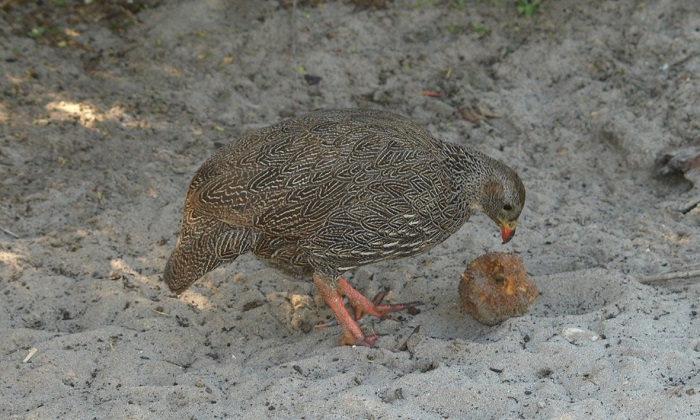
From a distance the Cape Spurfowl appears dark brown overall, and without distinctive facial markings. The upper parts are brown, intricately patterned with off-white chevrons. The crown is distinctly darker, giving a capped appearance. The throat is white with scattered black flecks. The feathers on the underparts, including the neck, upper breast and flanks are brown, intricately patterned with parallel, whitish chevrons. The plumage on the lower breast and belly has additional broad white central streaks. The legs and feet are dull orange-red.

Pternistis capensis
Cape Spurfowl (Pternistis capensis) 
Rietvlei, Western Cape
Photo by Gregg Darling

Juveniles resemble the adults but are duller overall.

The Cape Spurfowl is not likely to be confused with any other spurfowl due to its large size, overall dark colour and lack of red facial skin. It most closely resembles the Natal Spurfowl (Pternistis natalensis) and the Red-billed Spurfowl (Pternistis adspersus), however the range of the Cape Spurfowl does not overlap with these two species.

Cape Spurfowl
Cape Spurfowl (Pternistis capensis) 
Langebaan, Western Cape
Photo by Lance Robinson

Status and Distribution

The Cape Spurfowl is a common to locally abundant resident. It is endemic to southern Africa, occurring mainly as a fynbos endemic, with seemingly isolated populations in Namaqualand and along the Orange River to Prieska. It occurs marginally in extreme southern Namibia along the Orange River.

SABAP2 distribution map for Cape Spurfowl
SABAP2 distribution map for Cape Spurfowl (Pternistis capensis)  – March 2024. Details for map interpretation can be found here.

There is no evidence of range contraction and the Cape Spurfowl is not considered threatened. The species has benefited from habitat transformation because of its ability to colonise alien vegetation and suburban parklands. However, in agricultural lands it is impacted by the severe fragmentation of natural patches of habitat.

Habitat

Habitat for Cape Spurfowl
Typical habitat
Montagu district, Western Cape
Photo by Karis Daniel

The Cape Spurfowl’s preferred habitat is coastal and montane fynbos, especially strandveld and renosterveld. In drier areas in the surrounding Karoo it is found in riverine scrub along drainage lines. It has adapted well to exotic Acacia thickets, as well as farmlands, parks and gardens. Its presence on farms and in suburban areas is dependent on pockets of natural vegetation in which to roost and breed.

Pternistis capensis
Cape Spurfowl (Pternistis capensis). Note the large spurs on this male’s legs.
Kirstenbosch National Botanical Garden, Western Cape
Photo by Neels Jackson

Behaviour

The Cape Spurfowl occurs in pairs or small coveys of up to 20 birds. It is a conspicuous species and its presence is often revealed by its call. They become tame and confiding around people, foraging in the open, and even approaching humans and flying onto picnic tables to scavenge food.

When alarmed, the Cape Spurfowl erects the crown feathers. It flies well but is reluctant, preferring to run into cover when disturbed. Coveys may sometimes perch in trees after they’ve been flushed but are more likely to land on the ground before fleeing into dense cover.

A covey of Cape Spurfowl having a drink
Cape Spurfowl (Pternistis capensis) drinks mostly during the late afternoon. They often drink in covey.
Koringberg, Western Cape
Photo by Les Underhill

The Cape Spurfowl is very noisy during the early morning and late afternoon. They roost at night huddled together on the ground and sometimes in trees or in reedbeds. The Cape Spurfowl regularly dustbathes in fine dust and gravel. Drinks mostly during the late afternoon.

Pternistis capensis
The Cape Spurfowl (Pternistis capensis) readily feeds on fallen fruit.
Langebaan district, Western Cape
Photo by Graham Bull

The Cape Spurfowl forages in the open but is rarely found far from cover. They search for food by scratching in leaf litter and loose soil. Its diet is varied. During summer they feed primarily on invertebrates like insects, small snails, termites and ants. They also readily consume fallen fruit, including grapes, apples and pears. In winter the diet mainly consists of fresh shoots, leaves, bulbs, corms, seeds, berries and fallen grain. It sometimes also scratches through the dung of large herbivores in search of grubs and undigested seeds.

Cape Spurfowl
A Cape Spurfowl (Pternistis capensis) scratching through herbivore dung for grubs and seeds.
Witsand district, Western Cape
Photo by Johan and Estelle van Rooyen

The Cape Spurfowl breeds from August to January. It is a monogamous, solitary nester. The nest is a shallow scrape on the ground, thinly lined with grass stems and occasionally feathers. The nest is well concealed, typically under dense tangles of scrub.

Pternistis capensis
Cape Spurfowl (Pternistis capensis) female on the nest.
Langebaan district, Western Cape
Photo by Graham Bull

Four to eight eggs are laid per clutch. Larger clutches of up to 14 eggs are probably laid by two females. The eggs are brownish cream to pale pink.

nest of Cape Spurfowl
Cape Spurfowl (Pternistis capensis) female on the nest.
Langebaan district, Western Cape
Photo by Graham Bull

Incubation begins once the full clutch has been laid. The incubation period lasts from 22 to 25 days and is performed entirely by the female. Newly hatched young are precocial but chicks are still brooded by both adults, with possible cooperative brood care by related hens.

Cape Spurfowl with chicks
Cape Spurfowl (Pternistis capensis) with young.
Tygerberg Nature Reserve, Western Cape
Photo by Gerald Wingate

Further Resources

Species text from the first Southern African Bird Atlas Project (SABAP1), 1997.

The use of photographs by Desire Darling, Gerald Wingate, Graham Bull, Gregg Darling, Johan and Estelle van Rooyen, Karis Daniel, Lance Robinson, Les Underhill, Neels Jackson and Terry Terblanche is acknowledged.

Virtual Museum (BirdPix > Search VM > By Scientific or Common Name).

Other common names: Cape Francolin (Alt. English); Kaapse fisant (Afrikaans); Kaapse Frankolijn (Dutch); Francolin criard (French); Kapfrankolin (German); Francolim do Cabo (Portuguese)

A list of bird species in this format is available here.
Recommended citation format: Tippett RM 2024. Cape Spurfowl Pternistis capensis. Biodiversity and Development Institute. Available Online at https://thebdi.org/2024/03/20/cape-spurfowl-pternistis-capensis/

Bird identificationbirding

Pternistis capensis
Cape Spurfowl (Pternistis capensis) 
Witsand district, Western Cape
Photo by Johan Van Rooyen

White Stork (Ciconia ciconia)

Cover image: White Stork by Lance Robinson– Biesiesvlei, Free State – BirdPix No. 243136

Identification

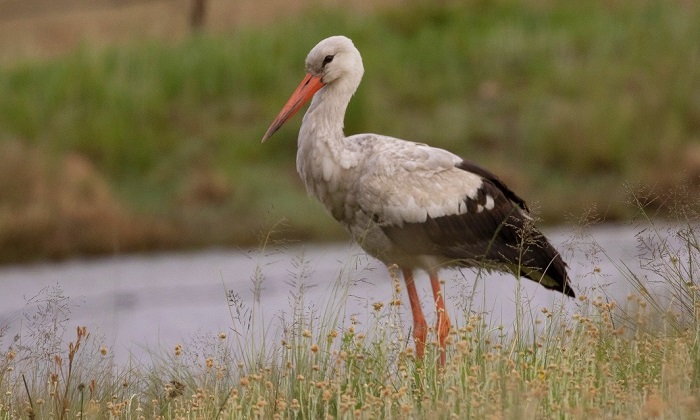
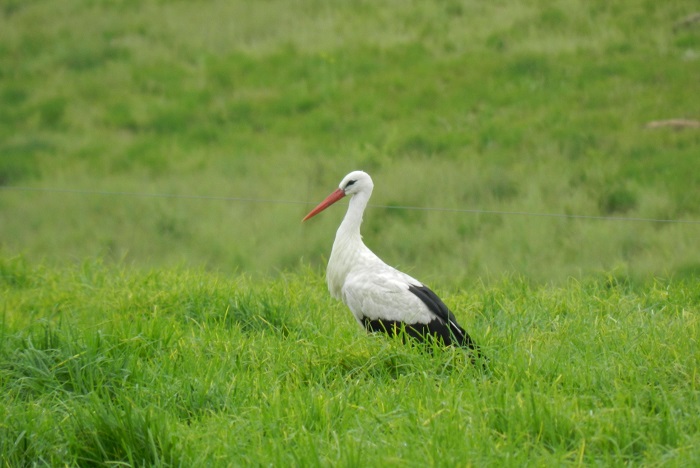
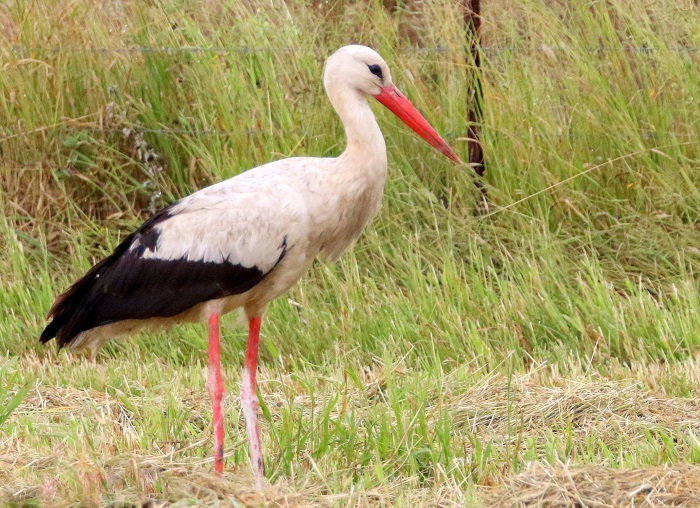
The White Stork is a large and striking bird. It is conspicuous and unmistakable. The entire body is white with black flight feathers and a striking bright red bill and legs. The White Stork is unlikely to be confused with any other species. The sexes are alike.

Identification of White Stork
White Stork Ciconia ciconia
Seekoeivlei Reserve, Free State
Photo by Ilse Hulme

Juveniles have black bills with a reddish base and dull brownish-red legs. The wing coverts and flight feathers are brownish-black.

White Stork in flight
White Stork Ciconia ciconia
Kromme River, Eastern Cape
Photo by Gregg Darling

Status and Distribution

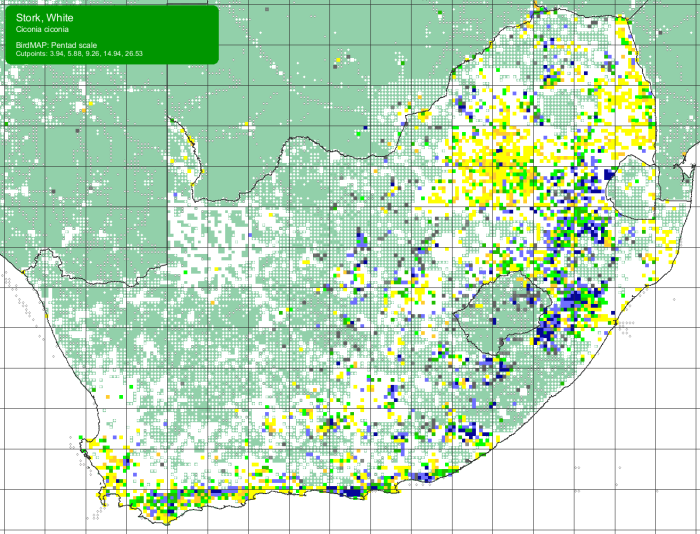
The White Stork is, for the most part, a non-breeding Palearctic migrant to southern Africa. Most birds arrive in October and depart by May. A small number of birds breed in the southern parts of the Western Cape, from near Cape Town to Mossel Bay and Calitzdorp. These breeding birds are apparently resident.

SABAP2 distribution map for White Stork
SABAP2 distribution map for White Stork Ciconia ciconia – March 2024.
Details for map interpretation can be found here.

Palearctic birds breed from north Africa, western Europe and Scandinavia east to China. Winters are spent throughout sub-Saharan Africa. In southern Africa it occurs mainly in the eastern and extreme southern regions, with scattered records in the arid west. It generally avoids areas that receive less than 500mm of rain per year, except after periods of good rainfall.

The White Stork is common to abundant in southern Africa. Numbers vary greatly from year to year and are influenced by conditions elsewhere in Africa. Abundance is greatest when conditions are dry further north.

Ciconia ciconia
White Stork Ciconia ciconia
Ixopo District, KwaZulu-Natal
Photo by Malcolm Robinson

With one exception, the current distribution in southern Africa is probably unchanged from historical times. But its presence in the Western Cape is relatively recent, dating back to around the 1960s, after the establishment of agricultural croplands in the Overberg and Swartland regions east and north of Cape Town, respectively. The number of White Storks in the Overberg, east of Cape Town, is far larger than the number in the Swartland, north of Cape Town.

Through the 20th century, until the 1980s, the White Stork suffered a decline in its northern hemisphere breeding range, especially in western Europe. This trend has been reversed, and numbers are still increasing. It has never been considered to be globally threatened. The main threats to the species are from habitat loss, collisions with overhead power lines, pesticide contamination and hunting.

Habitat

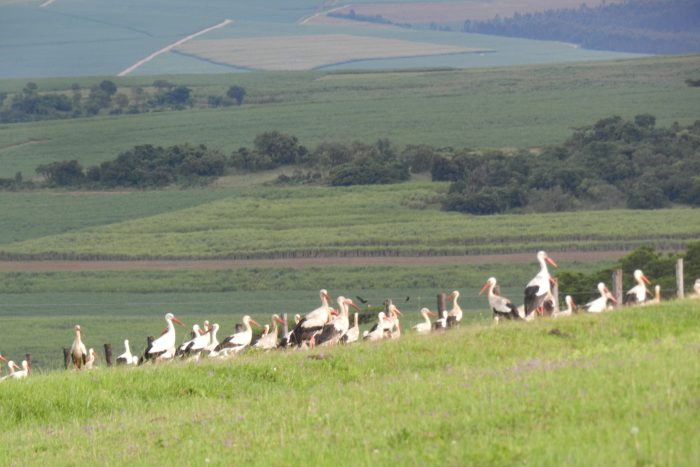
White Stork habitat
White Storks Ciconia ciconia in typical open, agricultural habitat.
Wartburg district, KwaZulu-Natal
Photo by Malcolm Robinson

White Storks inhabit a variety of open habitats including grasslands, open woodland, seasonal wetlands, agricultural crop fields and pastures. It is estimated that as much as 86% of birds in South Africa are found on croplands and pastures. Arid and semi-arid vegetation types in the west are generally avoided except in years of above average rainfall. However, the White Stork is common in the grass dominated eastern fringes of the Nama-Karoo. The White Stork drinks regularly and is often found around dams and wetlands but is not dependent on aquatic habitats.

Ciconia ciconia
White Stork Ciconia ciconia
Bakubung, North West
Photo by Pieter Cronje

Behaviour

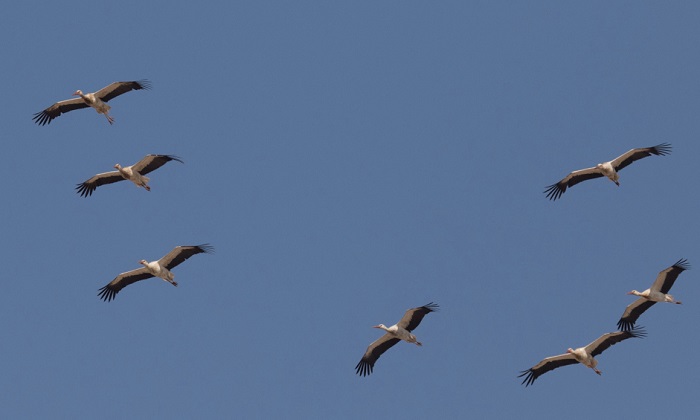
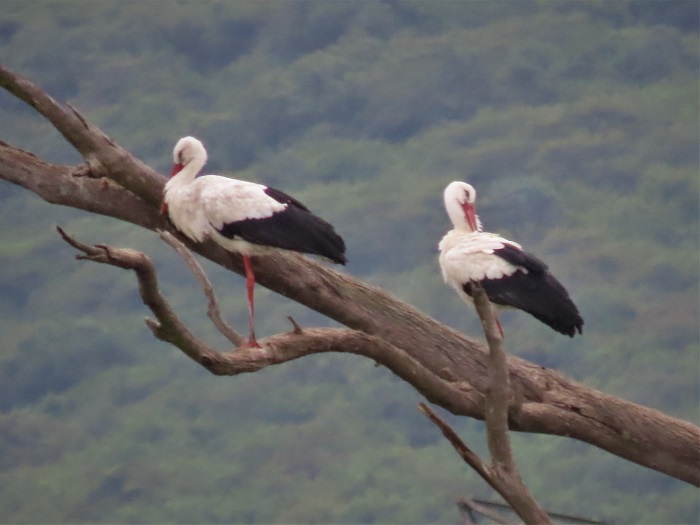
The White Stork usually occurs in flocks numbering 10 to 50 birds, but sometimes congregates in the thousands or even tens of thousands. They may gather in groups near water around midday. Sometimes rests standing on 1 leg, with its bill buried in the neck feathers. This posture is thought to minimise heat loss. As with other storks they cool themselves down in hot weather by defecating on their legs. White Storks roost gregariously in trees or at shallow wetlands, sometimes alongside Abdim’s Storks. Travels in large flocks, circling on thermals to gain height. Flies with the neck and legs fully extended.

White Storks in flight
White Stork Ciconia ciconia
Hwange National Park, Zimbabwe
Photo by Derek Solomon

White Storks usually forage in well-spaced groups. It is estimated that as many as 20 000 birds can gather at locust irruptions in the Karoo. Walks slowly and steadily, searching for prey. They regularly follow large game animals and domestic cattle in order to capture flushed insects.

Ciconia ciconia
White Stork Ciconia ciconia
Mgeni River, KwaZulu-Natal
Photo by Malcolm Robinson

The White Stork is predatory, and feeds on a wide range of small animal prey. It consumes agricultural pests, including Bollworms (Heliothis armigera), Armyworms (Spodoptera exempta) and Brown Locusts (Locustana pardalina). It also eats mice, small reptiles (snakes and lizards), amphibians, fish, molluscs, various large insects, the young of ground-breeding birds, scorpions, caterpillars and termite alates. Indigestible food material is regurgitated in the form of pellets.

Its breeding behaviour is little known in South Africa, but is probably similar to that in Europe, Asia and north Africa. Breeding has been recorded from September to November in South Africa. In 2024, we are making a determined effort to find out just how many pairs are breeding in South Africa. Read about this initiative here. If you know of a nest, or find one, please let us know (ring@thebdi.org).

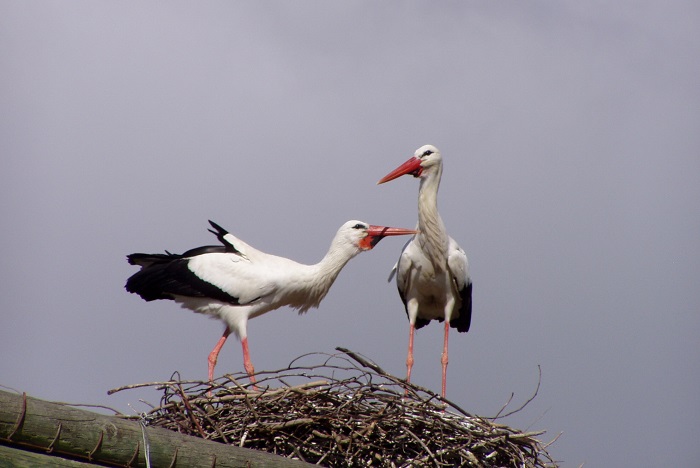
Breeding White Storks
White Stork Ciconia ciconia
A nest at the former Tygerberg Zoo, Western Cape
Photo by Les Underhill

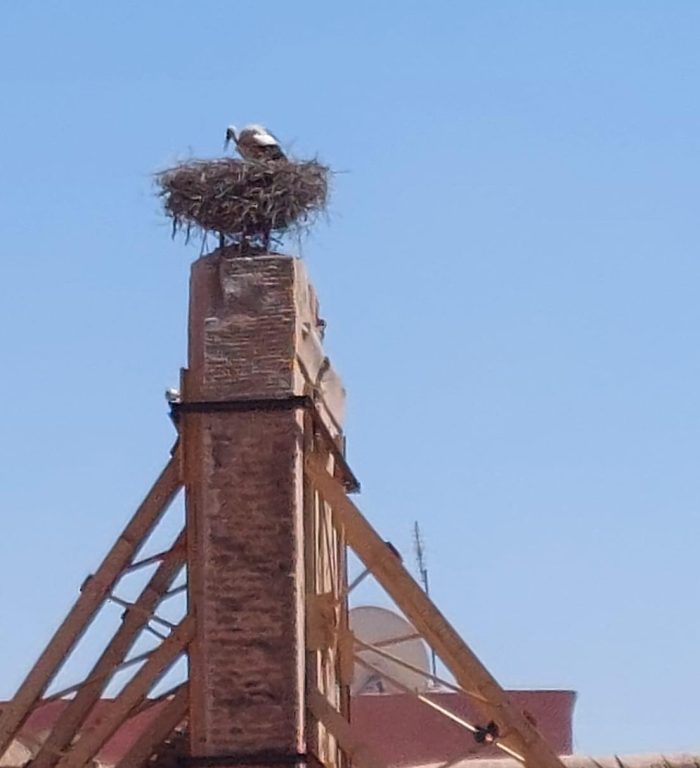
White Storks are monogamous. The nest is a large platform of sticks, reeds, clods of earth and grass. The nest is built quickly, by both sexes in as little as 8 days. The majority of nesting material is contributed by the male and nest material is added periodically throughout the breeding cycle. Nests are placed up to 13m above the ground, in a tree or broken chimney etc. Nests are regularly added to and re-used, but not every year, and the nest gradually increases in size over time.

One to six dull white eggs are laid per clutch. Incubation duties are shared by both sexes and incubation lasts for around 30 days. Incubation begins once the first egg has been laid, resulting in the eggs hatching asynchronously. The newly hatched young are covered with sparse creamy-white down, becoming dense, white and woolly as they grow.

The young are brooded, fed and cared for by both parents. Fledged birds remain dependent on their parents for up to 20 days after leaving the nest.

Ciconia ciconia
White Stork Ciconia ciconia
Kgomo-Kgomo flood plain, North West
Photo by Lia Steen
White Stork nest, Marrakesh, Morocco
White Stork on its nest in Marrakesh, Morocco, 14 April 2024. Photograph Jean Ramsay.

Further Resources for the White Stork

Species text in the first Southern African Bird Atlas Project (SABAP1), 1997.

The use of photographs by Garth Aiston, Gerald Wingate, Gregg Darling, Michael Wright, Phillip Nieuwoudt, Tino Herselman and Zenobia van Dyk is acknowledged.

Virtual Museum (BirdPix > Search VM > By Scientific or Common Name).

Other common names: Witooievaar (Afrikaans); uNogolantethe, uNowanga (Zulu); Ingwamza (Xhosa); Gewone Ooievaar (Dutch); Cigogne blanche (French); Weißstorch (German); Cegonha-branca (Portuguese)

List of species available in this format.

Recommended citation format: Tippett RM 2024. White Stork Ciconia ciconia. Biodiversity and Development Institute. Available online at https://thebdi.org/2024/03/14/white-stork-ciconia-ciconia/

Bird identificationbirding

White Storks in field
White Stork Ciconia ciconia 
Wartburg district, KwaZulu-Natal
Photo by Malcolm Robinson

Black-headed Heron (Ardea melanocephala)

Cover image: Black-headed Heron by Les Underhill – Bloubergstrand, Western Cape – BirdPix No. 266676

Identification

The Black-headed Heron is a large black, grey and white heron. It is a familiar and conspicuous species.

Identification of Black-headed Heron
Black-headed Heron (Ardea melanocephala) 
Darvill, KwaZulu-Natal
Photo by Malcolm Robinson

The build is slender with long legs and an elongated neck. The head is black above, extending most of the way down the hind-neck. There are 1-3 long black plumes extending from the nape. The lower head, chin and fore-neck is white with variable black streaking on the lower fore-neck. The sides of the lower neck and back also have long grey-and-white plumes. The lower neck and upper parts, including the wings are dark slate grey with a paler greyish-white shoulder patch.

Black-headed Heron
Black-headed Heron (Ardea melanocephala) 
Thurlow, KwaZulu-Natal
Photo by Malcolm Robinson

The underparts are uniform pale grey. The bill has a dark greyish-black upper mandible, while the lower mandible is dull yellow-grey. The legs are long and black. The sexes are alike.

In flight the underwings are contrasting black and white

Ardea melanocephala
Black-headed Heron (Ardea melanocephala)
Mondplaas, Eastern Cape
Photo by Gregg Darling

Immature birds are dull grey, instead of black on the head and hind-neck. The underparts are mostly off-white with some rufous or buffy colouration on the lower neck and upper breast.

The Black-headed Heron most resembles the similarly sized Grey Heron (Ardea cinerea). Confusion is most likely between juveniles, but those of the Grey Heron are distinguished at all ages by the plain grey underwings. The underwings of the Black-headed Heron are contrasting black-and-white.

Ardea melanocephala
Black-headed Heron (Ardea melanocephala)
Gamkaberg conservancy, Western Cape
Photo by Pamela Kleiman

Status and Distribution

The Black-headed Heron is a common and widespread inhabitant of sub-Saharan Africa. It is mostly resident with no evidence of regional migration. However, it regularly undertakes local and sometimes more substantial movements in response to food availability.

It is widespread in southern Africa, but is largely absent from very arid areas of south-western and eastern Namibia and the more arid regions of the Kalahari Basin.

SABAP2 distribution map of Black-headed Heron
SABAP2 distribution map for Black-headed Heron Ardea melanocephala – March 2024.
Details for map interpretation can be found here.

In southern Africa the overall distribution is strikingly similar to that of the Grey Heron (Ardea cinerea), being concentrated in the wetter eastern and southern areas.

Agricultural development, particularly the clearing of woodland and the creation of pastures and cultivated lands, has increased its feeding habitat. Additionally, the construction of artificial waterbodies and the planting of alien trees has provided additional breeding habitat. This has led to an expansion in range and an increase in the number of breeding colonies.

The Black-headed Heron is an adaptable species. It remains common and is not considered threatened, however, it is vulnerable to poisoning in agricultural areas and its breeding success is generally low.

Habitat

Habitat of Black-headed Heron
In typical open habitat at the Nieuwoudville Wild Flower Reserve, Northern Cape
Photo by Ryan Tippett

The Black-headed Heron is found in open habitats, preferring grasslands and floodplains, especially in transformed or disturbed landscapes. It favours moist habitats and areas close to wetlands but is not dependent on aquatic environments. The Black-headed Heron also inhabits open woodlands, fynbos and forest edges or clearings. It is less common in closed woodlands, undisturbed savannas and along the coast. The species temporarily moves into desert and semi-arid Karoo-scrub after periods of good rain.

Ardea melanocephala
Black-headed Heron (Ardea melanocephala) 
Underberg district, KwaZulu-Natal
Photo by Pamela Kleiman

It is readily attracted to freshly burnt areas, and has adapted to urban habitats, even tolerating heavy traffic as it forages along road verges. The Black-headed Heron requires tall trees and reedbeds for roosting and breeding.

Behaviour

The Black-headed Heron is generally solitary when hunting, but roosts and breeds communally. Roosts sometimes contain up to 100 birds and the same roost site is typically used each night. They often commute long distances from their roosting sites to feeding grounds.

Ardea melanocephala
Black-headed Heron (Ardea melanocephala) 
iSimangaliso Wetland Park, KwaZulu-Natal
Photo by Ryan Tippett

The Black-headed Heron is both diurnal and nocturnal, either standing and waiting for prey or stalking slowly and deliberately. When prey is spotted, the Black-headed Heron moves its head from side to side before rapidly striking with an extended neck. Prey is captured or speared with the bill and then juggled into a head-first position before swallowing. Food items are swallowed by jerking the head back and rapidly opening and closing the bill. Small items are swallowed alive, while larger prey is shaken or stabbed to death before swallowing. They will abandon food items that are too large to swallow.

Black-headed Heron with prey
Black-headed Heron (Ardea melanocephala)
Agulhas National Park, Western Cape
Photo by Tino Herselman

The Black-headed Heron is highly predatory. Its diet consists of both invertebrate and vertebrate prey. Invertebrates eaten include large insects like grasshoppers, locusts and beetles, as well as scorpions, spiders and crabs etc. Vertebrates consumed range from rodents to snakes, lizards, young tortoises, fish, frogs and birds up to the size of doves. They are occasionally known to scavenge. Indigestible bits of food are regurgitated in the form of large pellets.

This heron breeds year-round in southern Africa with peaks during the wetter months. They typically nest colonially, often in mixed-species colonies with other herons, egrets, cormorants, African Darter and storks.

Black-headed Herons breeding
Black-headed Heron (Ardea melanocephala) at a breeding colony.
Underberg district, KwaZulu-Natal
Photo by Pamela Kleiman

The nest is a large platform of sticks, lined with finer plant material and often bits of wool and hair. The nest is cooperatively built by both sexes with males supplying most of the nest material and females doing most of the construction. Nests are usually placed in a tree overhanging or submerged in water, and less often in reedbeds or on a cliff ledge.

Usually two to four eggs are laid per clutch, and they are pale blue and oval in shape. Incubation starts with the first laid egg and is performed by both sexes. Little is known about the development and care of the young. The nestling period lasts around 52 days and young birds become independent after 60 days.

Ardea melanocephala
Black-headed Heron (Ardea melanocephala)
Rhodes, Eastern Cape
Photo by Jorrie Jordaan

The nest is a large platform of sticks, lined with grass and is usually placed in the fork of a tree over water. Nests are sometimes also built in reedbeds or rarely, on cliffs or on the ground. The nest is normally constructed by the female with nest material brought to her by the male. Two to four blueish-green eggs are laid per clutch. The incubation period lasts for up to 28 days and is performed by both sexes. The nestling period lasts for a further 30 days or so. Nestlings are fed and cared for by both parents and are able to fly after about 50 days. Juvenile birds become independent after 60 to 70 days.

Black-headed Heron on beach
Black-headed Heron (Ardea melanocephala)
Stilbaai, Western Cape
Photo by Gerald Gaigher

Further Resources

Species text adapted from the first Southern African Bird Atlas Project (SABAP1), 1997.

The use of photographs by Aletta Liebenberg, Gary Brown, Gerald Gaigher, Gregg Darling, Jorrie Jordaan, Les Underhill, Malcolm Robinson, Pamela Kleiman and Tino Herselman is acknowledged.

Virtual Museum (BirdPix > Search VM > By Scientific or Common Name).

Other common names: Swartkopreier (Afrikaans); uNokilonki (Zulu); Isikhwalimanzi (Xhosa); Zwartkopreiger (Dutch); Héron mélanocéphale (French); Schwarzkopfreiher (German); Garça-de-cabeça-preta (Portuguese)

A list of bird species in this format is available here.
Recommended citation format: Tippett RM 2024. Black-headed Heron Ardea melanocephala. Biodiversity and Development Institute. Available online at https://thebdi.org/2024/03/11/black-headed-heron-ardea-melanocephala/

Bird identificationbirding

Ardea melanocephala with prey
Black-headed Heron (Ardea melanocephala)
Lake Malawi, Malawi
Photo by Gary Brown

Karoo Scrub Robin (Cercotrichas coryphoeus)

Cover image of Karoo Scrub Robin by Ryan Tippett – Carnarvon district, Northern Cape – BirdPix No. 274165

Identification

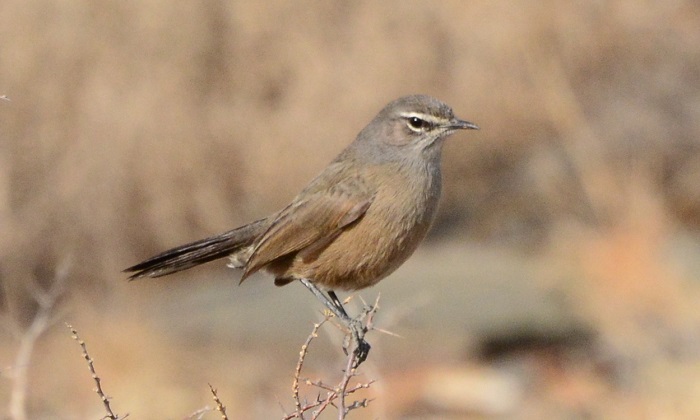
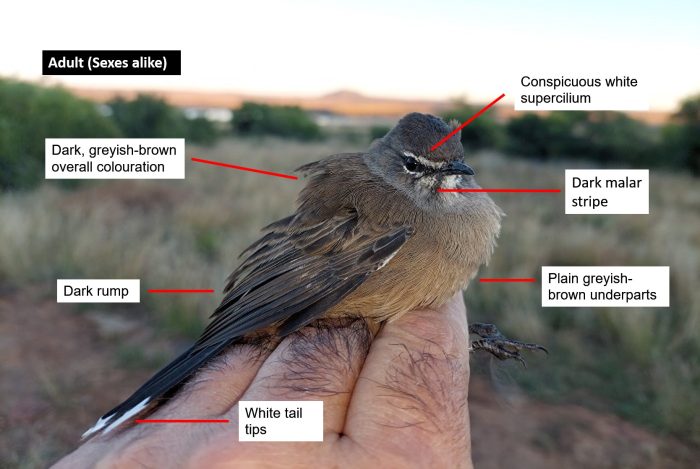
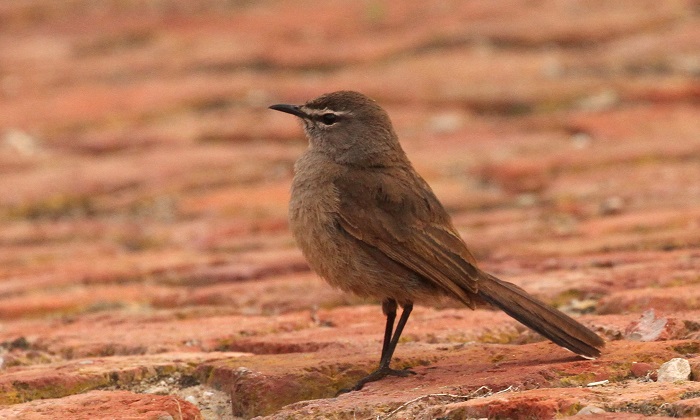
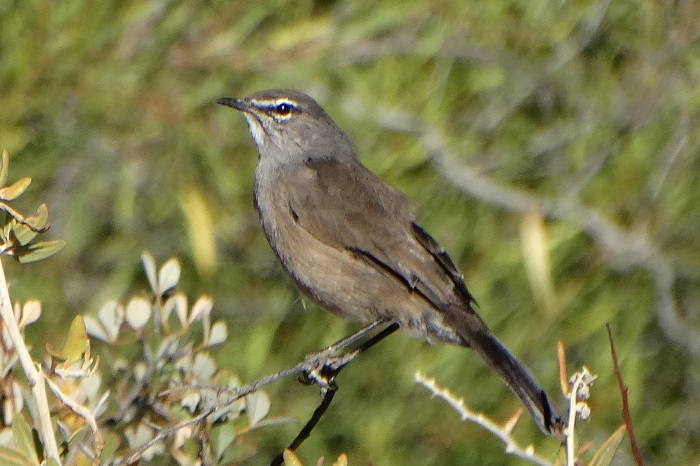
The Karoo Scrub Robin is overall, a dark, greyish-brown scrub robin with a blackish tail and noticeable white tips. Upperparts are brownish-grey, especially on the wings. The underparts are plain greyish brown with a contrasting whiteish throat. The head is also plain grey-brown but with a conspicuous white supercilium and a thin, dark malar stripe. The sexes are alike.

Identification Karoo Scrub Robin
Karoo Scrub Robin (Cercotrichas coryphoeus)
Rouxville district, Free State
Photo by Dawie de Swardt

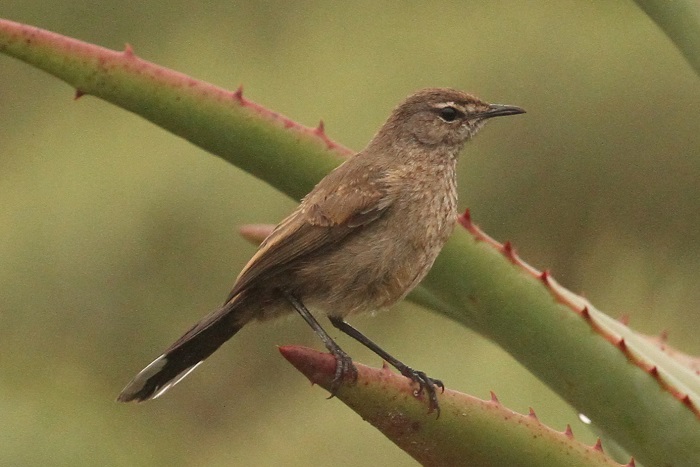
Juvenile and immature birds are similar but show buff spotting on the upperparts and are mottled in dark brown and buff below.

Cercotrichas coryphoeus
Karoo Scrub Robin (Cercotrichas coryphoeus). Immature.
Vleesbaai, Western Cape
Photo by Pieter La Grange

The Karoo Scrub Robin is easily recognisable but may be confused with the Kalahari Scrub Robin (Cercotrichas paena) where the ranges of the two species overlap. The Kalahari Scrub Robin is paler below and browner above, with a broader and longer white supercilium. The latter also has a russet-orange (not greyish-brown) upper tail and rump.

Status and Distribution

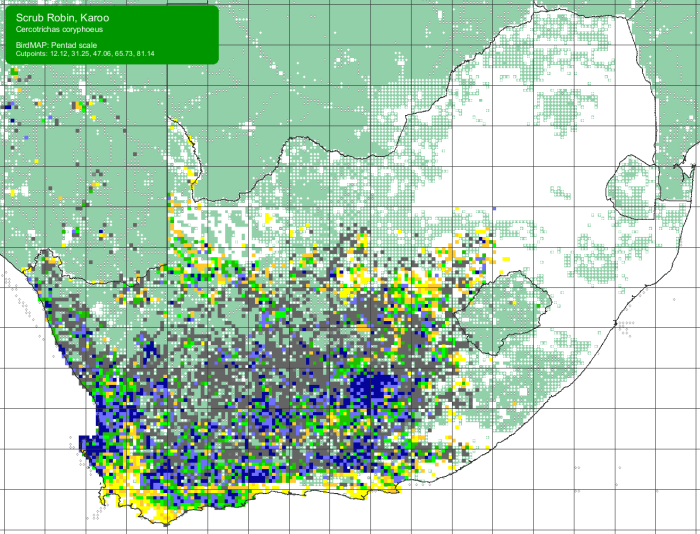
The Karoo Scrub Robin is a common resident and is endemic to southern Africa. It is confined to the central and western parts of southern Africa, from the Western Cape and throughout the Karoo to the central Free State and across into southern Namibia.

SABAP2 distribution map Karoo Scrub Robin
SABAP2 distribution map for Karoo Scrub Robin Cercotrichas coryphoeus – downloaded in February 2024.
Details for map interpretation can be found here.

Habitat

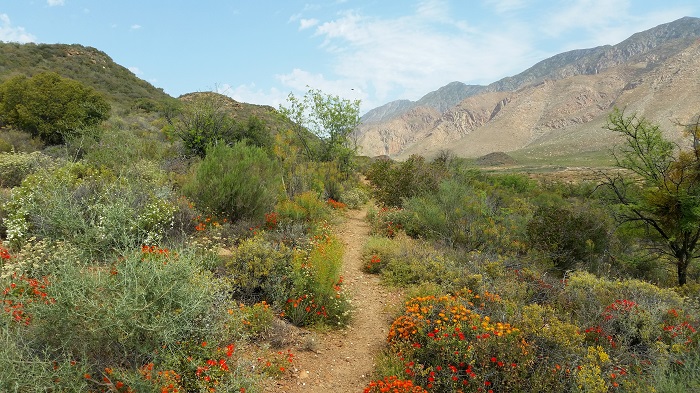
The Karoo Scrub Robin inhabits Nama and Succulent Karoo scrub, dry fynbos, strandveld, thorny riverine scrub and bushy hillsides. It favours habitats with bare patches between or under dense bushes, around a meter tall. It makes use of farm homestead gardens but seldom enters villages or towns.

Habitat Karoo Scrub Robin
Succulent Karoo habitat.
Montagu, Western Cape
Photo by Ryan Tippett

Behaviour

The Karoo Scrub Robin is usually encountered solitarily or in pairs. They are rather bold, inquisitive and excitable birds. Perches on the top of a bush or rock when disturbed while flicking its tail and calling loudly. If disturbed further they will fly off into the cover of vegetation with the tail fanned. They readily mob predators, calling harshly and constantly.

Cercotrichas coryphoeus
Karoo Scrub Robin (Cercotrichas coryphoeus)
Vleesbaai, Western Cape
Photo by Pieter La Grange

The Karoo Scrub Robin forages on the ground or among the low branches of bushes. They run well and will sometimes also hop. The Karoo Scrub Robin feeds mostly on invertebrates with insects making up the bulk of its diet. They also consume worms and small fruits.

Karoo Scrub Robin
Karoo Scrub Robin (Cercotrichas coryphoeus)
Bushmanskloof, Western Cape
Photo by Zenobia van Dyk

The Karoo Scrub Robin breeds from July to January with a peak during October. In drier areas it breeds opportunistically after rain. The nest is a coarse cup composed of sticks, grass and plant stems and is neatly lined with hair, rootlets or plant down.

Cercotrichas coryphoeus
Karoo Scrub Robin (Cercotrichas coryphoeus)
Tygerberg Nature Reserve, Western Cape
Photo by Gerald Wingate

The nest is usually placed on the ground under a dense bush and is well hidden. 2 to 4 (usually two or three) eggs are laid per clutch. The eggs are pale greenish-blue with brownish-red to purple blotches. All incubation is likely performed by the female and the incubation period lasts for around 15 days, during which time the male supplies her with food. The nestling period lasts another 15 days or so. The young are fed by both parents or sometimes by helpers, mainly with soft-bodied insects, such as termite workers and caterpillars.

Broods of the Karoo Scrub-robin are sometimes parasitised by the Diederik Cuckoo (Chrysococcyx caprius), although this appears to be rare.

Karoo Scrub Robin
Karoo Scrub Robin (Cercotrichas coryphoeus)
Langebaan, Western Cape
Photo by Graham Bull

Further Resources

Species text adapted from the first Southern African Bird Atlas Project (SABAP1), 1997.

The use of photographs by Dawie De Swardt, Gerald Wingate, Graham Bull, Pieter La Grange, Tino Herselman and Zenobia van Dyk is acknowledged.

Virtual Museum (BirdPix > Search VM > By Scientific or Common Name).

Other common names: Slangverklikker (Afrikaans); Agrobate coryphée (French); Karruheckensänger (German); Rouxinol-do-mato do Karoo (Portuguese)

A list of bird species in this format is available here.
Recommended citation format: Tippett RM 2024. Karoo Scrub Robin Cercotrichas coryphoeus. Biodiversity and Development Institute. Available online at https://thebdi.org/2024/03/09/karoo-scrub-robin-cercotrichas-coryphoeus/

Bird identificationbirding

Cercotrichas coryphoeus
Karoo Scrub Robin (Cercotrichas coryphoeus)
Middelburg district, Eastern Cape
Photo by Tino Herselman

BDInsight – March 2024

Cover image: Three-banded Plover (Charadrius tricollaris) – Vanrhynsdorp, Western Cape – Photo by Amandine Dore

Welcome to the March 2024 edition of the BDInsight. We have plenty of news to share and plenty of exciting events coming up. Read on to find out more…..

Bird Ringing

The 2024 ringing season kicked off with our first course for the year held at Botuin in Vanrhynsdorp in the Western Cape Province. This was the 7th BDI bird ringing course. You can get links to the previous courses and other bird ringing events here.

Although we had some extremely hot (over 40°C) and windy days, the last 3 days of the course started with nice and overcast conditions. Our week long ringing course was based at Botuin, from 31 January until 6 February 2024. We caught 285 birds, including retraps, of 37 species. As on previous trips, we visited the Vanrhynsdorp Sewage Works and Gifberg veld in addition to ringing in the Botuin gardens.

Early mornings at Gifberg. Setting up the nets for the morning ringing session.

The species diversity was highest in the Botuin gardens, with some exciting species being Namaqua Warbler, Chestnut-vented Warbler and a Fairy Flycatcher (Table 1). Most birds were caught at the Vanrhynsdorp Sewage Works, with a total catch of 65 Southern Red Bishops on two visits. Exciting species here included four Three-banded Plovers and a Little Stint. The karoo veld on the slopes of Gifberg had lower numbers and species but this site produced five Rufous-eared Warblers (a pair caught in a spring trap simultaneously!), three Large-billed Larks and a Karoo Chat.

Overall the most caught species were the Southern Red Bishop (67 birds) and Cape Sparrow (59). Lots of retraps from previous ringing events at Vanrhynsdorp were processed, including several that had moved between the sewage works and Botuin, a straight line distance of 1.5 km (see more here).

The team setting up a nice shady spot to process the birds caught in the nets.

There are two more ringing courses planned for 2024. They are:

  • 1 to 7 May at Ouberg Private Nature Reserve, Montagu, Western Cape
  • 09 to 15 September at New Holme Lodge, near Hanover, Northern Cape.
  • More details are here. There is a broad description of the course activities here.

Virtual Museum

Up-to-date distribution maps for species are critical for taking conservation decisions about species. Spring is springing, and the butterflies and moths, dragonflies and damselflies, will soon be out and about. Now is the time to dust off your cameras and get out into the field and start refreshing records in the Virtual Museum.

Records made long ago in a grid cell are slowly losing their value as evidence that the species is still present there, and need to be refreshed.

If your access to the Virtual Museum is not working (eg password issues) please contact Megan Loftie-Eaton for help (megan@thebdi.org).

BDI-style Bird Species Texts

We are aiming to make it easier for beginner birders! Key to this is the production of “BDI-style” species texts on the BDI website. The BDI-style texts do not only focus on identification but provides all sorts of interesting information.

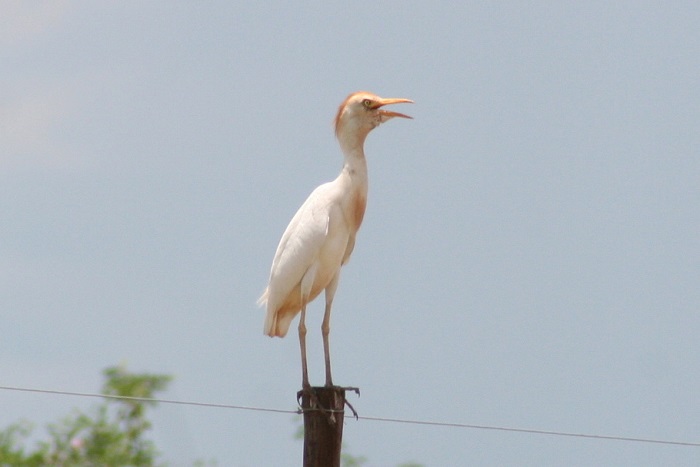
Western Cattle Egret (Bubulcus ibis). Breeding adult.
George, Western Cape
Photo by Cobus Elstadt

We added texts for four species during February 2024:

BDI Social Media

Don’t forget that you can follow the BDI and all our exciting news and stories on our various social media channels:

Grey Heron (Ardea cinerea)

Cover image: Grey Heron by Ryan Tippett– Zimanga Game Reserve, KwaZulu-Natal – BirdPix No. 22138

Identification

The Grey Heron is a large, conspicuous and easily identifiable species. The sexes are alike.

Identification of Grey Heron
Grey Heron (Ardea cinerea) 
St. Lucia Estuary, KwaZulu-Natal
Photo by Malcolm Robinson

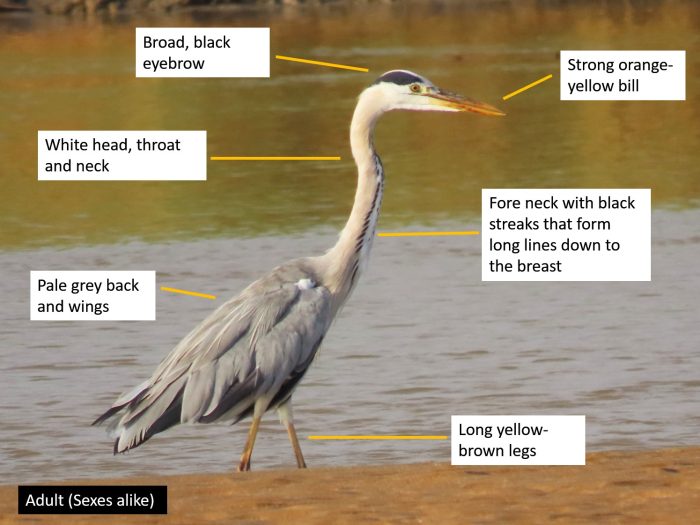
Adults in breeding plumage have a white head, nape, throat and neck. The fore neck has a series of black streaks that form a pair of lines ending at the breast. The eyebrow is black and broad, leading to plumes that form a lax crest. The back and tail pale are grey, and the upper wings are pale grey, with black shoulder patches. The underparts are pale greyish-white with pale grey plumes on the breast. The straight, pointed bill is orange-yellow and the eyes are dull yellow. The long legs are yellowish-brown. Non-breeding adults are similar but lack the plumes on the nape and breast.

Ardea cinerea
Grey Heron (Ardea cinerea) 
Middelburg, Eastern Cape
Photo by Tino Herselman

In flight the Grey Heron is seen to have pale grey upper wings with black shoulder patches. From below the wings are uniform dark blueish-grey.

Grey Heron
Grey Heron (Ardea cinerea) 
Cape Town, Western Cape
Photo by Dave Rimmer

Juveniles resemble non-breeding adults, but are paler grey with less contrasting colours. The forehead and crown are dark grey and the nape is dull black and they have heavy, dark brown streaking on the throat. Immatures and juveniles also have duller bills with dark grey upper mandibles.

Ardea cinerea
Grey Heron (Ardea cinerea). Juvenile
Okavango Delta, Botswana
Photo by Derek Solomon

The Grey Heron most resembles the similarly sized Black-headed Heron (Ardea melanocephala). Confusion is most likely between juveniles, but those of the Grey Heron are distinguished at all ages by the plain grey underwings. The underwings of the Black-headed Heron are contrasting black-and-white.

Grey Heron
Grey Heron (Ardea cinerea) 
Piketberg district, Western Cape
Photo by Zenobia van Dyk

Status and Distribution

The Grey Heron is a common resident and local nomad. It is widespread across Eurasia and Africa. The range of the Grey Heron covers most of Africa (excluding the Sahara), Europe and Asia (including India, China, Japan and Indonesia). In Africa it is primarily a Palearctic migrant north of the equator, and a breeding resident to the south.

The Grey Heron occurs throughout most of southern Africa. It is is less common in the drier west where it concentrates at the coast and along major river systems and at isolated water bodies. It is absent from the very arid parts of Namibia, the Kalahari basin and some of the north-western parts of the Northern Cape due to a lack of surface water.

SABAP2 distribution map for Grey Heron
SABAP2 distribution map for Grey Heron Ardea cinerea – February 2024.
Details for map interpretation can be found here.

The Grey Heron is not threatened locally or globally. A regional range expansion probably occurred during the 20th century, helped by agricultural practices and the construction of artificial water bodies.

Habitat

Habitat for Grey Heron
Typical habitat
Kosi Bay, KwaZulu-Natal
Photo by Ryan Tippett

The Grey Heron frequents shallow water bodies in all major habitat types. These include the marine intertidal zone, estuaries, lagoons, rivers, lakes, marshes and pans. It also common at man-made habitats like dams, canals, sewage works and salt works. It is sometimes also found in open grassland near water.

Ardea cinerea
Grey Heron (Ardea cinerea) 
Noordhoek, Western Cape
Photo by Fanie Rautenbach

Behaviour

The Grey Heron is generally found singly or in small groups when hunting, but is colonial when breeding. They are commonly seen standing or wading in shallow water, but sometimes in water deep enough to partially submerge the body.

Grey herons
Grey Heron (Ardea cinerea) 
Velddrif, Western Cape
Photo by Rene Navarro

The Grey Heron is mostly active by day but will also hunt after dark, especially on moonlit nights. It often stands still for long periods while waiting for food to come to them. On occasion it dives for fish from a perch, submerging completely. When prey is sighted, it rapidly extends its neck and strikes, spearing or capturing prey with the bill. Prey is manipulated into a head-first position before being swallowed. Food items are swallowed by jerking the head back and rapidly opening and closing bill. Small items are swallowed alive, while larger prey is shaken or stabbed to death before swallowing. They will discard food items that are too large to swallow.

Ardea cinerea
Grey Heron (Ardea cinerea) 
Mashatu Game Reserve, Botswana
Photo by Derek Solomon

The Grey Heron is predatory and consumes a wide range of animal prey, with fish weighing up to 110 grams being preferred. They will also readily take frogs, large tadpoles, molluscs, crustaceans, worms, insects, turtle hatchlings, eels, snakes, lizards, small rodents and birds. Plant material is rarely eaten. The Grey Heron occasionally steals food from other species like cormorants and is itself a regular victim of kleptoparasitism by African Fish Eagles (Haliaeetus vocifer) and Grey-headed Gulls (Chroicocephalus cirrocephalus).

Grey Heron
Grey Heron (Ardea cinerea) 
Garden Route National Park, Western Cape
Photo by Jean Hirons

Grey Herons roosts singly or in groups, usually in trees and sometimes also on cliffs. It flies with the neck pulled into an ‘S’ shape with legs outstretched.

The Grey Heron has been recorded breeding throughout the year but mainly during the summer months. They usually nest colonially and often in mixed-species colonies with other herons, egrets, cormorants, African Darter and storks. They will sometimes also nest singly or in small groups.

Ardea cinerea
Grey Heron (Ardea cinerea) on its nest.
Montagu, Western Cape
Photo by Fanie Rautenbach

The nest is a large platform of sticks, lined with grass and is usually placed in the fork of a tree over water. Nests are sometimes also built in reedbeds or rarely, on cliffs or on the ground. The nest is normally constructed by the female with nest material brought to her by the male. Two to four blueish-green eggs are laid per clutch. The incubation period lasts for up to 28 days and is performed by both sexes. The nestling period lasts for a further 30 days or so. Nestlings are fed and cared for by both parents and are able to fly after about 50 days. Juvenile birds become independent after 60 to 70 days.

Grey Heron
Grey Heron (Ardea cinerea)
Manyeleti Nature Reserve, Limpopo
Photo by Vaughan Jessnitz

Further Resources for the African Sacred Ibis

Species text adapted from the first Southern African Bird Atlas Project (SABAP1), 1997.

The use of photographs by Dave Rimmer, Derek Solomon, Fanie Rautenbach, Jean Hirons, Malcolm Robinson, Rene Navarro, Tino Herselman, Vaughan Jessnitz and Zenobia van Dyk is acknowledged.

Virtual Museum (BirdPix > Search VM > By Scientific or Common Name).

Other common names: Bloureier (Afrikaans); uNokilonki (Zulu); Isikhwalimanzi (Xhosa); Blauwe Reiger (Dutch); Héron cendré (French); Graureiher (German); Garça-real (Portuguese)

A list of bird species in this format is available here.

Recommended citation format: Tippett RM 2024. Grey Heron Ardea cinerea. Biodiversity and Development Institute. Available online at https://thebdi.org/2024/02/23/grey-heron-ardea-cinerea/

Bird identificationbirding

Ardea cinerea
Grey Heron (Ardea cinerea)
Middelburg, Eastern Cape
Photo by Tino Herselman

Western Cattle Egret (Bubulcus ibis)

Cover image: Western Cattle Egret by David Kennedy– Linyanti Swamps, Botswana – BirdPix No. 249235

The Western Cattle Egret is monotypic, meaning it lacks close relatives and has been placed in its own genus. They are not that closely related to other egrets.

Identification

The Western Cattle Egret is a conspicuous, largely all-white bird and is normally closely associated with cattle and large game animals.

It is the smallest of the white egrets and has a stocky build with a relatively short bill, neck and legs. They are all white when not breeding but develop buff-coloured plumes on the crown, mantle and breast. The bill colour varies from yellow to orange, and the legs are dull brownish to yellow. The sexes are alike.

Identification guide Western Cattle Egret
Western Cattle Egret (Bubulcus ibis). Breeding adult.
George, Western Cape
Photo by Cobus Elstadt

Immature and juvenile birds are all-white and have black bills, legs and feet.

The Western Cattle Egret could be confused with the larger Intermediate Egret (Ardea intermedia), but that species is slimmer, with a longer-neck and a longer bill, and its lower legs are blackish, not yellowish. Little Egret differs from juvenile Western Cattle Egrets by having a more slender build and has black legs with bright yellow feet and a longer bill.

Cattle Egret
Western Cattle Egret (Bubulcus ibis). Non-breeding adult.
Rondebosch, Western Cape
Photo by Les Underhill

Status and Distribution

The Western Cattle Egret has a very wide distribution and is found throughout the warmer regions of the world. The species was historically confined to tropical Africa, Madagascar and south-east Asia but it has expanded its range dramatically during the 20th century. The Western Cattle Egret now occurs throughout Africa, across the Mediterranean region, India, southern Asia, Japan, Australia, New Zealand, and North and South America!

Western Cattle Egret in breeding plumage
Western Cattle Egret (Bubulcus ibis). Breeding Adult.
Louis Trichardt district, Limpopo
Photo by Megan Loftie-Eaton

A global increase in cattle farming, coupled with high breeding rates and effective dispersal and migration strategies, have enabled the species to undergo one of the most remarkable range expansions and population increases of any bird.

During the late late 1800s the Western Cattle Egret first began spreading throughout Africa and reached southern Europe by 1950. African birds are believed to have dispersed across the Atlantic Ocean to north-eastern South America in the 1880’s, reaching Alaska by 1981. Its range expansion across Asia to Australia and New Zealand took place in the 1940’s.

SABAP2 distribution map Western Cattle Egret
SABAP2 distribution map for Cattle Egret Bubulcus ibis – February 2024.
Details for map interpretation can be found here.

The Cattle Egret is a very common resident or nomad and is found throughout southern Africa, but is sparse in the arid western regions. It is not threatened.

Habitat

Habitat Westrn Cattle Egret
Cattle Egret (Bubulcus ibis). Breeding Adult.
Karoo-Gariep Nature Reserve, Northern Cape
Photo by Les Underhill

The Cattle Egret inhabits open grassland, grassy savanna, floodplains, wetland fringes, semi-arid scrub, man-made pastures and agricultural lands. They are usually associated with large game mammals or domestic stock, especially cattle, buffalo and elephants. Western Cattle Egrets are also occasionally found on open seashores and avoid dense woodland, forest and desert. Roosts in trees or reedbeds in or near inland waters like marshes, rivers and dams..

Bubulcus ibis
Cattle Egret (Bubulcus ibis). Breeding Adult.
Franskraal district, Western Cape
Photo by Cobus Elstadt

Behaviour

Western Cattle Egrets are highly gregarious and are most often found in flocks of 10 to 20 birds. Birds usually gather in larger numbers at water in the late afternoon, before flying to their roosting site. They often roost communally with other water birds. In the morning they disperse up to 20 km away to its feeding grounds.

Bubulcus ibis
Western Cattle Egret (Bubulcus ibis)
Baynesfield district, KwaZulu-Natal
Photo by Malcolm Robinson

Typically hunts by walking steadily before either running forward to stab at prey, or standing crouched, with its neck swaying before striking. They may glean items from vegetation, or seize flushed prey in the air. Small food items are swallowed whole, larger ones are repeatedly pecked or washed in water before swallowing.

Breeding adult Western Cattle Egret
Western Cattle Egret (Bubulcus ibis). Breeding adult.
Hartbeespoort, North West
Photo by Mark Stanton

They will occasionally follow ploughs to seize disturbed invertebrates, but are far more often associated with mammals, ranging from cattle and other domestic livestock such as sheep and goats, to antelope, zebra, buffalo, rhinos and elephants.

They frequently perch on the backs of large mammals, particularly in tall grass, where visibility is poor.

Research has shown that by associating with mammals, and feeding on disturbed prey items, they obtain, on average, 37% more food than they would by foraging alone.

Western Cattle Egret, with a cow
Western Cattle Egret (Bubulcus ibis). Breeding adult.
Thurlow Nature Reserve, KwaZulu-Natal
Photo by Malcolm Robinson

This egret’s diet consists largely of insects. Locusts and grasshoppers predominate, but a wide range of other invertebrates are consumed such as beetles, caterpillars, flies, spiders and earth worms. Ticks are also important in their diet and are mostly gleaned from vegetation but are sometimes also removed from large mammals. Vertebrates like frogs, tadpoles, fish, reptiles, small mammals, adult birds and nestlings are also eaten.

Bubulcus ibis, with zebras
Western Cattle Egret (Bubulcus ibis)
South Luangwa National Park, Zambia
Photo by Derek Solomon

The Western Cattle Egret breeds throughout the year in South Africa. Breeding mainly takes place from August to February with a November/December peak in the summer rainfall regions. It breeds during winter in the winter rainfall region of the Western Cape.

It is a highly colonial breeder, often in mixed colonies with other species such as storks, herons, egrets, spoonbills and cormorants. The nest is a simple platform of sticks lined with leaves and grass. Nests are most frequently placed in trees but also in bushes or sometimes even on the ground.

Western Cattle Egret
Cattle Egret (Bubulcus ibis)
Kirkwood District, Eastern Cape
Photo by Irene Brown

Two to five eggs are laid per clutch. The eggs are dull white, sometimes with a blueish tinge and usually with some reddish-brown spots. The incubation period lasts for around 29 days and incubation duties are shared by both parents. Chicks are altricial and the nestlings are ready to leave the nest after 14 to 21 days. The young birds are fed and cared for by both parents.

Further Resources for the Western Cattle Egret

Species text adapted from the first Southern African Bird Atlas Project (SABAP1), 1997.

The use of photographs by Cobus Elstadt, David Kennedy, Derek Solomon, Irene Brown, Karis Daniel, Les Underhill, Malcolm Robinson, Mark Stanton and Megan Loftie-Eaton is acknowledged.

Virtual Museum (BirdPix > Search VM > By Scientific or Common Name).

Other common names: Cattle Egret (Alternative English Name); Veereier, Springkaanvoel (Afrikaans); iLanda (Zulu); Dzandza (Tswana); Koereiger (Dutch); Héron garde-boeufs (French); Kuhreiher (German); Garça-boieira (Portuguese)

List of bird species in this format is available here.
Recommended citation format: Tippett RM 2024. Western Cattle Egret Bubulcus ibis. Biodiversity and Development Institute. Available online at https://thebdi.org/2024/02/19/western-cattle-egret-bubulcus-ibis/

Bird identificationbirding

Western Cattle Egret, in flight
Western Cattle Egret (Bubulcus ibis)
Greyton district, Western Cape
Photo by Karis Daniel

Little Swift (Apus affinis)

Cover image: Little Swift by Gerald Wingate – Vanschoorsdrif, Western Cape – BirdPix No. 186019

Swifts are specialised, highly aerial birds with long pointed wings and short or deeply forked tails that provide superb manoeuvrability. They have very short legs and toes, and small bills with a wide gape to enable swallowing while in flight. Swifts and Spinetails belong to the family APODIDAE.

Identification

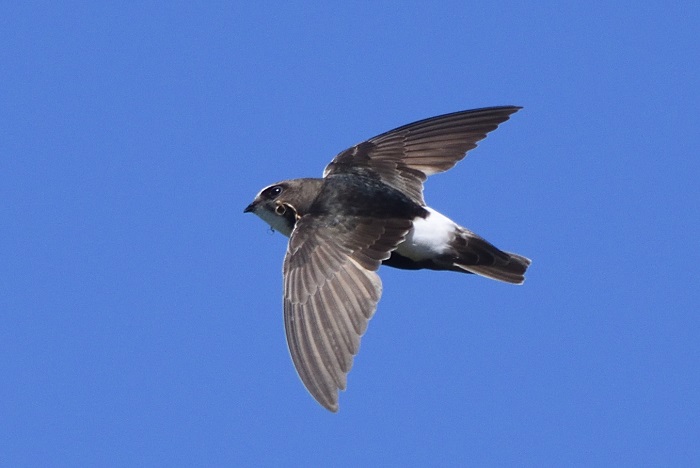
Identification guide for Little Swift
Little Swift (Apus affinis)
Carnarvon district, Northern Cape
Photo by Ryan Tippett

The Little Swift is a smallish species with a stocky build and a short, square tail that appears rounded when spread. The body is dark brownish-black, slightly darker and glossier on the mantle and back. It has a large, white throat patch and a distinctive, broad white rump that wraps around onto the flanks. This is often visible from below. The wings are dark brown to dull black with a silvery-grey hue. The bill is black while the feet are purplish-black and the eyes are dark brown.

Little Swift in flight
Little Swift (Apus affinis)
St. Lucia, KwaZulu-Natal
Photo by Garth Aiston

The sexes are alike in plumage colouration. Juveniles are duller and browner than adults with pale-edged feathers.

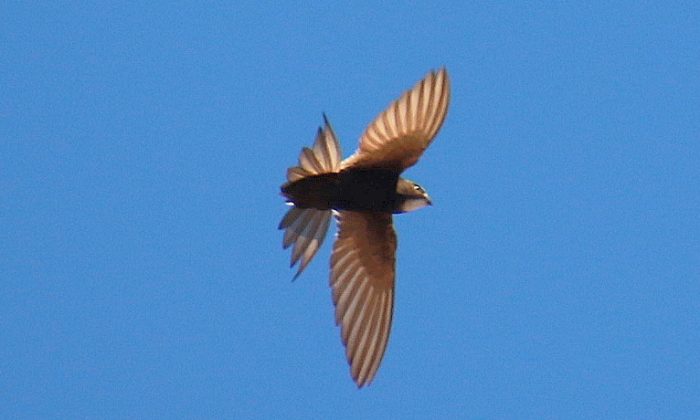
Little Swift from below
Little Swift (Apus affinis)
Carnarvon district, Northern Cape
Photo by Ryan Tippett

The Little Swift is most similar to the Mottled Spinetail (Telacanthura ussheri), but the latter has distinctive short secondaries, bulging inner primaries and a white vent bar. White-rumped Swift (Apus caffer) and Horus Swift (Apus horus) have deeply to shallowly forked tails.

Little Swift
Little Swift (Apus affinis)
Walter Sisulu Botanical Gardens, Gauteng
Photo by Marius Meiring

Distribution and Status

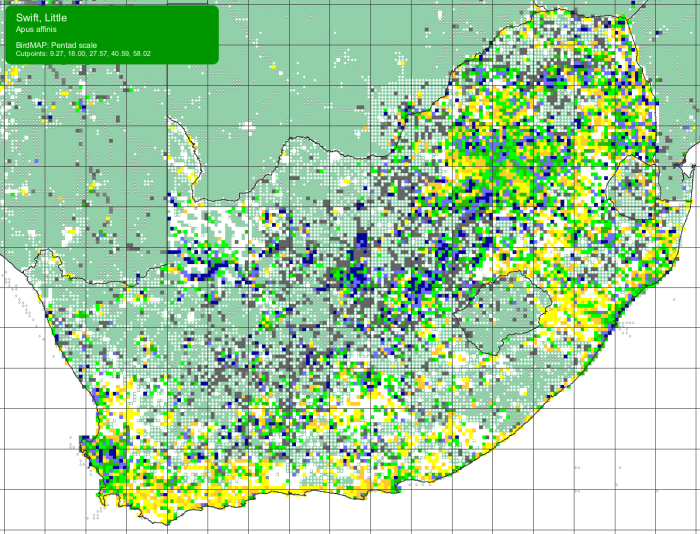
The Little Swift is distributed throughout sub-Saharan Africa and the Indian sub-continent, with isolated populations in Morocco, the Arabian Peninsular, Iran and Turkmenistan. It occurs throughout southern Africa but is largely absent from the Namib Desert and the Kalahari (see habitat below).

SABAP2 distribution map for Little Swift
SABAP2 distribution map for Little Swift (Apus affinis) – February 2024. Details for map interpretation can be found here.

The local range of the Little Swift has increased dramatically since 1900. It was historically confined to the dry western regions of southern Africa but is now common across the region. It originally nested on cliffs but has adapted to make extensive use of man-made buildings and other structures for breeding on. The Little Swift is now a common resident and partial migrant and is still expanding its local range and populations.

Little Swift
Little Swift (Apus affinis)
Vanschoorsdrif, Western Cape
Photo by Gerald Wingate

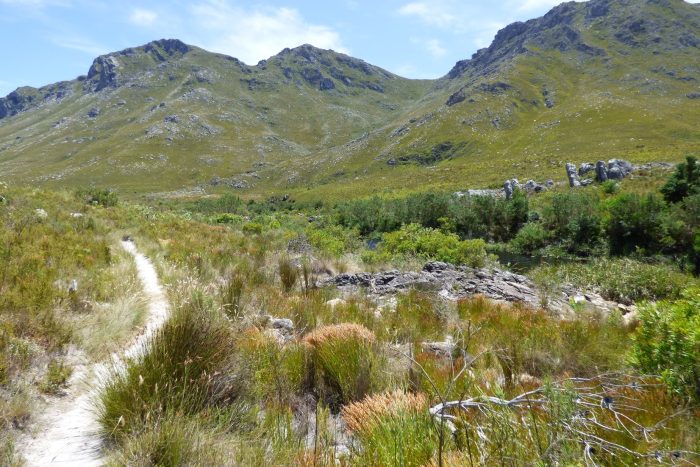
Habitat

Little Swift habitat
Habitat – Kogelberg Nature Reserve, Western Cape
Photo by Sharon Stanton

The Little Swift is most often seen near its breeding colonies around cliffs, gorges, rocky crags and in built up areas.

It forages in the air over all vegetation types including woodland and forest but prefers more open habitats like grasslands, Karoo scrub and fynbos. It occurs regularly over water and drinks frequently. The Little Swift is scarce or absent over much of the Namib and Kalahari, where its presence is limited by the availability of surface water for drinking.

Behaviour

Apus affinus
Little Swift (Apus affinis)
Bird Island, Western Cape
Photo by Les Underhill

The little Swift is highly gregarious, often in flocks of hundreds of birds. It frequently forms mixed species foraging flocks with other swifts and occasionally with swallows.

It is mostly silent when feeding, but becomes very vocal in large flocks during ‘circus’ flight around roosting and nesting sites, especially in the late afternoon. In ‘Circus’ flight, large numbers of birds wheel and spiral together, calling incessantly. The purpose or function of this remains uncertain. Little Swifts roost in their nests or under the eaves of buildings.

Apus affinus
Little Swift (Apus affinis)
Kruger National Park, Limpopo
Photo by Lappies Labuschagne

Typically flies at an almost constant height and speed, alternately fluttering and gliding slowly.

The Little Swift drinks regularly by skimming the water surface, with wings held high. They are insectivorous aerial specialists that feed on a wide array of flying insects such as termite alates, damselflies, dragonflies, mantids, katydids, grasshoppers, bugs, lacewings, antlions, beetles, flies, mosquitoes, wasps, ants, moths, butterflies and spiders.

They are attracted to termite alate emergences, foraging aerially and sometimes even on the ground. They also opportunistically follow fires to capture insects flushed by the flames. Little Swifts often forage at great heights, particularly in winter, and may travel up to 20km per day in search of food.

Apus affinus
Little Swift (Apus affinis)
Gifberg, Western Cape
Photo by Salome Willemse

Breeds from September to May in southern Africa. The Little Swift is monogamous, and is usually a highly colonial nester but is known to sometimes nest solitarily. Nests are often found to be touching or overlapping. The nest is a closed bowl with a small side-top entrance. It is composed of grass and feathers and glued together with saliva. Nests are usually placed under an overhang or the eaves of buildings, bridges or a natural rock face.

Little Swift nest
Little Swift (Apus affinis)
Kruger National Park, Limpopo
Photo by J. Terblanche

1 to 3 elongate, white eggs are laid per clutch. The incubation period lasts from 17 to 23 days and incubation duties are shared by both sexes. The nestling period lasts for a further 40 days or so and the young are cared for by both sexes.

Apus affinus
Little Swift (Apus affinis)
Britstown district, Northern Cape
Photo by Cathy Jenkins

Further Resources

This species text is adapted from the first Southern African Bird Atlas Project (SABAP1), 1997.

The use of photographs by Cathy Jenkins, Garth Aiston, Gerald Wingate, J. Terblanche, Lance Robinson, Lappies Labuschagne, Les Underhill, Marius Meiring, Salome Willemse and Sharon Stanton is acknowledged.

Virtual Museum (BirdPix > Search VM > By Scientific or Common Name).

Other common names: Kleinwindswael (Afrikaans); Nkonjana (Tswana); Huisgierzwaluw (Dutch); Martinet des maisons (French); Haussegler (German); Andorinhão-pequeno (Portuguese)

A list of bird species in this format is available here.
Recommended citation format: Tippett RM 2024. Little Swift Apus affinis. Biodiversity and Development Institute. Available Online at https://thebdi.org/2024/02/12/little-swift-apus-affinis/

Bird identificationbirding

Little Swift
Little Swift (Apus affinis)
Alberton district, Gauteng
Photo by Lance Robinson