Skip to content
BDI
  • Home
  • Departments
    • Research Training
      • Introduction
      • Research Themes
      • Study Sites
      • Logistics
    • Bird Ringing
      • Introduction
      • Ringing history
      • The Value of Bird Ringing
    • Science and Ecology Specialist Consulting
    • Citizen Science – Biodiversity Conservation & Research
    • Biodiversity Observations
  • About
    • What we do
    • Who we are
    • Contact us
  • News
    • Archive
    • BDI Research
    • BDI Bridge
    • BDInsight
  • Upcoming BDI events
  • Biodiversity Projects
    • Bird Feeder Project
    • Atlas of Frogs & Toads
    • Atlas of African Neuroptera and Megaloptera
    • Atlas of Dragonflies & Damselflies
    • Atlas of Butterflies & Moths
  • Karoo Research Centre

Category: Birds

Archive/Bird Feeder Project/Bird identification/Birding/BirdPix/Birds

Egyptian Goose (Alopochen aegyptiaca)

Posted on 07/03/2022 by Bird Feeder Project: Karis Daniel & Megan Loftie-Eaton

Identification The Egyptian Goose is not actually a goose, but a shelduck. It has many characteristics of a duck, but also some external traits of a goose. Egyp...
Archive/Bird ringing/Birds

Climate in Africa influences timing of migration of Willow Warblers in Poland

Posted on 06/03/2022 by Les Underhill

Since the 1980s, many migrant birds have arrived increasingly earlier in Europe in the northern hemisphere spring (March-April-May). This has often been attribu...
Identification guide for Common Waxbill (Estrilda astrild)
Archive/Bird Feeder Project/Bird identification/Birding/BirdPix/Birds

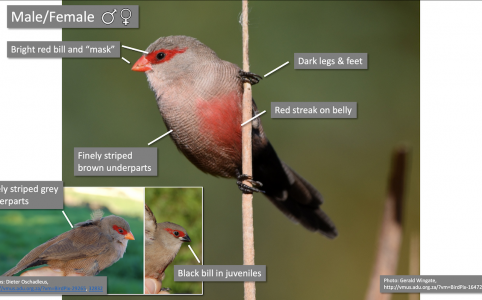
Common Waxbill (Estrilda astrild)

Posted on 04/03/2022 by Karis Daniel

Identification Common Waxbills are small greyish-brown birds. This species is not sexually dimorphic; males females look the same. Overall, the Common Waxbill i...

Archive/Bird Feeder Project/Bird identification/Birding/BirdPix/Birds

Cape Canary (Serinus canicollis)

Posted on 04/03/2022 by Karis Daniel

Cape Canaries are small, brightly-coloured birds. Males and females can be difficult to tell apart; you must look closely!

Archive/Bird Feeder Project/Bird identification/Birding/BirdPix/Birds

Cape White-eye (Zosterops virens)

Posted on 04/03/2022 by Karis Daniel

The Cape White-eye is a very small, fast-moving bird. Males and females look alike but show geographic variation. This term means that one species can look diff...

Archive/Bird Feeder Project/Bird identification/Birding/BirdPix/Birds

Pin-tailed Whydah (Vidua macroura)

Posted on 04/03/2022 by Karis Daniel

Identification The Pin-tailed Whydah is a small sexually dimorphic species. Males and females differ dramatically when breeding, and appear similar outside of t...

Archive/Bird Feeder Project/Bird identification/Birding/BirdPix/Birds

Cape Weaver (Ploceus capensis)

Posted on 04/03/2022 by Bird Feeder Project: Karis Daniel & Megan Loftie-Eaton

Identification The Cape Weaver is a medium-sized, brightly coloured bird. Males and females look similar but are not quite alike. Males also differ slightly in ...

Archive/Bird Feeder Project/Bird identification/Birding/BirdPix/Birds

Southern Masked Weaver (Ploceus velatus)

Posted on 04/03/2022 by Bird Feeder Project: Karis Daniel & Megan Loftie-Eaton

Identification The Southern Masked Weaver is a medium-sized, brightly coloured bird. Males and females look similar outside of the breeding season but are easil...

Archive/Bird Feeder Project/Bird identification/Birding/BirdPix/Birds

Red-winged Starling (Onychognathus morio)

Posted on 04/03/2022 by Karis Daniel

Cover photo: BirdPix 19074 – Gregg Darling – Red-winged Starling Identification The Red-winged Starling is a large, black bird with striking reddish...

Archive/Birds/Data and statistics/News

African Oystercatchers on Robben Island

Posted on 11/11/2021 by Megan Loftie-Eaton

Hot off the press! A new paper, published in Wader Study and authored by Itxaso Quintana, Rio Button and Prof Les Underhill, describes a single-year study of th...

Posts navigation

« Previous 1 … 18 19 20 21 Next »
  • Home
  • Departments
    • Research Training
      • Introduction
      • Research Themes
      • Study Sites
      • Logistics
    • Bird Ringing
      • Introduction
      • Ringing history
      • The Value of Bird Ringing
    • Science and Ecology Specialist Consulting
    • Citizen Science – Biodiversity Conservation & Research
    • Biodiversity Observations
  • About
    • What we do
    • Who we are
    • Contact us
  • News
    • Archive
    • BDI Research
    • BDI Bridge
    • BDInsight
  • Upcoming BDI events
  • Biodiversity Projects
    • Bird Feeder Project
    • Atlas of Frogs & Toads
    • Atlas of African Neuroptera and Megaloptera
    • Atlas of Dragonflies & Damselflies
    • Atlas of Butterflies & Moths
  • Karoo Research Centre

Recent posts

  • Ringers’ Symposium : 6 to 12 November 2…
    The Biodiversity and Development Institute […]
  • Cinnamon-breasted Bunting (Emberiza tahapisi)
    Cover image of Cinnamon-breasted Bunting […]
  • Violet-eared Waxbill (Granatina granatina)
    Image of Violet-eared Waxbill by Tony Archer […]
  • Kalahari Scrub Robin (Cercotrichas galactotes…
    Cover image of Kalahari Scrub […]
  • African Harrier-Hawk (Polyboroides typus)
    Cover image: African […]
The Biodiversity & Development Institute is a non-profit company registered with the Companies and Intellectual Property Commission of South Africa (CIPC), Reg. No. 2015/136344/08.
Registration in terms of the Non-Profit Organisations Act: 302-671 NPO.


Directors:
Prof Les Underhill, Ms Sue Gie, Jorn Das
les@thebdi.org
072 062 1140


Address:
Old Farm Road, Rondebosch, 7700, Western Cape, South Africa
© 2026 BDI
Powered by WordPress | Theme: Graphy by Themegraphy